Ostim University Ranking 2026 - The Full Guide for Engineering Students Who Want More Than a Classroom

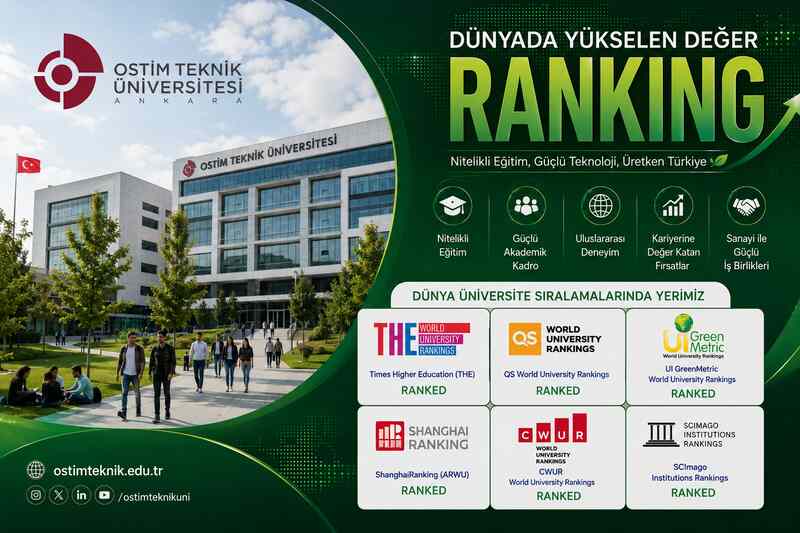
There's a specific kind of student who ends up researching Ostim Technical University. Usually it's someone who wants to study engineering but not just engineering. They want something more hands-on, more connected to actual industry, more focused on what happens after graduation rather than just during the degree. And somewhere in that search, they found Ostim.
So let me give you the complete picture: what the ranking numbers actually mean for a university this young, what makes this institution genuinely different from other Ankara and Istanbul private universities, and why the triple accreditation stack (ABET + MÜDEK + EUR-ACE) matters for your career more than most people realize.
Ostim University Ranking - The Numbers and What They Tell You (2026)
Let's go through each system honestly.
Webometrics 2026 Webometrics places Ostim Technical University at approximately 2,244th globally and 145th nationally in Turkey. This is one of the better Webometrics positions among the data points available some sources cite figures as high as 8,590 to 12,590 globally and 180th nationally, but these reflect earlier update cycles. The Webometrics position has been improving as the university builds its web presence and publication footprint.
UniRanks 2026 UniRanks gives Ostim a global rank of 15,170 with a score of 23.23. UniRanks uses a composite methodology weighted toward research output and institutional recognition the lower position here compared to Webometrics reflects the still-early research publication record of a university founded in 2017.
AD Scientific Index 2026 The AD Scientific Index, which tracks the H-index and citation impact of individual faculty members, lists 243 ranked scientists from Ostim Technical University in 2026. The most prominent is Turgay Unver in Natural Sciences/Molecular Biology & Genetics at world rank #157,185. While these faculty positions are still developing in global terms, the sheer number of indexed researchers (243) for a 2017-founded university reflects serious and deliberate faculty recruitment.
QS Regional Indicators 2026 Multiple sources cite Ostim as falling within the top 100 universities in Turkey according to QS regional indicators for 2026, reflecting its niche specialization in applied sciences and engineering. It does not appear in the main QS World University Rankings, and is not yet in THE's main band both require research publication thresholds that take years to accumulate.
The honest synthesis Ostim Technical University is a 9-year-old institution that began admitting students in 2017 and received university status officially. No ranking system is kind to universities this young the entire architecture of global rankings is built on research publication records, citation counts, and academic reputation surveys that take 15–20 years to build. The Webometrics position of ~145th in Turkey is actually respectable for a university of this age.
What rankings don't capture at all: being the first university in Turkey embedded inside an organized industrial zone, having a triple engineering accreditation that only a handful of Turkish universities hold, and offering programs like Aerospace Engineering, Artificial Intelligence Engineering, and Materials Science & Nanotechnology that barely exist at other Turkish private universities.
That's the real story and it's what the rest of this article covers.
Turkey's First Industrial University; What This Actually Means
Most articles about Ostim call it "Turkey's first industrial university" and leave it there. But that phrase needs explaining, because the reality is more concrete than it sounds.
The OSTİM Organized Industrial Zone (OIZ) in Ankara is Turkey's largest hub for small and medium-sized enterprises. Inside this single zone operate over 6,500 companies across 17 business sectors machinery manufacturing, metal processing, electrical-electronics, construction machinery, automotive, plastics, rubber, medical devices, aerospace, and defense. These companies employ over 60,000 professionals and produce goods exported across Europe, the Middle East, and Central Asia.
Ostim Technical University was founded by the OSTİM Foundation not by a group of investors looking to enter the education market, but by the industrial zone itself. The university's campus sits at the address Ostim, 100. Yıl Blvd 55/F literally inside the industrial zone, 50 meters from the Ostim metro station.
Why does this matter? Because the physical proximity and organizational connection between the university and the companies changes what education can practically deliver.
For engineering students, this means:
Internship placements in companies actively looking for engineering graduates not students scrambling to find placements independently
Research partnerships with manufacturers and technology companies on real problems, not simulated case studies
Part-time work opportunities for 3rd and 4th year students inside OSTİM enterprises
Prototype production through the Innovation Factory inside OSTİM Technopark where students can physically manufacture prototypes and conduct R&D studies with real equipment
Partnerships with industry bodies including the Chambers of Defense and Aviation Industries, the Chamber of Railways and Transport Industries, and the Turkish Union of Chambers of Industry
Research consistently shows this kind of physical, institutional proximity is what makes the difference between a university-industry relationship that works and one that exists only on paper. A 2025 paper by Baykara published in Industry and Higher Education studying a Turkish university that relocated to the center of an organized industrial zone found that close physical proximity and organizational co-founding between a university and an OIZ creates an "equal partnership" innovation model that enables collaboration intensity not achievable through arm's-length agreements. This is precisely Ostim's structural advantage not a partnership agreement, but institutional co-founding.
A 2023 systematic review by Rossoni et al. in Management Review Quarterly covering 86 studies of university-industry collaboration found that relational social capital — the degree of trust, connection, and ongoing relationship between academics and industry partners — is the most critical factor in making these collaborations productive. A university founded by, and located inside, an industrial zone has relational social capital built into its DNA in a way that a conventional university working to build external partnerships does not.
A 2022 firm-level study of manufacturing companies in Turkey by Kleiner-Schaefer et al. published in the Journal of Technology Transfer found that the most significant barriers to university-industry collaboration in Turkey were lack of information about UIC opportunities and lack of financial support both of which are structurally eliminated when the university and the companies share the same institutional foundation.
For students thinking about employability after graduation: a 2024 study by Al-Abri et al. in Humanities and Social Sciences Communications found that engineering students who participated in structured university-industry internship programs showed overwhelmingly positive outcomes in teamwork, communication, career clarity, and workplace participation. The findings strongly supported embedded internship programs as a driver of graduate employability exactly the model Ostim's industrial zone integration provides by default.
The Triple Accreditation Stack ABET + MÜDEK + EUR-ACE
This is Ostim's most underappreciated credential and the one that most directly affects your degree's international value.
Most Turkish private universities hold MÜDEK accreditation for engineering it's the standard in Turkey. Some, like Okan University, also hold ABET. Ostim holds all three:
MÜDEK: The Association for Evaluation and Accreditation of Engineering Programs in Turkey. Aligned with international accreditation standards. Required for Turkish professional engineering registration.
ABET: The American Accreditation Board for Engineering and Technology. Recognized in over 41 countries globally. An ABET-accredited engineering degree signals that the program meets internationally benchmarked student outcome requirements crucial for professional engineering registration in the US, Canada, many Gulf states, and other ABET-aligned countries.
EUR-ACE: The European Accredited Engineer label, administered by the European Network for Accreditation of Engineering Education (ENAEE). EUR-ACE accreditation means your degree is specifically recognized as meeting European engineering education standards enabling professional registration pathways in EU countries through the EUR-ACE label.
The combination of all three is rare. Among Istanbul and Ankara private universities, very few hold all of ABET + MÜDEK + EUR-ACE simultaneously. For international students planning to work in Europe, the Gulf, North America, or countries that recognize these bodies the triple accreditation stack at Ostim is a genuine credential advantage.
A 2024 study by Akinci-Ceylan et al. in the European Journal of Engineering Education studied early-career aerospace and defense engineers and found that while technical knowledge was valued from their degree programs, graduates consistently identified the lack of academia-industry collaboration and professional skills development as the key gap in their preparation for the workplace. Ostim's combination of accredited engineering programs and direct industry integration is structurally designed to close exactly this gap that conventional engineering programs leave open.
The Rare Programs Nobody Else Offers
Here's what Ostim offers that you genuinely can't find at most other Turkish private universities:
Aerospace Engineering Most Turkish private universities don't offer aerospace engineering at all. Ostim does and the OSTİM industrial zone includes companies specifically in aerospace, defense, and aviation manufacturing. The Chambers of Defense and Aviation Industries are among the university's formal partners.
Artificial Intelligence Engineering A dedicated AI Engineering program not AI as a module inside computer engineering, but a standalone degree track. With 243 faculty members indexed in the AD Scientific Index and a research culture oriented toward applied technical problems, this program reflects where the engineering job market is heading.
Materials Science and Nanotechnology One of the rarest engineering specializations in Turkey. Materials science and nanotechnology sits at the intersection of physics, chemistry, and engineering and produces graduates who work in semiconductors, advanced manufacturing, biomedical materials, energy storage, and defense applications. Finding this at an affordable private university with ABET accreditation is genuinely unusual.
Software Engineering (separate from Computer Engineering) Many universities conflate these two programs. Ostim offers both as distinct degree tracks, with Software Engineering focused on development lifecycle, software architecture, and systems a more industry-oriented framing.
Dual Major Program High-achieving Ostim students can study two majors simultaneously and graduate with two degrees. This isn't a minor certificate it's a full second bachelor's qualification. For students who want, say, Computer Engineering plus International Trade and Finance, or Electrical Engineering plus Business Administration, this is a concrete career differentiation tool.
Programs and Fees for International Students (2026)
Here's the honest fee picture for international students in 2026:
Bachelor's Programs - Engineering (English and Turkish)
Computer Engineering: approximately $4,500–$5,500/year
Aerospace Engineering: approximately $5,000–$6,000/year
Software Engineering: approximately $4,500–$5,500/year
Artificial Intelligence Engineering: approximately $4,500–$5,500/year
Materials Science and Nanotechnology: approximately $4,000–$5,000/year
Electrical and Electronics Engineering: approximately $3,250–$4,500/year
Mechanical Engineering: approximately $3,250–$4,500/year
Industrial Engineering: approximately $3,250–$4,000/year
Bachelor's Programs - Non-Engineering
Business Administration: approximately $2,250–$3,000/year
International Trade and Finance: approximately $2,250–$3,000/year
Management Information Systems: approximately $2,500–$3,500/year
Interior Architecture and Environmental Design: approximately $3,000–$4,000/year
Associate Degree Programs
Approximately $2,000/year
Master's Programs
Thesis tracks: approximately $2,000–$2,250 total program cost
Non-thesis tracks: slightly lower
Available in English and Turkish across engineering and business disciplines
Scholarships available:
Trustee Board Scholarships: 25%–100% tuition reduction (merit-based)
Türkiye Scholarships (government): full tuition + accommodation + health insurance highly competitive but available to international applicants
Merit awards for current students maintaining high GPA across two successive semesters
Sibling discounts for families enrolling multiple students
The fees at Ostim are broadly competitive with Istanbul private universities not dramatically cheaper, but comparable. The real cost advantage is the city of Ankara itself, which is significantly more affordable than Istanbul for day-to-day student expenses.
Ankara vs Istanbul; The Honest Cost Comparison
This is something most university comparison articles gloss over, but for international students on a budget it matters a lot.
Ankara is Turkey's capital, not its most famous city but for students, that works in your favor. Monthly living costs for a student in Ankara average approximately $600–$900/month covering accommodation, food, transportation, and personal expenses. The same budget in Istanbul — particularly for the European side districts near major private universities runs closer to $900–$1,400/month.
Over a four-year bachelor's degree, that difference compounds significantly. A student at Ostim in Ankara vs a comparably-priced Istanbul university might save $4,000–$10,000 over the full degree just in living expenses without any difference in tuition fees.
Ankara also offers:
Government institutions and embassies: relevant for Political Science, International Trade, and Business students looking for internships in policy or diplomacy
METU (Middle East Technical University) nearby one of Turkey's top engineering universities, with which Ostim has a partnership. Students in the OSTİM zone benefit from being in an engineering culture shaped by METU's presence
Direct metro access to the Ostim campus (2 minutes' walk from the metro station)
On-campus dormitories with single, double, and triple rooms at approximately $50/month (1,500 TL/month as of recent figures confirm current rates with the International Office)
Accreditation and International Recognition
YÖK: Full accreditation by Turkey's Council of Higher Education. All programs officially recognized.
MÜDEK: Engineering accreditation aligned with international standards. Running for all engineering programs at the Faculty of Engineering.
ABET: American Accreditation Board for Engineering and Technology. Recognized in 41+ countries. Engineering graduates can use ABET accreditation for professional registration pathways in the US, Canada, Gulf states, and ABET-recognized countries.
EUR-ACE: European Accredited Engineer label. Engineering graduates have pathways to professional registration in EU countries through EUR-ACE.
YÖK + Turkish University Council — National recognition at all levels.
EU Countries: Recognized through Bologna Process compliance and ECTS credit structure.
Arab Countries: Recognized in multiple Arab countries. Verify your specific country with the International Office before enrolling.
Erasmus+: Full Erasmus+ participant. Students can study one to two semesters at European partner universities with credit transfer and financial support.
Mevlana Exchange: Turkish government exchange program enabling study at universities in partner countries outside the EU.
Campus Life and Facilities
Ostim's campus is a single, purpose-built site in Ankara's Yenimahalle district within the OSTİM industrial zone. It covers a substantial area and includes:
20 specialized laboratories: including engineering labs configured for the specific programs offered (materials, electronics, computing, mechanical, aerospace)
Innovation Factory inside OSTİM Technopark: prototype production workshop with state-of-the-art equipment for applied R&D
Research centers: Center for Industrial Policy and Development, Writing Center, Center for Lifelong Learning, Entrepreneurship and Leadership Centers
Sports facilities: football field, basketball courts, volleyball courts, tennis courts, handball, archery, swimming pool, fitness center
On-campus dormitories: single, double, triple rooms; affordable monthly costs
Health center, cafeteria, conference hall, library
The campus benefits from being 50 meters from the Ostim metro station one of the better public transport connections of any Turkish university campus. The Atlantis Mall (restaurants, cafes, stores) is a 10-minute drive away.
How Ostim Compares to Peer Turkish Technical Universities
University | Webometrics Turkey Rank | Accreditation (Engineering) | Bachelor's (EN) | Signature Strength |
|---|---|---|---|---|
Ostim Technical University | ~145th | MÜDEK + ABET + EUR-ACE | $3,250–$6,000/yr | Industrial zone integration, aerospace, nanotechnology, AI engineering |
Istanbul Okan University | ~108th | MÜDEK + ABET | $4,000–$4,500/yr | Own hospital, Career & Life Program, ISEP member |
Istanbul Kultur University | ~138th | MÜDEK | $3,000–$4,500/yr | IR/Diplomacy, law, 3 accreditations |
Nisantasi University | ~150th | MÜDEK | $2,450–$3,000/yr | Aviation simulation, EAAE comms |
Beykoz University | ~164th | No engineering accreditation listed | ~$1,700–$3,300/yr | Logistics, aviation management |
The comparison that stands out most: Ostim is one of only a small number of private Turkish universities to hold all three major engineering accreditations simultaneously (MÜDEK + ABET + EUR-ACE). Okan holds MÜDEK + ABET but not EUR-ACE. Kultur holds MÜDEK only. For students targeting European engineering professional registration specifically, Ostim's EUR-ACE label is a differentiator.
On fees: Ostim's engineering programs are in a similar range to Okan and Kultur, slightly higher than Nisantasi for standard programs, but the Ankara cost-of-living advantage means the effective cost of studying at Ostim over a full degree is often lower than comparable Istanbul options when accommodation and daily expenses are factored in.
Frequently Asked Questions
Q: Is Ostim University's ranking low? A: Yes, by most global metrics but this is entirely explained by its age. Ostim was founded in 2017. Global ranking systems like QS and THE require research publication records that take 15–20 years to accumulate. A 9-year-old institution ranked in the top 145 in Turkey (Webometrics) is actually performing well for its age. The more relevant evaluation is its accreditation credentials and industry integration model, both of which are strong.
Q: Does Ostim's ABET accreditation mean the degree is recognized in the USA? A: ABET accreditation means your engineering degree meets the standards required for applying to US engineering professional licensing processes (PE exam). It doesn't automatically grant you a US license professional engineering registration requires additional steps depending on your state. But ABET accreditation is the critical first credential in that process, and without it, your path is significantly harder.
Q: What makes Ostim different from other Turkish private universities? A: Three things no competitor truly replicates: the physical embedding inside Turkey's largest industrial zone (6,500+ companies, 60,000+ professionals accessible for internships and research), the triple accreditation stack (MÜDEK + ABET + EUR-ACE) on engineering programs, and the rare program mix (Aerospace Engineering, AI Engineering, Materials Science & Nanotechnology) typically only found at major public research universities.
Q: Can Ostim students do a dual major? A: Yes. High-performing students can enroll in a second major program simultaneously and graduate with two bachelor's degrees. This is a formal university policy, not an informal arrangement and it's structured for students who want to combine engineering with business, finance, or design specializations.
Q: How affordable is Ankara for international students? A: Monthly living costs for students in Ankara average approximately $600–$900, compared to $900–$1,400 in Istanbul. On-campus dormitory rooms cost approximately $50/month (confirm current rates). Over a four-year degree, the Ankara cost-of-living advantage can amount to $4,000–$10,000 in savings compared to equivalent Istanbul programs at similar tuition levels.
Q: Does Ostim have Erasmus+ exchange opportunities? A: Yes. Ostim is an Erasmus+ participant and also participates in the Mevlana exchange program. Students can study one to two semesters at European partner universities with full credit transfer and Erasmus financial grant support.
Final Verdict; Who Should Seriously Consider Ostim?
Let me give you the direct answer.
Ostim Technical University is not the right choice if you need a globally famous brand name, a QS top-500 position, or a full social-arts-medicine university experience. It's a focused technical university in Ankara with a clear mission: engineering and applied sciences, deeply connected to industry, at competitive fees.
It's the right choice if:
You want engineering with ABET + EUR-ACE + MÜDEK accreditation and the broadest possible international professional registration options
You're studying a rare specialization Aerospace Engineering, AI Engineering, Materials Science & Nanotechnology that most Turkish private universities don't even offer
You want real industry contact throughout your degree, not just an "industry partnership" listed on a website, but a university literally founded by and located inside a 6,500-company industrial zone
You want dual major flexibility to combine engineering with business or finance and graduate with two degrees
You want to study in Ankara at lower daily living costs than Istanbul, while being in Turkey's capital city with government, embassy, and public-sector career pathways
Read more at: OSTİM Technical University - Everything You Need to Know Before You Apply as an International Student
universityfinder.org has a free university matching tool share your program goals, budget, and academic background and we'll compare Ostim against every Turkish private university that fits your specific situation.