Studying Medicine in Turkey: Honest Comparison of Medipol, Biruni, Bahçeşehir, Istinye and Üsküdar Universities FOCUS KEYWORD: study medicine in Turkey

Let's be real about something first. If you search for "best universities to study medicine in Turkey," you'll find dozens of articles that basically repeat the same list in a different order, add a few bullet points about hospital infrastructure, and call it a day. Nobody tells you what actually differs between these universities, what the tuition reality looks like for all six years, or what happens to your degree after you graduate especially when you go back to your home country and try to get licensed.
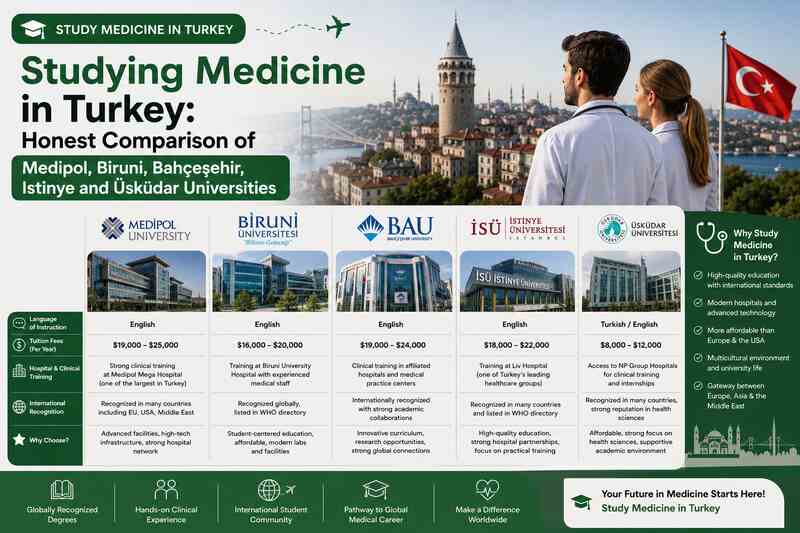
This article does that differently. I'm going to walk you through five of the most chosen private universities for medicine in Turkey Istanbul Medipol, Biruni, Bahçeşehir (BAU), Istinye, and Üsküdar and compare them honestly across the things that actually matter: accreditation, clinical training infrastructure, tuition fees, rankings, and post-graduation degree recognition. Then I'll explain how to decide which one fits your specific situation, and why getting proper guidance before you apply saves you from some very costly mistakes.
This is not a ranking list. It's a decision-making guide.
Why Studying Medicine in Turkey Attracts Thousands of International Students Every Year
Turkey has become one of the most popular destinations for studying medicine abroad, particularly for students from Africa, the Middle East, South Asia, and Central Asia. The reasons are clear when you look at the numbers. Private universities in Turkey offer English-medium medicine programs at a fraction of what you'd pay in Europe or North America. The programs are 6 years long (the same as most European medical schools), and they include integrated hospital clinical training not just theory.
According to ICEF Monitor data, Turkey is targeting 500,000 international students by 2028, with medicine and health sciences being among the top programs driving that growth. As of 2026, Turkey has over 30 private foundation universities offering medicine-related faculties, with more than 10,000 international students enrolled in health sciences programs.
But that growth in options also means more complexity. Not every medical program in Turkey is equal. Some are TEPDAD-accredited, some are not. Some have their own JCI-accredited hospitals, others rely on external agreements. And crucially — not every Turkish medical degree will be recognized the same way in your home country.
So let's look at each university properly.
Understanding the Accreditation System Before You Choose
Before I compare the five universities, you need to understand the accreditation framework. There are two levels here.
YÖK (Yükseköğretim Kurulu) the Turkish Higher Education Council is the baseline. Every legitimate university and every medicine program in Turkey is supervised by YÖK. This is the minimum, not the achievement. If a university doesn't have YÖK recognition, walk away.
TEPDAD (Association for Evaluation and Accreditation of Medical Education Programs) is Turkey's national medical education accreditation body. TEPDAD evaluates whether a medicine faculty meets national standards for curriculum, faculty qualifications, simulation labs, and clinical training. A TEPDAD accreditation is currently the strongest quality signal for a Turkish medicine program. It also affects how your degree is viewed by international licensing bodies.
WDOMS (World Directory of Medical Schools) is the international listing maintained by the World Federation for Medical Education (WFME). For international medical graduates wanting to practice in the US, Canada, UK, and many other countries, your medical school must be listed in WDOMS. This is non-negotiable for many licensing pathways.
ECFMG and USMLE for students planning to practice or do residency in the United States, ECFMG (Educational Commission for Foreign Medical Graduates) certification is required. To get it, you must pass USMLE Step 1 and Step 2 Clinical Knowledge, plus meet the ECFMG Pathways requirements including the OET Medicine exam. The Turkish university you graduated from must be listed in WDOMS and in the ECFMG's IMED directory.
Now, with that foundation in place, let's look at the universities.
Istanbul Medipol University; The Largest and Most Clinically Integrated
Istanbul Medipol is probably the most recognized name among international students searching for best universities to study medicine in Turkey, and there are solid reasons for that. Founded in 2009, it grew rapidly into one of the largest private universities in the country over 49,000 students across all programs as of 2025.
For medicine specifically, Medipol operates its own university hospital complex on the Kavacık campus, affiliated with the Joint Commission International (JCI) the same international hospital accreditation standard used in leading hospitals worldwide. This is not something most universities can claim. JCI accreditation for affiliated hospitals means clinical training takes place in an internationally evaluated environment, not just a general practice setting.
The medicine program runs 6 years in English. Medipol's medical faculty holds TEPDAD accreditation and the university is listed in WDOMS, making graduates eligible for ECFMG certification and USMLE pathways. Medipol is also EQAR-recognized (European Quality Assurance Register), which places it within the European Higher Education Area.
The main honest drawback: tuition is the highest on this list. The English-medium medicine program sits around $38,000–$44,000 per year depending on the academic year and any scholarship adjustments. Over 6 years, that's a significant total investment. Partial scholarships of 25%–50% are available for strong academic profiles, but they're competitive.
Medipol ranks around 2,178–2,430 globally depending on the ranking system used. In the QS EECA rankings it sits in the 351–400 band. It's not in the top 500 globally, but for a 15-year-old private university focused on health sciences, those rankings reflect steady research output alongside strong clinical infrastructure.
Best for: Students who prioritize having the strongest clinical infrastructure from year one, want JCI-affiliated hospital training, and can manage the higher tuition.
Read more at: Istanbul Medipol University Ultimate Guide for International Students
Biruni University; The Research-First Health Sciences Specialist
Biruni University is younger founded in 2014 and smaller, but it has built a strong identity around health sciences and scientific research faster than many older institutions. Its research productivity is notable: Biruni ranked 4th among 208 Turkish universities in published articles per faculty member in recent years, which is a real signal of academic depth.
For medicine, Biruni's School of Medicine holds TEPDAD accreditation valid until 2030 confirmed at a ceremony where TEPDAD President Prof. İskender Sayek personally presented the certificate. It also holds YÖKAK (YÖK's own quality assurance board) accreditation. Biruni is listed in WDOMS.
Biruni operates two affiliated hospitals: Biruni University Hospital and Biruni Dental Hospital, both supporting clinical rotations. The simulation centers are well-regarded and students report early clinical exposure from the preclinical years.
Tuition for the English-medium medicine program is around $21,000–$22,500 per year making it one of the more affordable options among the five on this list while still holding full TEPDAD accreditation. The university also offers Arabic-speaking student communities and international student advisory services, which matters a lot for students coming from Arab countries.
On the recognition side: Biruni's medicine program is accepted in several Gulf countries, Saudi Arabia's Ministry of Education recognizes it, Kuwait's Ministry of Higher Education accredits health science programs there, and it's recognized in Qatar and UAE for medical programs.
Ranking-wise, Biruni sits in the 1201–1500 band in Times Higher Education which actually reflects strong research performance for a university of its size and age. In US News Best Global Universities it ranks 1563rd.
Best for: Students who want TEPDAD-accredited medicine training with solid research exposure at a more manageable annual tuition, particularly those from Arab-speaking countries.
Read more at: Biruni University Ultimate Guide for International Students
Bahçeşehir University (BAU); The Global Brand with Strong International Connections
Bahçeşehir known as BAU is one of the most internationally recognized private universities in Turkey across all disciplines, and its medicine program carries that same global brand strength. BAU has campuses and programs in multiple countries, making it a genuinely international institution rather than just a Turkey-focused school.
BAU's Faculty of Medicine holds TEPDAD accreditation, which is one of the strong selling points for students planning post-graduate studies or licensing in the US or Canada. The TEPDAD certification makes BAU medicine graduates competitive for ECFMG pathways and USMLE licensing.
BAU's affiliated teaching hospital is Medical Park Hospital in Göztepe, right next to the faculty campus — a convenient and practical arrangement that gives students consistent access to clinical rotations. Medical Park is one of Turkey's largest private hospital groups, so the range of specializations students are exposed to is broad.
Tuition for English-medium medicine at BAU is around $27,000–$28,000 per year, with Turkish-medium study slightly less expensive. BAU is one of the pricier options after Medipol, but the global brand reputation and strong hospital access tend to justify that for many students.
BAU's global ranking sits at approximately 1609 globally on Webometrics, making it one of the better-ranked private universities in Turkey overall. BAU also participates actively in Erasmus programs and has over 400 partnership agreements with universities worldwide relevant if you plan any international exchange during your studies.
Recognition is strong in Arab countries, and BAU is recognized in the US and Canada for several programs. For medicine graduates specifically, the TEPDAD accreditation and WDOMS listing are the relevant factors for international licensing.
Best for: Students who want an internationally branded institution, are considering post-graduation options in the US or Canada, and want a university with strong Erasmus and exchange program access.
Read more at: Bahcesehir University Guide for International Students
Istinye University; The Hospital Network Advantage
Istinye is the youngest on this list (founded in 2015) and also the most expensive. But it has a structural advantage that makes it genuinely distinctive among Turkish private universities: it was founded by the MLP Care Group, which operates the Liv Hospital and Medical Park networks a group of over 30 hospitals across Turkey.
For a medical student, that means your clinical training isn't limited to one affiliated hospital. You rotate across a network of private hospitals with diverse specializations, different patient populations, and varying levels of complexity. Istinye University Hospital Liv Hospital Bahçeşehir is one of the flagship affiliated training hospitals, housing an organ transplant center, stroke center, IVF center, advanced oncology, and intensive care units. This is a level of clinical exposure that most medical universities anywhere in the world can't easily match.
Istinye's medicine program is taught in English, is listed in WDOMS, and is recognized internationally through its partnerships with the MLP Care Group's global medical networks. The university is working toward TEPDAD accreditation and has strong YÖK oversight.
Tuition is the second highest on this list at approximately $27,000–$29,000 per year. The university's global Webometrics ranking sits around 2329, and it appears in the 1201–2000 band in Times Higher Education.
One thing worth knowing about Istinye: because the university is relatively young, some national licensing bodies in certain countries still require additional verification steps for Istinye graduates, beyond WDOMS listing. This is not unusual for newer institutions, but worth checking specifically for your home country's requirements.
Best for: Students who value clinical exposure above everything else, want to train in a multi-hospital environment with high case diversity, and are comfortable with premium tuition.
Read more at: Istinye University Guide for International Students
Üsküdar University; The Neuroscience and Psychiatry Specialist
Üsküdar University is the most distinctive on this list in terms of academic identity. It's not trying to be a broad general medical university it's built around neuroscience, psychology, and their integration into health sciences. The psychiatry and neuroscience departments are genuinely strong by Turkish private university standards.
For international students choosing medicine specifically, Üsküdar's focus on brain sciences means the curriculum has a noticeably stronger psychiatric and neurological component compared to the other four universities. If you're interested in psychiatry, neurology, behavioral medicine, or integrated health approaches, this is worth noting.
Tuition for English-medium medicine at Üsküdar is around $22,000–$24,000 per year. The university's global ranking is approximately 2892 on Webometrics, and it appears in the 2001+ band in Times Higher Education. Üsküdar is listed in WDOMS and recognized in Gulf countries.
Clinical training links at Üsküdar include affiliated hospital partnerships, with a particular emphasis on mental health and neurological departments. The hospital network is smaller than Medipol or Istinye, so breadth of clinical specialty exposure is more limited but depth in the neuroscience-related areas is genuine.
Best for: Students with a specific interest in psychiatry, neurology, or mental health medicine, and those who want a more specialized academic environment at a mid-range tuition.
Read more at: Uskudar University Guide for International Students
Side-by-Side Comparison Table
Feature | Istanbul Medipol | Biruni University | Bahçeşehir (BAU) | Istinye University | Üsküdar University |
|---|---|---|---|---|---|
Founded | 2009 | 2014 | 2001 | 2015 | 2011 |
Medicine Annual Tuition (EN) | ~$38,000–$44,000 | ~$21,000–$22,500 | ~$27,000–$28,000 | ~$27,000–$29,000 | ~$22,000–$24,000 |
Program Language | English & Turkish | English & Turkish | English & Turkish | English & Turkish | English & Turkish |
TEPDAD Accreditation | Yes | Yes (until 2030) | Yes | In progress | Yes |
WDOMS Listed | Yes | Yes | Yes | Yes | Yes |
YÖK Recognized | Yes | Yes | Yes | Yes | Yes |
Hospital Affiliation | Own JCI-accredited hospital complex | Biruni University Hospital + Dental | Medical Park Göztepe | MLP Care Group (Liv + Medical Park, 30+ hospitals) | Partner hospitals, psychiatry focus |
Webometrics Global Rank | ~2,178–2,430 | ~2,172 | ~1,609 | ~2,329 | ~2,892 |
THE Band | 1201+ | 1201–1500 | 1201+ | 1201–2000 | 2001+ |
Key Strength | Largest clinical complex; JCI affiliation | Research output; most affordable TEPDAD-accredited option | Global brand; TEPDAD; Erasmus network | Unmatched hospital network breadth | Neuroscience and psychiatry focus |
Scholarship Possibility | 25%–50% partial | Available | 25%–50% partial | Available | Available |
Tuition figures are approximate for the 2026–2027 academic year. Always confirm current rates directly with the university or through a registered admission advisor.
Post-Graduation: What Happens to Your Degree
This section is the one most articles skip completely. You spend 6 years and a significant amount of money studying medicine in Turkey. Then what?
Practicing in Turkey itself Graduates who want to work in Turkey must pass the TUS (Tıpta Uzmanlık Sınavı), Turkey's specialist training exam, to enter residency programs. Turkish medical licensing requires Turkish language proficiency for clinical practice, so international graduates planning to stay in Turkey need functional Turkish.
Practicing in the US or Canada This is possible but involves a multi-step process. Your university must be listed in WDOMS. You then need to pass USMLE Step 1 and Step 2 CK, meet ECFMG Pathway requirements (including the OET Medicine exam for communication skills), get ECFMG certified, and then match to a US residency program. This is the same pathway for any international medical graduate, regardless of country. All five universities on this list are WDOMS-listed, so that first step is covered.
Practicing in the EU Recognition in EU countries is done on a country-by-country basis. Turkey is not an EU member, so automatic mutual recognition doesn't apply. Most EU countries require you to pass a local equivalency exam or licensing test, regardless of your Turkish degree. Some countries, like Germany, have specific pathways for Turkish medical graduates given the large Turkish community. Check with the national medical council of your target country before enrolling anywhere.
Practicing in Arab countries Turkish medical degrees are broadly accepted across the GCC and Arab world, though most countries require a credential verification process and sometimes a local licensing exam. Biruni, BAU, and Medipol specifically have documented recognition in Saudi Arabia, Kuwait, Qatar, and UAE.
Practicing in Pakistan, Nigeria, India, or other South/Southeast Asian countries Recognition varies widely. Pakistan's PMC (Pakistan Medical Commission) maintains a list of recognized foreign medical schools. Nigeria's MDCN has its own recognition requirements. These change, so checking with the specific licensing board of your country before enrolling is essential not after you graduate.
A 2020 study published in the International Journal of Medical Education by Demiral Yilmaz, Sahin, and Nazli (DOI: 10.5116/ijme.5e47.d7de) examined the adaptation process of international medical students at Turkish universities. The research found that while academic goals and curriculum structure were generally well-received, social adaptation and communication challenges particularly around language were the most common difficulties reported by international students. This is a real factor: even in English-medium programs, clinical years involve patient interaction in Turkish, and students who build functional Turkish early settle in much faster professionally and personally.
The Questions You Should Actually Ask Before Choosing
Most students ask: "Which university is the best?" But that's not the right question. Better questions are:
Is the program listed in WDOMS? All five on this list are but always verify current status directly at wdoms.org for the specific program, not just the institution.
Does the medical faculty hold TEPDAD accreditation? Medipol, Biruni, and BAU have confirmed TEPDAD status. Istinye is working toward it. Üsküdar holds it. Check the TEPDAD website directly for current status.
What do the first clinical rotations look like? Some universities start real hospital contact in year 3 or 4. Others integrate clinical exposure earlier. Ask specifically when and where clinical training starts.
How does your home country recognize this degree? This is your most important question and it requires you to contact your national medical licensing board, not just ask the university.
What is the total cost over 6 years? Annual tuition multiplied by 6, plus living expenses in Istanbul (roughly $400–$700 per month depending on accommodation type), visa fees, and insurance. For Medipol at $40,000/year that's potentially $240,000 in tuition alone before living costs. For Biruni at $21,000/year, it's significantly more manageable.
Is there a real scholarship option for you? Ask before you start, not after. Some universities offer early-bird scholarships or nationality-specific reductions. These have limited seats.
Why universityfinder.org Is the Right Partner for This Decision
Choosing where to study medicine is one of the most important decisions of your life. The stakes are high six years, significant money, and your professional future as a doctor. This is not a decision to make based on a YouTube video or a friend's recommendation.
universityfinder.org has been supporting international students through Turkey's medical university admission process for years, with a team that operates from two offices on the European side of Istanbul. These are not remote advisors working from a laptop in another country. They are people physically in Istanbul who know the admissions offices at Medipol, Biruni, BAU, Istinye, and Üsküdar who know which scholarship slots are currently open, which programs have international student quota availability for this intake cycle, and what document preparation each university actually requires.
The on-ground support matters especially for medicine students. When you arrive in Istanbul, the team handles your airport reception with proper transport, walks you through final university registration, helps with course selection, and sorts out your document translation for your ikametgah (residence permit). For medicine students specifically, who often arrive needing to register for simulations and clinical orientation in their first weeks, having someone who knows the process is the difference between a smooth start and a chaotic one.
Every service is completely free for students no application fees, no consulting charges. The agency works with university authorization, meaning you pay the same tuition as any direct applicant but get full guidance from first contact to first day of class and beyond.
If you're seriously considering studying medicine in Turkey, start with a free consultation at universityfinder.org. The team will look at your grades, your budget, your target country for practicing after graduation, and your program preferences and give you an honest recommendation, not just the university they find easiest to place you in.
Frequently Asked Questions
Q: Which of these five universities is cheapest for medicine in English? A: Biruni University is the most affordable at around $21,000–$22,500 per year for English-medium medicine, while still holding TEPDAD accreditation. Üsküdar follows at approximately $22,000–$24,000. Medipol is the most expensive at $38,000–$44,000 per year.
Q: Is TEPDAD accreditation the same as international accreditation? A: TEPDAD is Turkey's national medical education accreditation body it evaluates whether a program meets national quality standards. It's an important domestic marker of quality and it influences how international bodies assess the program. It's not the same as WDOMS listing, which is the international directory recognition that affects licensing abroad. You need to check both separately.
Q: Can I take USMLE after graduating from these universities? A: Yes, if your university is listed in WDOMS (all five on this list are) and you get ECFMG certified. ECFMG certification requires passing USMLE Step 1 and Step 2 CK, plus completing ECFMG Pathway requirements including the OET Medicine exam. The process takes time and has costs, so plan for it well before graduation.
Q: Will my Turkish medicine degree be recognized in my home country? A: This depends entirely on your home country. You must check with your national medical licensing board not with the university. Some countries recognize WDOMS-listed Turkish degrees directly with local exam requirements. Others need additional steps. Some have bilateral agreements. This question has no universal answer.
Q: Do these universities teach clinical years in English or Turkish? A: Lectures and curriculum are in English for English-medium programs. But clinical rotations involve real patients in Turkish hospitals, and patient interaction is in Turkish. Even in English programs, students who don't develop functional Turkish face real challenges in clinical years. Plan for some Turkish language learning alongside your studies.
Q: How early do students start clinical training at these universities? A: Typically, full clinical rotations start in years 4–6, but pre-clinical exposure and simulation training begin earlier. Medipol and Istinye, given their hospital infrastructure, tend to offer earlier integration of clinical simulations. Ask each university specifically about the year-by-year clinical schedule.
Q: Is it possible to get a scholarship for medicine at these universities? A: Partial scholarships of 25%–50% tuition reduction are available at most of these universities for strong applicants. Full scholarships for medicine are rare at private universities. Türkiye Bursları (YTB government scholarship) is the main route to full funding but it's highly competitive and has its own application cycle (usually closing early in the calendar year). Apply early and ask directly about scholarship options when you first contact the university or an admission advisor.
How to Make the Final Decision; A Practical Framework
Step 1, Confirm your home country's recognition requirements. Contact your national medical licensing board before anything else.
Step 2, Set a realistic total budget for 6 years (tuition plus living) and decide what's genuinely manageable.
Step 3, Verify WDOMS listing and TEPDAD status for the specific faculty at the specific university check both official websites directly.
Step 4, Look at hospital affiliations in the context of your specialty interest. If you're leaning toward psychiatry, Üsküdar's focus is relevant. If you want the broadest clinical exposure, Istinye's hospital network wins.
Step 5, Consider the scholarship conversation early. Contact admission advisors who work directly with the universities to find out what's currently available.
Step 6, Talk to someone who actually knows these institutions from the inside, not just from a ranking website.
universityfinder.org is a free starting point that covers all of these steps. Their team has walked hundreds of medicine students through this exact process and will tell you honestly which university matches your profile including if none of the five on this list is the right fit.