What It Actually Means to Study Medicine in Turkey (And What to Expect)

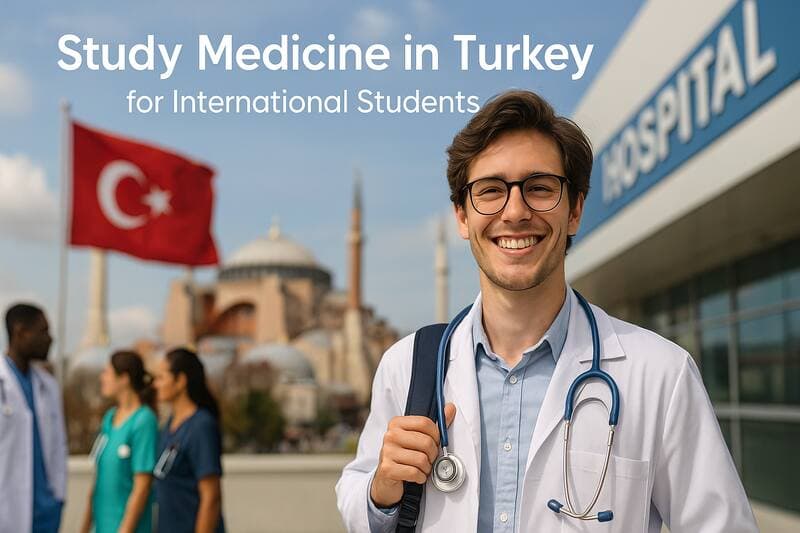
So you've been researching study medicine in Turkey and you keep landing on the same surface-level answers - six years, English tracks, affordable. That's all true. But if you're seriously considering this path, you need a clearer picture of what the degree actually involves, what it costs, and what happens after you graduate. Let's go through it properly.
The Degree, the Title, and What It Means
The medical degree you get from a Turkish university is called Tıp Doktoru, which is the Turkish equivalent of an MD or MBBS. It's not some unrecognized qualification - most Turkish medical faculties are listed in the World Directory of Medical Schools (WDOMS), which is the WHO/FAIMER database that licensing authorities worldwide use to verify medical graduates. That listing is basically the key that opens the door to international exams like USMLE (USA) and PLAB (UK).
Worth knowing: TEPDAD (the Turkish medical education accreditation body, formally known as Tıp Eğitimi Değerlendirme ve Akreditasyon Derneği) is Turkey's recognized accreditor for medical programs. If you're planning to practice in the US eventually, your school needs to be both WDOMS-listed and ECFMG-eligible. Most accredited private and public Turkish medical schools are, but you should verify for your specific target university before applying.
And one small update for 2026 - the USMLE exam registration process for international medical graduates has shifted. As of January 2026, exam scheduling moved to FSMB, while ECFMG still handles certification. So it's two separate portals now. Small thing, but it trips people up.
How the Six Years Actually Flow
The structure is pretty consistent across universities, whether you're at a public school or a private one. Here's how it normally breaks down:
Years 1-3 (Pre-clinical phase): This is where you build the scientific foundation - Anatomy, Physiology, Biochemistry, Histology, Microbiology, Pharmacology. There's also early clinical skills training and simulation labs in most modern programs. Heavy reading, lots of exams, and not much patient contact yet.
Years 4-5 (Clinical rotations): This is when things get real. You rotate through Internal Medicine, Surgery, Pediatrics, OB-GYN, Psychiatry, Family Medicine and more, across university hospitals and affiliated clinics. Istanbul's high-volume hospitals mean you see a genuinely wide range of cases - that's one of the real advantages of choosing a big-city school.
Year 6 (Internship): You function as an intern doctor under supervision. Full-time rotations, real responsibilities, actual patient care. By the end of this year, you're expected to be practice-ready.
Some students add a preparatory year for English or foundational sciences before Year 1, so the total timeline can stretch to seven years. Not everyone needs it, but it's a legitimate route if your science background has gaps.
English Tracks, Turkish Tracks, and the Language Reality
A lot of students come in expecting fully English-medium instruction and then find the reality is more complicated. Yes, many private universities offer study medicine in Turkey in English, and some are genuinely 100% English-medium for classroom teaching. But once you're in clinical rotations, most patient communication happens in Turkish. That's just the reality of practicing medicine in a Turkish hospital.
I've seen students underestimate this. You don't need to be fluent in Turkish before you arrive, but basic medical Turkish - enough to take a patient history and communicate with nursing staff - becomes important by Year 4. Some universities offer Turkish language support through TÖMER (the official Turkish language teaching center). Use it early.
If you're applying without an IELTS score, many private universities accept their own internal English proficiency test or offer a one-year English prep course before Year 1. So study in Turkey without IELTS is genuinely possible - you just route through that prep year or sit the university's exam instead.
What Does It Actually Cost?
This is probably the most searched question around this topic, and the range is wide enough to confuse people.
For private universities with English-medium medicine programs, tuition in 2026 typically runs between roughly $17,000 and $40,000+ per year, depending on the school. To give you some real figures: Atlas University charges around $25,000 per year, Okan University is around $22,000, Altinbas and Uskudar also sit in that $21,000-$22,000 range. Medipol is at the higher end, reaching up to $40,000 per year for some tracks.
Public universities are much cheaper but almost always teach in Turkish, and the seats available for international students are limited and competitive. Hacettepe University in Ankara, one of Turkey's top medical schools, has tuition in the low thousands of dollars per year but expects strong academic performance and Turkish-language readiness.
Living costs add another layer. In Istanbul, budget roughly $500-$800 per month covering accommodation, food, transport, and basics. Smaller cities like Izmir or Ankara are a bit cheaper. On top of that, factor in residence permit fees (ikametgah), health insurance, and visa costs when you're calculating the full picture.
A 2024 study published in BMC Medical Education - which surveyed 482 international medical students across 30 Turkish medical schools - found that affordability and the perceived value of Turkish medical education were among the main factors driving international enrollment. The research also noted significant variation in students' socioeconomic backgrounds, suggesting the cost profile of Turkish medicine programs appeals across a broader demographic than many expect.
Applying After High School: What You Actually Need
If you want to study in Turkey after 12th, the good news is the process is more straightforward than in most Western countries. You don't need a separate entrance exam at most private universities - a high school diploma with solid science grades is usually enough to apply.
Required documents typically include: your high school diploma and transcripts (translated and apostilled), passport copy, English proficiency evidence (IELTS/TOEFL or an internal exam), a personal statement or motivation letter (most medical faculties ask for this), and proof of financial means for the student visa. Some universities ask for recommendation letters too - check each school's specific list.
YÖS (Yükseköğretim Kurumları Sınavı) is Turkey's university entrance exam for foreign students. It's not compulsory at most private schools, but a good YÖS score can help with scholarship applications. Public universities are a different story - they tend to be more selective and may require YÖS or equivalent standardized test results.
Apply early. Seats in English-medium medicine programs fill up fast, and applications open months before the September/October start date.
Is It Actually Hard? Be Honest With Yourself
Yes. Medicine is demanding everywhere, and Turkey is no exception. Pre-clinical years require you to absorb enormous amounts of content quickly. OSCE-style practical assessments test clinical skills directly. Grading can be competitive, especially at the more established schools.
There's also the adaptation challenge. Earlier research published in Research in Comparative and International Education noted that international students in Turkey often struggle with different academic habits and the adjustment to a new educational culture - particularly in the first year. That's not unique to Turkey, but it's worth factoring in alongside the academic workload.
The payoff is real, though. By the time you finish Year 6, you've had genuine hospital experience in high-volume clinical settings. You hold an internationally recognized degree. And you've done it at a cost that, compared with UK or US medical schools, is significantly lower. For a lot of international students, that combination is exactly what they're looking for.


Here we compare public vs private universities, typical ranges, and your four focus universities.
Public vs Private Universities: General Fee Ranges
Type of University | Language Track (English) | Language Track (Turkish) | Notes on Cost & Affordability |
|---|---|---|---|
Public Universities | Approx USD 2,000–10,000/year depending on university & whether spot is English medium. | Lower still (sometimes around USD 1,500–6,000/year) for Turkish medium. | Public universities often have government subsidies; competition is tight; spots are limited. |
Private/Foundation Universities | Approx USD 10,000–27,500/year in many cases. Some high-end ones are higher. | Mixed Turkish/English tracks may cost less but still significantly more than public. | More flexibility, modern facilities, smaller class sizes; often internal English exam / prep year option. |
Cost of Living & Other Costs
Accommodation, food, transport, books/equipment add additional cost; depending on city (Istanbul highest).
Public universities often have dorms or cheaper housing; private universities may not.
Budget for visa, health insurance, potentially Turkish course or translation of documents.
Fees for Bahçeşehir, Medipol, Uskudar, Biruni & More Universities
Below is a table with approximate fees for Medicine / English track in your priority universities plus some other good choices. Note: always check the official university site for the latest fixed fees.
University | English Track Fee per Year (Medicine) | Notes & Highlights |
|---|---|---|
Istanbul Medipol University | ~$44,000/year for 100% English Medicine track. | High reputation, hospitals, strong clinical exposure. |
Bahçeşehir University (BAU) | ~$28,000/year (English). | Eng track, good facilities. |
Üsküdar University | ~$24,000/year English track. | Also Turkish track cheaper. |
Biruni University | ~$15,000-$25,500/year (English track) depending on intake. | More affordable among private options. |
Koç University | (English MD) fee not always publicly fixed in USD in source, but known to be among premium universities. | Very high standards, also requires Turkish learning by certain years. |
Acıbadem Mehmet Ali Aydınlar University | Private foundation, higher fee; likely in upper private range ~$28,000+ depending on year. | Strong hospital network. |
Altınbaş University | Private, with English Medicine; tuition in private universities range around $10,000-25,000 or more. | Good alternative. |
Istanbul University – Cerrahpaşa | Public; English track fee significantly lower (~40,000 Turkish Lira / yr in some sources) for English instruction. | Very competitive. |
Hacettepe University | Public, English track; fee moderate; older universities with strong reputation. | High academic standard; competition is tough. |
Ankara University | Public, English; similar to Hacettepe in value; moderate fees relative to private. | Good reputation, clinical placements. |
Here are at least 10 universities that are among the best or most popular for international students who want to study medicine in Turkey, especially in English or with English options. After the list, more detail on your focus ones.
University | Public / Private | English Track Available? | Approx. Fee (English Track) | Highlights / What Makes It Good |
|---|---|---|---|---|
Istanbul Medipol University | Private | Yes | ~$44,000/year | Huge clinical exposure, modern hospital network, English track, reputed faculty. |
Bahçeşehir University | Private | Yes | ~$28,000/year | Strong facilities, English medium, good student support. |
Üsküdar University | Private | Yes | ~$24,000/year | Option of cheaper Turkish track; more affordable among Istanbul privates. |
Biruni University | Private | Yes | ~$15,000-$21,000/year | One of more cost-effective private options. |
Acıbadem Mehmet Ali Aydınlar University | Private | Yes | High private range not clearly fixed but premium; likely above $28,000 in many intakes. | Strong hospital backing; research oriented. |
Altınbaş University | Private | Yes | Within the private tuition bands; maybe $15k-$25k depending on year. | Good modern facilities, popularity among internationals. |
Koç University | Private / Foundation | English | Among premium universities. Fee high. | Elite reputation, strong international recognition. |
Istanbul University-Cerrahpaşa | Public | English track exists | Much lower fee compared to privates; fee in Turkish Lira modest. | Very old, well known; lots of tradition; strong alumni. |
Hacettepe University | Public | English track | Moderate English track fees; less than private ones; still high competition. | Very strong in research and medical sciences; excellent quality. |
Ankara University | Public | Yes | Similar to Hacettepe; good value; moderate fees. | Being in capital; strong teaching hospitals; recognition. |
Academic Grades & High School Background
Strong high school grades are essential. Many universities request 70% or higher overall or equivalent in your national grading system.
Science subjects (Biology, Chemistry, Physics/Math) are advantageous/helpful. When your high school lacks some, prep years or taking extra courses sometimes required.
English Language Requirements / Study in Turkey Without IELTS
If you are applying to an English track, universities usually require proof of English (IELTS/TOEFL/PTE etc.). Some allow internal proficiency exams or prep year (without IELTS).
For Turkish track or mixed track, English requirement may be lower or not required. Turkish ability becomes needed especially by clinical years.
Entrance Exams
Public universities often use YÖS (Foreign Student Exam) or equivalents. Some accept SAT / ACT / IB depending on university.
Private universities may have their own application exam or simply evaluate high school transcripts + English proficiency etc.
Interview / Motivation / Additional Documents
You may need a motivation letter, passport copy, high school transcript with translation, possibly a GPA/grade equivalence. Some schools require letters of recommendation.
Some private universities have interviews or oral tests.
This is the process with actionable steps, matching your keywords: how to study MBBS in Turkey after 12th, applying to study medicine in Turkey etc.
Finish high school (12th or equivalent) with strong grades—especially in sciences.
Decide on language track (English / mixed / Turkish) and universities of interest (e.g., Bahçeşehir, Medipol, Uskudar, Biruni + others).
Check English proficiency requirements; either plan to take IELTS/TOEFL or prepare for internal proficiency test or prep year.
Take entrance exam if required (YÖS / or SAT/ACT etc) — for universities and track that require it.
Prepare documents: passport, high school diploma & transcripts (translated if needed), motivation letter, any exam scores, proof of English.
Submit application before deadlines (often by mid-year for fall intake). Private universities have their own admissions windows; public ones may have national timelines.
Accept offer & pay deposit / tuition; many private universities accept payments in installments; some have advance-payment discounts or scholarships.
Arrange visa & housing after official acceptance.
Let’s examine them in more detail: cost, strengths, what you need, how “easy/hard” they are comparatively.
University | Duration | Language Tracks | Fee (English) | What Sets It Apart | Entry Competitiveness / “Easiest University to Study Medicine in Turkey” Among These |
|---|---|---|---|---|---|
Istanbul Medipol University | 6 years | English (100%), English/Turkish mixed | ~$44,000/year (English) | Very large hospital network; strong facilities; reputation among international students; transparent fee schedule. | One of more expensive options; entry is competitive, especially for English track. |
Bahçeşehir University (BAU) | 6 years | English MD track | ~$28,000/year | Good support, modern campuses, fairly strong international recognition; somewhat more affordable among English private tracks. | Easier than top premium ones like Koç, but still demanding. |
Üsküdar University | 6 years | English & Turkish tracks | ~$24,000/year English | Offers both tracks; comparatively moderate tuition; somewhat more accessible. | Among these four, may be a “less hard” private choice if grades are good. |
Biruni University | 6 years | English & Turkish | ~$15,000-$25,500/year for English depending on intake | Lower cost among privates; decent facilities; growing visibility. | Possibly one of the more “attainable” among private English-track universities. |
Affordable public university options: Some public universities’ English-medium medicine costs are low (fees in Lira or conserved USD equivalent) compared to private universities. These are attractive to high-achieving students.
“Cheapest university” will depend on exchange rate, whether you need prep year, whether you need an English proficiency exam, living costs. Among private universities, Biruni, certain smaller foundation universities offer lower English track fees. Among publics, some state universities with English tracks are cheapest.
Even private ones though at “cheapest” levels are still significantly more expensive than Turkish / public medium tracks.
Question | Answer |
|---|---|
How many years to study medicine in Turkey? | 6 years standard; possibly 7 if including preparatory year. |
Requirements to study medicine in Turkey? | High school diploma, strong in science; English proficiency (or internal proficiency/prep year); sometimes entrance exams (YÖS, SAT etc). |
How to study in Turkey without IELTS? | Use university’s internal English test or take the English preparatory year if offered. |
How much does it cost to study medicine in Turkey? | Public: ~$1,500-$10,000/year; Private/English: approx $10,000-$27,500/year for many universities. |
Best university to study medicine in Turkey? | Depends on budget, language, location. Among top: Koç, Medipol; among cost-value: Biruni, Üsküdar. |
Cheapest university in Turkey to study medicine for international students? | Likely some smaller foundation private universities or public universities with English tracks; among your four, Biruni is among cheaper. |
Is studying medicine in Turkey hard? | Yes , academically rigorous, competitive entry, clinical requirements, language demands. |
Studying medicine in Turkey is a powerful path: international recognition, a 6-year curriculum with substantive clinical exposure, possibly lower cost (especially in public or more affordable private universities). You do need high grades, planning around English proficiency (or prep/exam), and choosing the right university based on cost, language track, location, and your own strength.
Among your four priority universities:
Medipol: premium choice, high cost, strong facilities.
BAU: moderate among privileges, good reputation.
Üsküdar: fairly good balance between cost & English track.
Biruni: more affordable, still good value.
Also many other universities (Koç, Altınbaş, Acıbadem, Istanbul University-Cerrahpaşa, Hacettepe, Ankara University) provide excellent options, especially if you’re aiming for quality and recognition.