MIT for International Students 2026-2027: Fees, Financial Aid and Admission Guide


AI Snapshot
MIT for International Students 2026-2027: Fees, Financial Aid and Admission Guide is a private higher-education institution in USA. International students can explore its programs and apply through University Finder with free, end-to-end guidance. Founded in 1861.
Last updated: 30 September 2026
In March 2026, the Massachusetts Institute of Technology admitted 1,299 students from 28,349 applicants for the Class of 2030, an acceptance rate of about 4.6%. The admitted students came from 58 countries (The Tech, March 2026). And here's what makes MIT special for families outside the US: it reads every application need-blind, international students included, and meets the full financial need of everyone it admits.
So if you're a student in Lagos who builds robots, or a girl in Lahore who can't stop solving math olympiad problems, MIT is not a fantasy. It's a real option, and money shouldn't be what stops you. Getting in is the hard part.
In this guide I'll explain MIT for international students step by step: what it costs in 2026-2027, how the aid works, what MIT's own application asks for, deadlines, campus life, visas, rankings, and the news from the last two years that affects you directly, especially the cuts to graduate places.
Quick answer (2026-2027): MIT's estimated undergraduate cost of attendance for 2026-27 is $93,730, with tuition of $33,360 per term ($66,720 a year). MIT is need-blind for international applicants and meets full need: families earning under $200,000 pay no tuition and under $100,000 pay nothing. The SAT or ACT is required, and about 40% of MIT students attended tuition-free in 2025-26. Verified against the MIT Course Catalog, MIT Registrar and The Tech, September 2026.
MIT key facts
Fact | Detail |
|---|---|
Full name | Massachusetts Institute of Technology |
Type | Private research university |
Location | Cambridge, Massachusetts, USA (Boston area) |
Founded | 1861 |
International students (fall 2025) | 4,030, about 28% of all students, from 138 countries |
International undergraduates (fall 2025) | 529 |
Class of 2030 | 1,299 admitted from 28,349 applicants (about 4.6%) |
Undergraduate cost of attendance 2026-27 | $93,730 (estimated) |
Tuition 2026-27 | $33,360 per term |
Aid policy | Need-blind for all applicants, meets full need |
QS World University Rankings 2027 | 1st in the world |
President | Sally Kornbluth |
Page last verified | 30 September 2026 |
What Is MIT, and Why Do International Students Want It So Much?
MIT was founded in 1861, just as the American Civil War began, by a scientist named William Barton Rogers. His idea was simple but new at the time: teach science and engineering through hands-on work, not just lectures. That idea became MIT's Latin motto, mens et manus, meaning "mind and hand." The university moved from Boston to its current home in Cambridge, along the Charles River, in 1916.
Here's how I explain MIT to students: if most universities are libraries, MIT is a workshop. You learn a theory on Monday and you're building something with it by Friday. Wartime radar research, the guidance software that flew the Apollo missions to the Moon, and countless robotics and AI breakthroughs came out of MIT labs. More than 100 Nobel Prize winners have been MIT faculty, staff or alumni.
MIT is also very international. In fall 2025 it had 4,030 international students, about 28% of all 14,250 students, from 138 countries (MIT International Students Office). Most of them are graduate students; only 529 are undergraduates, which tells you how competitive the undergraduate international places are. The biggest groups come from China (980), India (286), Canada (255), South Korea (248) and Germany (127).
At around 4,500 students in total, the undergraduate college is small, and the vast majority study science or engineering. Its president, Sally Kornbluth, is a biologist who has led MIT since January 2023, and in October 2025 she made MIT the first university to reject the federal government's proposed "compact" with universities (The Tech, October 2025). I'll explain why that matters for you in the news section.
MIT vs Koç University vs Sabancı University: A Comparison for International Students
Most students who dream of MIT want engineering, computer science or natural sciences. In Turkey, Sabancı University and Koç University are two private universities with strong English-taught engineering and science programs that actively recruit international students. Here's how they compare.
MIT | Koç University | Sabancı University | |
|---|---|---|---|
City | Cambridge, USA | Istanbul, Türkiye | Istanbul, Türkiye |
Type | Private research university | Private foundation university | Private foundation university |
Teaching language | English | English | English |
Entrance tests for international applicants | SAT or ACT required | SAT and other international exams | SAT, ACT, GCE A-Levels or TR-YÖS |
Aid model | Need-blind, meets full need; free under $100,000 family income | Merit scholarships of 100%, 75%, 50% or 25% of tuition | Merit-based scholarships by academic record and quota |
Undergraduate cost 2026-27 | $93,730 estimated, before aid | Set yearly in USD; confirm with admissions | Set yearly in USD; confirm with admissions |
Application | MIT's own application | Online application | Online application, $30 fee |
Sources: MIT Course Catalog, The Tech, Koç University international tuition and scholarships, Sabancı University 2026-2027 application requirements, checked September 2026. Koç and Sabancı hadn't published 2026-27 international fee amounts on these pages when checked.
The clearest difference is odds versus aid. MIT's aid is the most generous in the world for low- and middle-income families, but with only a few hundred international undergraduate seats, getting in is extremely hard. At Koç and Sabancı, strong SAT or A-Level results give you a realistic chance of admission and can bring a scholarship of up to 100% of tuition, even if your family's income is comfortable.
The second difference is structure. Like MIT, Sabancı lets you start without a fixed major and choose after exploring, which suits students who love science but aren't sure which field yet. Koç has a more traditional faculty-based structure with strong engineering and sciences. Both give you a route into Europe and the Middle East, with far lower living costs than Boston.
My advice for a strong science student: apply to MIT if you're in range, because need-blind aid makes it a no-lose application. But put a realistic, well-funded option like Sabancı or Koç next to it, so your future doesn't depend on a 5% chance.
What the Research Says About International Students at Places Like MIT
You might wonder: do universities like MIT actually value international students, or is it just nice words? Research gives a strong answer, and it also explains why US work rules after graduation matter so much for you.
A major study by Stuen, Mobarak and Maskus (2012), published in The Economic Journal, used data on 2,300 science and engineering departments at 100 large US universities over 25 years. It found that both foreign and domestic graduate students are central to research, and that the marginal foreign student added more to publications and citations. A 10% drop in the foreign share of doctoral students lowered science and engineering research output by about 5 to 6%. The authors also warned that visa restrictions keeping out high-quality foreign students are especially costly for US innovation. (Stuen et al., 2012)
A 2026 study by Yoo in the Academy of Management Proceedings looked at the STEM OPT extension, which gives international STEM graduates extra time to work in the US. After the extension was introduced, the number of first-time immigrant inventors near top research universities rose by roughly 60 to 87%, with no sign that US-born inventors were pushed out. (Yoo, 2026)
What does this mean for you? It explains why MIT publicly defends international students, and why the recent cuts in graduate places worry its leaders. And it shows that STEM OPT is more than a visa detail. For an MIT graduate, those extra years of US work can be the start of a patent, a startup or a research career. So choosing a STEM major, which almost every MIT student does, has real long-term value.
Your Next Step
Here's the honest bottom line on MIT for international students. If you love math and science and your SAT and grades are at the top, apply. Need-blind aid means your family's income won't hold you back, and if you get in, cost is unlikely to stop you. But with fewer than 600 international undergraduates on campus, MIT should be your dream, not your only plan.
That's where universityfinder.org can help. We have a free university matching tool: share your grades, budget and the program you want, and we'll suggest universities that really fit you, in the US, Europe, Turkey and beyond. No fees and no pressure, just a clearer list.
MIT is organized into five schools plus the Schwarzman College of Computing. Undergraduates can major in any of them, and MIT calls its majors "Courses," each with a number. So when an MIT student says "I'm Course 6," they mean electrical engineering and computer science.
School | Known for |
|---|---|
School of Engineering | Mechanical, electrical, aerospace, chemical, civil, biological engineering |
School of Science | Mathematics, physics, chemistry, biology, brain and cognitive sciences |
Schwarzman College of Computing | Computer science, AI and data science across all fields |
Sloan School of Management | MBA, business analytics, finance, management |
School of Architecture and Planning | Architecture, urban planning, the MIT Media Lab |
School of Humanities, Arts, and Social Sciences | Economics, political science, linguistics, writing |
Undergraduate study at MIT
You apply to MIT, not to a department, and you choose your major at the end of your first year. Every student takes the General Institute Requirements, a core of math, physics, chemistry and biology, plus humanities classes. Think of it as MIT making sure every student, even a future economist, has the same strong science base.
The most popular majors are computer science, electrical engineering, mathematics, mechanical engineering, physics and economics. MIT's economics department, by the way, is one of the best in the world, which many students don't know.
A big part of MIT life is UROP, the Undergraduate Research Opportunities Program. Most undergraduates join a real research lab at some point, often paid or for credit, working next to PhD students and professors. For an international student, a UROP project can be the thing that later wins you a graduate place or a job.
Like other US universities, MIT has no undergraduate medicine or law degree; those are graduate programs in the US, and MIT doesn't have a medical school of its own [internal link: /blog/study-medicine-abroad].
Graduate programs
Most international students at MIT are graduate students, mainly in engineering, science and computing, where PhDs are normally fully funded. MIT Sloan's MBA and one-year master's programs are also popular. But be aware: MIT is admitting nearly 500 fewer graduate students for 2026-27 because of funding pressure, so competition for PhD and research master's places is tougher than usual (see the news section).
First, the simple part: MIT charges international students exactly the same as American students. There's no extra foreign-student tuition.
Undergraduate costs 2026-27
Item | Amount (USD) |
|---|---|
Tuition | $33,360 per term ($66,720 for fall and spring) |
Student life fee | $210 per term |
Estimated total cost of attendance (tuition, fees, housing, food, books, personal costs) | $93,730 |
Sources: MIT Registrar, Tuition and Fees 2026-27 and MIT Course Catalog, Undergraduate Costs, checked September 2026.
The $93,730 figure is MIT's own estimate of the full yearly budget, not just the bill it sends you. It already includes housing, food, books and personal costs, which makes it more honest than a tuition-only number. Flights home aren't a fixed part of it, so if you're flying from Lagos, Karachi or Delhi, add those on top. Boston winters also mean buying a real coat and boots in your first month.
Graduate costs
Graduate students pay the same base tuition of $33,360 per term, but most PhD students in engineering and science have their tuition paid in full through research or teaching assistantships, plus a monthly stipend. Some professional programs cost much more: MIT's MBA, Executive MBA and certain specialized master's programs range from about $89,000 to $222,000 in tuition, depending on the program and its length (MIT Registrar) [internal link: /blog/mit-tuition-fees-2026-2027].
Now, before you panic about $93,730: in 2025-26, about 60% of MIT students received financial aid, and around 40% attended tuition-free (MIT Course Catalog). The sticker price is one thing. What your family pays is usually something very different.
MIT Scholarships and Financial Aid for International Students
Here's the most important fact in this whole guide. MIT is one of only a handful of universities in the world that is need-blind for all applicants, including international students, and that also meets 100% of demonstrated need for everyone it admits (The Tech, November 2024).
Let me put it simply. When MIT reads your application, it doesn't know or care whether your family can pay. If you're admitted, MIT looks at your family's real finances and gives you enough grant money to cover the gap. You don't have to be rich to go to MIT, and you don't have to be a US citizen to get help.
How much will your family pay?
Since 2025-26, MIT's aid works like this for families with typical assets:
Family income under $100,000: MIT covers the full cost of attendance, so you pay nothing for tuition, housing or food.
Family income between $100,000 and $200,000: no tuition. Your family pays a contribution toward housing and food on a sliding scale, up to about $23,970 a year.
Above $200,000: many families still receive aid, depending on their full financial situation.
Source: The Tech, 21 November 2024, reporting MIT's aid expansion effective 2025-2026.
For most families in Nigeria, Pakistan, India, Bangladesh, Egypt or Kenya, yearly income in US dollars is far below $100,000. So an admitted student from an ordinary middle-class family in Abuja or Faisalabad would likely pay nothing to attend MIT.
Important details for international families
MIT gives no merit scholarships and no athletic scholarships. All aid is need-based, and it comes as grants you don't repay, not loans. Over half of undergraduates receive need-based aid, and MIT's endowment-funded aid budget was about $167 million in 2024-25 (The Tech).
You'll need to send the CSS Profile and your parents' income documents, translated into English where needed. Be honest and complete, because the aid office uses these papers to calculate your award. From what I've seen with students who reach out to universityfinder.org, the ones who struggle are usually those who send incomplete financial documents and get a smaller offer than they deserve. Take the time to do this part right.
MIT acceptance rate for international students
For the Class of 2030, MIT admitted 1,299 of 28,349 applicants, about 4.6%. In the early round alone, it admitted 655 of 11,883, about 5.5% (The Tech, December 2025; The Tech, March 2026). MIT doesn't publish a separate international rate, but the numbers give a clue: only 529 of MIT's undergraduates in fall 2025 were international, roughly 1 in 9 (MIT ISO). Because many strong students from all over the world compete for those few seats, the odds for international applicants are usually tighter than the overall rate.
What MIT's application asks for
One thing that surprises students: MIT doesn't use the Common Application. It has its own online application, and it's quite different in style. You'll need:
MIT's own application with several short essays, each a few hundred words at most, about your interests, your community and something you enjoy doing just for fun.
SAT or ACT scores. Required. MIT brought testing back in 2022, saying scores help it identify students who'll succeed in its math-heavy core.
Two teacher evaluations: one from a math or science teacher, and one from a humanities, social science or language teacher.
Secondary school report with a counselor recommendation, plus your transcripts.
You'll also send a midyear report. And there's an interview with a local MIT Educational Counselor, an alumnus in your region, when one is available. It's strongly encouraged but not held against you if no one is available near you.
Do you need IELTS or TOEFL for MIT?
If English isn't your first language, MIT asks most international applicants to show English proficiency through TOEFL, IELTS or Duolingo, especially if you haven't studied in English. MIT publishes minimum and recommended scores on its admissions site, so check them before you book a test. If your school taught fully in English, you may not need one; confirm your case with MIT Admissions.
What MIT is looking for
MIT talks about "the match" between you and the Institute. In practice, it looks for strong math and science preparation, real hands-on curiosity, collaboration (not just competition), and a sense that you'll add something to the community. Olympiad medals and research help, but they aren't required. I've seen students admitted with a simple but deep project, like a low-cost water filter tested in their own village, explained honestly and clearly. What MIT wants to see is how you think and how you build.
MIT Application Deadlines 2026-2027 (Fall 2027 Entry)
MIT admits first-year students for the fall term only. There are two rounds:
Round | Application deadline | Decision | Notes |
|---|---|---|---|
Early Action (EA) | November 1, 2026 | Mid-December 2026 | Non-binding and non-restrictive |
Regular Action (RA) | January 5, 2027 | Mid-March 2027 | Deferred early applicants are reviewed again here |
Financial aid documents | Around your round's deadline | With your decision | CSS Profile and parents' income papers |
Reply to offer | May 1, 2027 | Confirm enrollment | |
Arrival | Late August 2027 | Start visa steps right after admission |
Last cycle's regular deadline was January 5, 2026, and decisions came out on March 14, 2026 (The Tech). Confirm current dates on the MIT Admissions site before submitting.
Here's a fun MIT detail: regular decisions usually come out on March 14, which is "Pi Day" (3.14), and in 2026 they were released at 1:59 pm, because π = 3.14159 (The Tech, March 2026). Very MIT.
Should you apply early?
MIT's Early Action is non-restrictive, which means you can still apply early to other universities too. In the Class of 2030 cycle, most early applicants weren't decided in December: 7,738 of 11,883 were deferred to the regular round (The Tech, December 2025). So a deferral isn't a rejection. If your SAT and essays are ready by October, early is a good choice. But if you need the November or December SAT date, apply in the regular round.
A simple timeline
Grade 10 or 11: take the SAT, and push hard in math and physics.
Summer before final year: start MIT's short essays and plan one hands-on project you can talk about.
September to October: ask your two teachers early, book your MIT interview, prepare financial documents.
November 1 or January 5: submit.
If you're admitted in December or March, apply for your I-20 and book a visa appointment that same week.
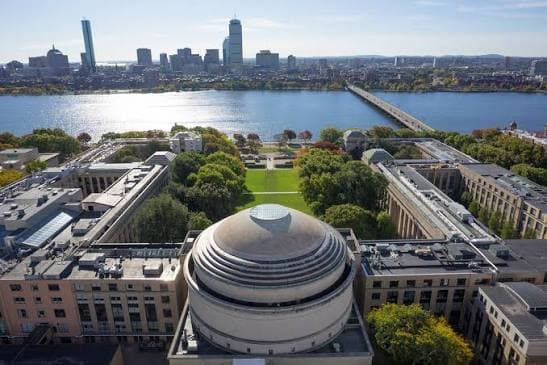
MIT's campus stretches along the Charles River in Cambridge, right across the water from downtown Boston. Harvard is about a 20-minute walk away, and Boston Logan International Airport is roughly 20 to 30 minutes by subway or taxi, which makes arriving from abroad fairly easy. The famous Great Dome and the "Infinite Corridor," a long hallway running through the main buildings, are the heart of campus.
Where you'll live
First-year undergraduates are required to live on campus, and most students stay in MIT housing for all four years. MIT's dorms are famous for their strong personalities. Some are quiet and studious, some are known for building things in the hallway at 2 am, and each has its own traditions. Before you arrive, you'll read about the dorms and rank your choices.
Housing and food are part of the estimated $93,730 cost of attendance, and if you're on aid, they're covered according to your aid package. Graduate students can apply for graduate housing, but Cambridge rents are high, so apply early.
Labs, makerspaces and libraries
MIT has hundreds of research labs, including the MIT Media Lab, the Computer Science and Artificial Intelligence Laboratory (CSAIL), and centers for energy, nanotechnology and biology. Student makerspaces let undergraduates use 3D printers, laser cutters and machine shops. One honest note: in November 2025, MIT announced it would close the Dewey and Barker libraries in June 2026 to save money after the new endowment tax, citing a $300 million budget gap (The College Fix). Other libraries stay open, and most research material is digital anyway.
Life as an international student
The MIT International Students Office (ISO) handles I-20s, visa questions, travel signatures, OPT applications and immigration updates, and it publishes detailed statistics on international students every year. With students from 138 countries, you'll find cultural groups for almost every region, including African, South Asian, Pakistani, Arab and Muslim student associations, prayer spaces on campus, and halal food nearby in Cambridge and Boston.
Honestly, the hardest adjustment for most students isn't the cold. It's the workload. MIT is famous for hard problem sets, and many students spend long nights working in groups. The good news is that first-semester grades are recorded only as pass or no record, which gives you time to adjust before letter grades count.
In the QS World University Rankings 2027, published in June 2026, MIT is number 1 in the world, ahead of Stanford and Imperial College London (tied 2nd), Oxford (4th) and Harvard (5th). That edition ranked more than 1,500 universities across 106 higher education systems (QS release via AAP, June 2026). MIT has held QS's top spot for well over a decade, which is a record no other university comes close to.
It also sits at or near the top of subject rankings for engineering, computer science, physics, mathematics, economics and architecture. Other ranking systems place it slightly differently. The Shanghai Ranking (ARWU), for example, weighs research prizes heavily and usually puts MIT in the top five. But in every major table, MIT is among the best in the world [internal link: /blog/mit-rankings].
Is an MIT degree recognized in my country?
Yes. MIT is accredited by the New England Commission of Higher Education (NECHE), the regional accreditor recognized by the US Department of Education, and many of its engineering programs are also accredited by ABET, the global standard for engineering degrees. Employers and governments around the world recognize MIT degrees. If you need formal equivalence at home later, for a government job, an engineering license, or YÖK denklik in Turkey, you'll go through that country's normal process for foreign degrees, and an MIT degree passes it without difficulty.
Getting your F-1 student visa
After you confirm your place, MIT's International Students Office issues your Form I-20. Your aid letter counts as proof of funding for the part MIT pays.
Pay the SEVIS I-901 fee online.
Complete the DS-160 visa form and book an interview at the US embassy or consulate.
Bring your passport, I-20, admission letter, financial documents and SEVIS receipt to the interview.
Students in STEM fields sometimes go through extra security screening, called administrative processing, which can add weeks or even months. Combined with long appointment waits in cities like Lagos, Abuja, Karachi and Islamabad, that's a real risk. So the day your I-20 arrives, book your visa appointment. Don't wait until summer.
Working while you study
On an F-1 visa you can work on campus up to 20 hours a week during the semester and full-time in breaks. At MIT, many undergraduates earn money through paid UROP research positions, and graduate students usually work as research or teaching assistants.
Working after MIT
After graduation, Optional Practical Training (OPT) gives you up to 12 months of work authorization in the US in your field. Because nearly all MIT degrees are in STEM, most MIT graduates can also apply for the 24-month STEM OPT extension, giving up to three years in total. That's a big advantage over non-STEM degrees. Longer-term work usually requires an H-1B visa, which became more restricted and costly for employers in 2025, so talk to the ISO before planning around it.
Careers and the MIT network
MIT graduates are recruited by top tech companies, engineering firms, banks, consulting firms, startups and research labs, and a huge number of MIT alumni have founded companies. The MIT alumni network is especially strong in technology, energy, finance and science. Many international graduates also return home to lead engineering projects, universities and startups, and an MIT degree opens doors almost anywhere in the world.
MIT went through a lot in the last two years: a new tax, research funding cuts, a political fight over a federal "compact," and big changes to graduate admissions. Here's what happened, newest first, with a reference at the end of each item so you can check it yourself.
June 2026: number 1 in the world again
The QS World University Rankings 2027 placed MIT first in the world, ahead of Stanford, Imperial, Oxford and Harvard. Reference: QS release via AAP, 17 June 2026.
May 2026: nearly 500 fewer graduate students
MIT announced it would admit nearly 500 fewer graduate students for 2026-27, close to a 20% drop compared with 2024. Federal research awards to MIT fell by more than 20% in a year. President Kornbluth said many faculty were already cutting graduate students, postdocs and projects, and that policy changes were discouraging some top international applicants. Reference: The College Investor, May 2026, summarizing the Boston Globe.
March 2026: Class of 2030 admitted
On March 14 (Pi Day), MIT released regular decisions. In total it admitted 1,299 of 28,349 applicants, about 4.6%, from 58 countries. Reference: The Tech, 19 March 2026.
December 2025: early admits and many deferrals
MIT admitted 655 of 11,883 early applicants, about 5.5%, and deferred 7,738 to the regular round. Reference: The Tech, 18 December 2025.
November 2025: library closures
MIT said it would close the Dewey and Barker libraries in June 2026, pointing to a $300 million budget gap caused by the endowment tax and federal research cuts. Reference: The College Fix, November 2025.
October 2025: MIT rejects the federal compact
On October 1, the federal government sent universities a "Compact for Academic Excellence" that, among other things, asked them to cap international undergraduates at 15%. On October 10, MIT became the first university to reject it, with President Kornbluth arguing that scientific funding should depend on scientific merit alone. For international students, this was an important signal that MIT intends to keep admitting students from everywhere. References: The Tech, 3 October 2025, The Tech, 10 October 2025.
Fall 2025: 4,030 international students
MIT's official statistics counted 4,030 international students, about 28% of the student body, from 138 countries; 529 were undergraduates. Reference: MIT International Students Office, 2025-2026.
July to September 2025: the endowment tax arrives
In July, MIT leaders warned that the new 8% endowment tax would cost about 10% of MIT's annual central budget. By September, MIT had a staff hiring freeze and many departments had reduced graduate admissions. References: MIT Provost and EVP letter, 10 July 2025, Boston Globe, 9 September 2025.
November 2024: free tuition under $200,000
MIT announced that from 2025-26, families earning under $200,000 pay no tuition and those under $100,000 pay nothing, while keeping need-blind admission for all. Reference: The Tech, 21 November 2024.
What this means for you
For undergraduates, the core promise hasn't changed: need-blind admission and full need met, even for international students. For graduate applicants, places are clearly shrinking, so apply widely. And MIT's public rejection of the 15% cap is good news for international applicants, though US visa policy still needs close attention.
Here's my honest list, with the reasoning behind each point.
Pros
Need-blind with full need met: asking for aid never affects your admission, and your need is fully covered if you get in.
Free for most families from developing countries: under $100,000 family income, you pay nothing at all.
World number 1 in QS 2027: the degree carries weight with employers and universities everywhere.
Hands-on learning and research: through UROP, most undergraduates work in real labs, often paid.
Almost every MIT degree also qualifies for the 24-month STEM OPT extension, giving you up to three years of US work experience after graduation.
Cons
Tiny number of international undergraduate seats: only 529 international undergraduates in fall 2025, so the odds are very tough.
Heavy workload: problem sets are long and hard, and stress is real, especially in the first year.
Shrinking graduate places: nearly 500 fewer graduate admits in 2026-27 makes PhD entry even harder.
Science core for everyone: all students take math, physics, chemistry and biology, which isn't ideal if you mainly want humanities.
Boston winters are also long and cold, which can be tough for students from tropical countries.
Who is MIT best for?
MIT is ideal for an international student who loves math, science and building things, and who wants to spend four years solving hard problems with other people who feel the same. It suits future engineers, computer scientists, physicists, economists and founders. It's not the right fit for a student who wants a mostly humanities education or a pre-medical degree with a hospital next door [internal link: /blog/harvard-university-international-students] [internal link: /blog/stanford-university-international-students].
universityfinder.org is a member of the Acadex University Admission Association [internal link: /acadex], a global association of admission agencies working in partnership with universities. Acadex members follow a standard admission process, a standard maximum admission time and standard application criteria. They also give every student a standard orientation that includes an introduction to the host country's laws. Only agencies with a chamber of commerce registration, references and at least five years of university partnerships can join, which protects students from scammers and unauthorized agents.
Official MIT links: MIT Undergraduate Costs · MIT International Students Office
Sources and verification
Reviewed by the universityfinder.org editorial team (Acadex University Admission Association member) on 30 September 2026. Costs checked against MIT's official catalog and registrar; each news item checked against the sources below.
MIT International Students Office: General Statistics 2025-2026
The Tech: MIT tuition-free for families under $200,000 (November 2024)
Boston Globe: MIT sees significant new financial pressures (September 2025)
The College Investor: MIT to admit fewer graduate students (May 2026)
Koç University: tuition and scholarships for international students
Yoo (2026), The Impact of Temporary Student Visa Extensions on Patenting: Evidence from STEM OPT