Columbia University for International Students: Fees, Financial Aid and Admission Guide


AI Snapshot
Columbia University for International Students: Fees, Financial Aid and Admission Guide is a private higher-education institution in USA. International students can explore its programs and apply through University Finder with free, end-to-end guidance.
Last updated: 30 September 2026
Columbia had one of the most difficult years in its history in 2025: a $400 million funding cut, a presidential resignation, a $221 million settlement with the US government, and headlines about international students being detained. And yet, for the Class of 2030, Columbia received a record 61,031 applications and admitted 2,581 students from 111 countries (Ivy Coach, 2026). Students clearly still want to study in New York.
So what does all this mean if you're looking at Columbia University for international students in 2026-2027? In short: it's still one of the best universities in the world, it's in the middle of Manhattan, and it meets full financial need for admitted international students. But it's need-aware for applicants from outside the US, it's expensive, and it comes with more political noise than most campuses.
In this guide I'll walk you through all of it, step by step: the real 2026-27 cost, how aid works, the testing rule that's about to change, deadlines, life in New York, visas, rankings, and a full, sourced account of the news from the last two years.
Quick answer (2026-2027): Columbia College and Columbia Engineering tuition for 2026-27 is $72,800, and the full estimated budget is $99,774 to $100,884. Columbia is need-aware for international applicants but meets 100% of demonstrated need for those it admits; you must request aid when you apply. The 2026-27 cycle is test-optional, but SAT or ACT will be required from the 2027-28 cycle. Verified against Columbia Financial Aid and Columbia Undergraduate Admissions, September 2026.
Columbia University key facts
Fact | Detail |
|---|---|
Type | Private research university (Ivy League) |
Location | Morningside Heights, Manhattan, New York City |
Founded | 1754 as King's College |
Undergraduate colleges | Columbia College and Columbia Engineering (SEAS), plus the School of General Studies |
International students (fall 2025) | 13,729 from 153 countries |
Class of 2030 | 2,581 admitted from 61,031 applicants (about 4.2%) |
Undergraduate tuition 2026-27 | $72,800 |
Estimated total budget 2026-27 | $99,774 to $100,884 |
Aid for international students | Need-aware admission; 100% of need met after admission |
Testing | Optional for 2026-27; SAT or ACT required from 2027-28 |
President | Jennifer Mnookin (from July 1, 2026) |
Page last verified | 30 September 2026 |
What Is Columbia University, and Why Is It So International?
Columbia was founded in 1754 as King's College, by royal charter from King George II of Britain, which makes it the oldest university in New York and the fifth-oldest in the United States. After the American Revolution it was renamed Columbia, and in 1897 it moved to its current campus in Morningside Heights, in upper Manhattan.
The easiest way to understand Columbia is this: it's a world-class university that happens to sit inside the world's most famous city. Your classroom is on 116th Street, and Wall Street, the United Nations, major hospitals, newsrooms and Broadway theaters are a subway ride away. For careers in finance, journalism, law, public policy, medicine and the arts, that location is a huge advantage.
Columbia is also one of the most international universities in the US. In fall 2025, it had 13,729 international students from 153 countries, according to its International Students and Scholars Office (Columbia ISSO). The largest groups come from China (6,372) and India (1,242), followed by South Korea, Canada and Taiwan. Most international students are in graduate programs, especially engineering and arts and sciences. Reporting on Columbia's 2025 agreement with the US government put international students at around 40% of total enrollment (KSAT / AP, July 2025).
Undergraduates are famous for the Core Curriculum, a set of shared courses in literature, philosophy, history, music, art and science that every Columbia College student takes, whatever their major. Think of it like everyone reading the same big books around the same seminar table, then arguing about them. It builds writing and discussion skills that employers love.
In January 2026, Columbia named Jennifer Mnookin, a legal scholar and former chancellor of the University of Wisconsin-Madison, as its new president, starting July 1, 2026 (ABC7 New York, January 2026). She follows two years of leadership changes, which I explain in the news section.
Columbia Pros and Cons for International Students
Here's my honest list, with a reason behind every point.
Pros
Full need met after admission: if you're admitted with aid, Columbia covers 100% of your demonstrated need, mostly with grants.
New York City: internships and jobs in finance, media, law, tech and international organizations are all within reach.
The Core Curriculum: shared seminars in great books, art and ideas build writing and argument skills employers value.
Test-optional this year: applicants for fall 2027 entry can still choose whether to send the SAT or ACT.
Columbia's journalism, international affairs, law and financial engineering programs are also among the most respected in the world.
Cons
Need-aware for internationals: asking for aid lowers your admission odds, and Early Decision applicants needing aid may be deferred.
Very high cost: the total budget passes $100,000 a year, and New York living costs are among the highest anywhere.
No aid later: if you don't request aid when you apply, you can't ask for it afterwards.
Political scrutiny: the 2025 agreement adds vetting for international applicants and a goal of relying less on international enrollment.
And Early Decision is binding, which is risky for any family that needs to compare aid offers.
Who is Columbia best for?
Columbia suits an international student who wants a serious liberal arts or engineering education inside a global city, loves reading, writing and debate, and wants a career in finance, media, policy, law or tech. It's a great fit if your family can pay, or if your application is strong enough to win a need-aware aid place. If aid is essential and you want the safest aid policy, need-blind schools like Harvard, Yale or MIT may be better targets
Columbia vs Koç University vs Sabancı University: A Comparison for International Students
Columbia's biggest selling points are a big-city location and a strong liberal arts core. Istanbul offers something similar: a global city of over 15 million people, where Koç University and Sabancı University teach in English and actively recruit international students. Here's how the three compare.
Columbia University | Koç University | Sabancı University | |
|---|---|---|---|
City | New York City, USA | Istanbul, Türkiye | Istanbul, Türkiye |
Type | Private (Ivy League) | Private foundation university | Private foundation university |
Teaching language | English | English | English |
Entrance tests for international applicants | Test-optional for 2026-27; SAT or ACT required from 2027-28 | SAT and other international exams | SAT, ACT, GCE A-Levels or TR-YÖS |
Aid model | Need-aware admission, 100% of need met after admission | Merit scholarships of 100%, 75%, 50% or 25% of tuition | Merit-based scholarships by academic record and quota |
Undergraduate cost 2026-27 | $72,800 tuition; about $100,000 total budget before aid | Set yearly in USD; confirm with admissions | Set yearly in USD; confirm with admissions |
Early round | Binding Early Decision | Not applicable | Not applicable |
Sources: Columbia Financial Aid, Columbia Undergraduate Admissions, Koç University international tuition and scholarships, Sabancı University 2026-2027 application requirements, checked September 2026. Koç and Sabancı hadn't published 2026-27 international fee amounts on these pages when checked.
The first difference is how money affects your chances. At Columbia, asking for aid can reduce your odds, but if you're admitted, the aid is generous. Koç and Sabancı work differently. There, scholarships reward your academic results, so a strong SAT or A-Level profile can win up to 100% off tuition without your family's income playing any role in admission.
The second is cost of living. New York is among the most expensive cities in the world, while Istanbul, though rising, is still far cheaper for rent, food and transport. For a self-funded student, that difference alone can be tens of thousands of dollars a year.
The third is risk. Columbia's Early Decision is binding, and the 2025 agreement adds extra vetting for international applicants. The Turkish universities give you a more predictable path with a clear scholarship outcome. My advice: if Columbia is your dream, apply, ideally in Regular Decision if you need aid. But put a strong Istanbul option like Koç or Sabancı on the same list.
What the Research Says About International Students, Policy Stress and Wellbeing
After everything that happened at Columbia in 2025, a fair question is: how do immigration pressures actually affect international students, and what helps? Two recent peer-reviewed studies give useful answers.
A 2026 study by Naseh and colleagues in the Journal of Immigrant and Minority Health interviewed 36 international graduate students from 15 countries across the US. It found that restrictive and changing immigration policies act as social determinants of health: they caused real stress and harmed wellbeing, while social support and careful planning helped students cope. Participants called for more consistent and transparent visa and work-authorization processes. (Naseh et al., 2026)
A 2025 study by Chaliawala and colleagues in the Journal of International Students, using National College Health Assessment data, found that about 82.7% of international students reported moderate to high psychological wellbeing. Students with high resilience were about seven times more likely to report good wellbeing, while high stress sharply lowered it. (Chaliawala et al., 2025)
What does this mean for you? Most international students do well, even in difficult years, and the ones who cope best build support around them early. At Columbia, that means using ISSO's advising, joining student communities from home, and asking for help before a small worry becomes a big one. From what I've seen with students at universityfinder.org, the ones who connect with an international student office in their first week feel far more secure all year.
Your Next Step
Here's the honest bottom line on Columbia University for international students. Academically, it's world-class, and if you're admitted with aid, Columbia covers your full need. But because it's need-aware, very expensive and binding in its early round, you need a careful strategy: decide early whether you need aid, use Regular Decision if you must compare offers, and build a balanced list around it.
That's exactly where universityfinder.org can help. We have a free university matching tool: share your grades, budget and the program you want, and we'll suggest universities that really fit you, in the US, Europe, Turkey and beyond. No fees, no pressure, just a clearer list.
Columbia is made up of undergraduate colleges and a long list of graduate and professional schools. Here are the ones international students ask about most.
School | Level | Known for |
|---|---|---|
Columbia College | Bachelor's (BA) | Liberal arts with the Core Curriculum |
Fu Foundation School of Engineering and Applied Science (Columbia Engineering) | Bachelor's, master's, PhD | Computer science, data science, financial engineering, operations research |
School of General Studies | Bachelor's | For students who took a break in their education, including many older and international students |
Graduate School of Arts and Sciences | Master's, PhD | Economics, statistics, sciences, humanities |
Columbia Business School | MBA, master's | Finance and New York business links |
School of International and Public Affairs (SIPA) | MIA, MPA | International affairs and development |
Columbia Law School | JD, LLM | LLM very popular with international lawyers |
Graduate School of Journalism | MS, MA | One of the world's most famous journalism schools |
Mailman School of Public Health | MPH, PhD | Global health and epidemiology |
Vagelos College of Physicians and Surgeons | MD, PhD | Medicine, linked to major New York hospitals |
Undergraduate study
If you apply as a first-year, you choose between Columbia College and Columbia Engineering on the same application. Columbia College students take the Core Curriculum plus a major, from economics to computer science. Engineering students take a smaller Core alongside a technical program. Either way, you share the same campus, dorms and New York life.
Popular majors include economics, computer science, political science, financial engineering, operations research, and neuroscience. Many students also take advantage of Barnard College, Columbia's affiliated women's college across the street, for cross-registration.
And like other US universities, Columbia has no undergraduate medicine or law degree. Those are graduate degrees in the US [internal link: /blog/study-medicine-abroad].
Graduate programs popular with international students
Columbia Engineering's master's programs in computer science, data science and financial engineering attract thousands of international students, as does SIPA's Master of International Affairs. The Law School's LLM and the Journalism School are also strong draws. Most of these master's programs are self-funded, so cost planning matters a lot more at graduate level than for undergraduates.
Columbia charges international undergraduates the same tuition as Americans. The difference is in how aid is decided, which I'll explain in the next section. First, the real numbers for 2026-27.
Undergraduate cost of attendance 2026-27 (living on campus)
Item | First-year student | Continuing student |
|---|---|---|
Tuition | $72,800 | $72,800 |
Fees | $4,160 | $3,430 |
Housing | $12,522 | $13,904 |
Food | $7,128 to $7,586 | $7,128 to $7,586 |
Books and supplies | $1,320 | $1,320 |
Personal expenses | $1,844 | $1,844 |
Total budget, before travel | $99,774 to $100,232 | $100,426 to $100,884 |
Source: Columbia Financial Aid, 2026-2027 Cost of Attendance, checked September 2026. First-year fees are higher because of one-time orientation charges.
So yes, the full budget passes $100,000 a year for many students. That's a lot of money. Columbia's travel allowance covers two round-trip flights and ranges from $944 to $1,254 for domestic distances, but a flight from Lagos, Karachi or Delhi to New York usually costs more than that, so budget the difference yourself.
New York is also one of the most expensive cities in the world. Coffee, transport and weekends out cost more than almost anywhere else. The good news is that on-campus housing and a meal plan are already inside the budget above, and they're covered by aid if you receive it.
Graduate tuition
Each Columbia graduate school sets its own tuition, and most professional master's programs, such as engineering MS degrees, SIPA, journalism, business and law, are expensive and often mainly self-funded for international students. PhD programs in the Graduate School of Arts and Sciences and Engineering are usually fully funded with a stipend. Always check the cost page of your exact program [internal link: /blog/columbia-tuition-fees-2026-2027].
That said, the sticker price isn't what most undergraduates pay. The average financial aid award for students who receive aid is about $79,375 a year (Columbia Undergraduate Admissions). Let's look at how that works for international students.
This is the part of Columbia University for international students that families most need to understand. Aid works in two steps. Each step has its own rule.
Step 1: applying (need-aware)
For US citizens, Columbia is need-blind. For international applicants, it's need-aware, meaning your financial need is considered during the admission review (Columbia Financial Aid). Columbia also notes that competitive international applicants who ask for aid in Early Decision may be deferred to the Regular Decision round (Columbia Undergraduate Admissions). In plain words: asking for aid makes admission harder, because Columbia has a limited international aid budget.
Step 2: once you're admitted (full need met)
Here's the good news. If you're admitted with aid, Columbia meets 100% of your demonstrated need (Columbia Financial Aid). Aid comes mainly as grants you don't repay, plus a small work-study part. The average award is about $79,375 a year, and around half of the admitted Class of 2030 received financial aid offers (Columbia Undergraduate Admissions; Ivy Coach).
For a student from a low- or middle-income family in Nigeria, Pakistan or Bangladesh, a full-need package can mean paying very little, sometimes close to nothing beyond personal costs.
The rule you can't ignore
If you're admitted without requesting aid, you can't switch later and apply for it, not in your first year and not after (Columbia Undergraduate Admissions). I've seen families hide their need to look "stronger," then face an impossible bill in year two. Please don't do that. Be honest from the start. If your family can't realistically pay over $100,000 a year for four years, ask for aid when you apply.
What about merit scholarships?
Columbia doesn't give merit scholarships to undergraduates. All undergraduate aid is need-based. For graduate study, some schools offer fellowships, and external funding such as government scholarships from your home country, Fulbright or employer sponsorship is common.
How does this compare with other universities? It's similar to Stanford, which is also need-aware for international students but meets full need after admission. Harvard, Yale and MIT work differently, since they're need-blind for international applicants
Columbia acceptance rate for international students
For the Class of 2030, Columbia College and Columbia Engineering admitted 2,581 of a record 61,031 applicants, an acceptance rate of about 4.23%, with admitted students from 111 countries. The year before, the Class of 2029 rate was 4.29%, from 59,616 applicants (Ivy Coach, 2026). Columbia is also growing its undergraduate classes by 125, then 200, then 250 students, which slightly increases the number of seats over the next few years. There's no separate international rate published, and because admission is need-aware for international students, the odds are tougher if you ask for aid.
What you need to submit
The Common Application or Coalition Application, including Columbia's own questions: short essays and lists about what you read, what you care about and why Columbia.
Transcripts from your secondary school, translated into English where needed, and later a midyear report.
Counselor recommendation and school report.
Two teacher recommendations.
The testing rule, and the change coming in 2027
For the 2026-2027 cycle (students entering in fall 2027), Columbia College and Columbia Engineering remain test-optional. But in June 2026, Columbia announced that the SAT or ACT will be required starting with the 2027-2028 cycle, for fall 2028 entry, with waivers possible for applicants who genuinely can't test (Columbia Undergraduate Admissions, June 2026). That makes Columbia the last Ivy League school to bring testing back (Bloomberg Law, June 2026).
So what should you do? If you're applying this year and you have a strong SAT, send it. It helps, especially for international applicants whose school grades may be hard to compare. If you're in grade 10 or 11 now, plan to take the SAT, because you'll need it.
Do you need IELTS or TOEFL for Columbia?
If English isn't your first language and your school doesn't teach in English, Columbia expects you to show English proficiency, usually through TOEFL, IELTS or the Duolingo English Test. Check the current requirement and recommended scores on Columbia's international applicants page before you book a test. Graduate programs have their own, usually strict, English minimums.
What Columbia looks for
Columbia is looking for students who'll use New York and the Core Curriculum well: intellectually curious readers and thinkers who engage with the world. Your Columbia-specific lists, like books you've read and events you follow, matter more than students expect. Honestly, from what I've seen at universityfinder.org, applicants who fill those lists with real, personal choices, not just famous titles, come across far more convincingly.
Columbia Application Deadlines 2026-2027 (Fall 2027 Entry)
Columbia College and Columbia Engineering admit first-year students for the fall term. There are two rounds:
Round | Application deadline | Decision | Notes |
|---|---|---|---|
Early Decision (ED) | November 1, 2026 | Mid-December 2026 | Binding: if admitted, you must attend |
Regular Decision (RD) | January 1, 2027 | Late March 2027 | Most international applicants seeking aid use this round |
Financial aid documents | Around your round's deadline | With your decision | Aid must be requested at application stage |
Reply to offer | May 1, 2027 | Confirm enrollment | |
Arrival | Late August 2027 | Start visa steps immediately after admission |
Dates follow Columbia's usual calendar; last cycle's admissions decisions for the Class of 2030 were announced in late March 2026 (Columbia Engineering, 30 March 2026). Confirm current dates on Columbia's admissions site before submitting.
Early Decision: think very carefully
Columbia's early round is Early Decision, which is binding. If you're admitted, you must withdraw your other applications and attend. That's a big deal for international students who need aid. Think of it like signing a contract before you've seen the price. Columbia says international students are welcome to apply ED, but those who need aid may be deferred to the regular round because of need-aware review (Columbia Undergraduate Admissions).
My honest advice: apply ED only if Columbia is clearly your first choice and your family can accept whatever aid package Columbia offers. If you need to compare aid offers from several universities, Regular Decision is the safer path.
Simple timeline
Grade 10 or 11: take the SAT, since it's optional this year but required from next year.
Summer before final year: start your Common App essay and Columbia's lists and short answers.
September to October: request recommendations and prepare financial documents and translations.
November 1 (ED) or January 1 (RD): submit, and tick the financial aid box if you need aid.
If you're admitted, request your I-20 right away and book a visa appointment that same week.
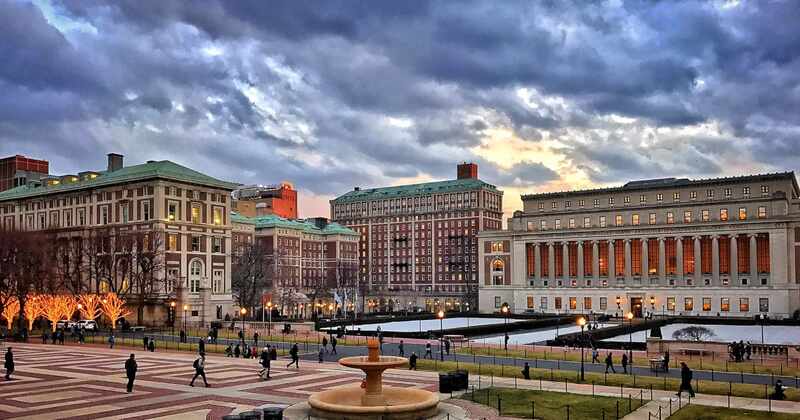
Columbia's main campus is in Morningside Heights, on the Upper West Side of Manhattan, around 116th Street and Broadway. The 1 subway line stops right at the gates and takes you to Times Square in about 20 minutes. JFK and Newark airports are the usual arrival points for international students, roughly 45 to 60 minutes away. Columbia's newer Manhattanville campus a few blocks north houses the Business School and major science buildings.
Where you'll live
Columbia guarantees housing for undergraduates in Columbia College and Columbia Engineering, and first-years live together in residence halls around the South Lawn. Housing ($12,522 for first-years) and food are part of the cost of attendance, so if you receive aid, they're covered by your package. That guarantee matters a lot in New York, where renting a small apartment near campus can easily cost several thousand dollars a month.
Graduate students can apply for Columbia housing, but spaces are limited and many rent in the neighborhood or in upper Manhattan. Start early, and be very careful with rental scams [internal link: /blog/cost-of-living-in-new-york-for-students].
Libraries and resources
Columbia's libraries, led by Butler Library, hold millions of volumes, and students also have access to museums, galleries and research centers all over the city, often free with a Columbia ID. The Center for Career Education, the Columbia Entrepreneurship programs and labs in engineering, data science and medicine give students plenty to join.
Life as an international student
The International Students and Scholars Office (ISSO) issues I-20s, answers visa questions and provides immigration updates. During the difficult 2025 period, Columbia says ISSO offered I-20 processing with a 24-hour turnaround, phone support seven days a week, and more than $500,000 in hardship grants for students facing unexpected visa or travel costs. More than 1,000 new international students joined its welcome event in September 2025 (Columbia Office of the President, October 2025).
New York is one of the most diverse cities on earth. You won't feel alone here. You'll find Nigerian, Ghanaian, Pakistani, Indian, Bangladeshi, Arab and Turkish communities, halal food on almost every corner, mosques across the city, and student groups for nearly every culture on campus. Winters are cold, so pack or buy a proper coat. But the city's energy makes up for it, and many international students say it's the best part of studying at Columbia.
Columbia's ranking depends a lot on which table you look at, and it's worth understanding why. In the QS World University Rankings 2027, Columbia isn't among the ten highest-ranked US universities; that list runs from MIT, Stanford and Harvard down to Berkeley and the University of Chicago (QS Insights, 2026). QS gives heavy weight to research citations per faculty member and to reputation surveys, and Columbia's size and structure play differently in that formula.
In US-focused rankings and in many subject tables, Columbia usually sits much higher. Its programs in journalism, international affairs, law, business, public health, economics and engineering fields like operations research and financial engineering are among the most respected in the world. So don't judge Columbia by one overall number. Look at the ranking for the subject you actually want to study [internal link: /blog/columbia-rankings].
Is a Columbia degree recognized in my country?
Yes. Columbia is accredited by the Middle States Commission on Higher Education (MSCHE), the regional accreditor recognized by the US Department of Education, and its engineering programs are accredited by ABET where applicable. Governments, employers and universities worldwide respect Columbia degrees. If you need official equivalence at home later, for example through your education ministry or YÖK denklik in Turkey, you'll follow that country's usual process for foreign degrees, and a Columbia degree passes it without difficulty.
Getting your F-1 student visa
After you accept your offer, Columbia's ISSO issues your Form I-20. Your aid letter counts as proof of funding for the part Columbia pays.
Pay the SEVIS I-901 fee online.
Complete the DS-160 visa form and book an interview at the US embassy or consulate in your country.
Bring your passport, I-20, admission letter, financial documents and SEVIS receipt to the interview.
Visa appointment waits in Lagos, Abuja, Karachi, Islamabad and parts of India can be very long, and screening became stricter in 2025. As part of its July 2025 agreement with the US government, Columbia also agreed to add questions to its application process asking international applicants about their reasons for wanting to study in the US, and to share certain disciplinary information about visa holders with the government (KSAT / AP, July 2025). Answer those questions honestly and thoughtfully.
Staying safe with your visa status
I'll be honest here, because it matters. In 2025, several international students and recent graduates connected to campus protests faced immigration action, and one case at Columbia made global headlines (see the news section). You have every right to your opinions. But as an international student, you should understand the rules of your visa status, know your rights, and use ISSO's advising and legal resources whenever you're unsure about anything.
Working while you study
F-1 students can work on campus up to 20 hours a week during term and full-time during breaks. Columbia's size means there are many campus jobs, and work-study is often part of undergraduate aid packages.
Working after Columbia
After graduation, Optional Practical Training (OPT) gives up to 12 months of US work authorization in your field. STEM graduates, such as those in engineering, computer science, data science, statistics or economics with a STEM designation, can add a 24-month STEM extension. New York is one of the best cities in the world to use OPT, with jobs in finance, consulting, tech, media, law and international organizations. Longer-term work usually requires an H-1B visa, which became more restricted and costly in 2025, so plan with ISSO.
Careers and the Columbia network
Columbia's alumni include US presidents, Supreme Court justices, Nobel laureates, Pulitzer Prize winners and leaders across finance, media and government worldwide. For international students, the combination of an Ivy League degree and years of New York experience is a strong base for a career at home or abroad.
No US university was in the news more than Columbia over the last two years. Some of it directly affects international students, so here's a clear, sourced summary, newest first. Every item ends with its reference so you can check it yourself.
June 2026: SAT or ACT required again from 2027-28
On June 12, 2026, Columbia announced that Columbia College and Columbia Engineering will require the SAT or ACT from the 2027-2028 admissions cycle, after staying test-optional for 2026-27. A faculty review found test scores a useful indicator of student success. Columbia was the last Ivy League school to make this change. References: Columbia Undergraduate Admissions, June 2026, Bloomberg Law, June 2026.
March 2026: record applications for the Class of 2030
Columbia admitted 2,581 students from a record 61,031 applications, about 4.23%, with admits from 111 countries. It's also the first class admitted after Columbia decided to expand its undergraduate enrollment in stages. References: Columbia Engineering, 30 March 2026, Ivy Coach, 2026.
January 2026: a new president
Columbia named Jennifer Mnookin, chancellor of the University of Wisconsin-Madison and a former UCLA law dean, as president from July 1, 2026. She follows Nemat Shafik, who resigned in August 2024, Katrina Armstrong, who stepped down in March 2025, and acting president Claire Shipman. Reference: ABC7 New York, 26 January 2026.
October 2025: support for international students
Columbia reported that nearly all international students who chose Columbia had arrived for fall 2025. It had paid more than $500,000 from an International Student Hardship Fund since April, offered 24-hour I-20 processing and seven-day phone support, and welcomed over 1,000 new international students. Reference: Columbia Office of the President, 8 October 2025.
July 2025: the $221 million settlement
On July 24, 2025, Columbia agreed to pay $200 million to the federal government over three years, plus $21 million to settle civil rights claims, to restore federal research funding, including more than $400 million in grants canceled earlier that year. The agreement includes new vetting questions for international applicants, sharing of certain disciplinary records for visa holders, and a commitment to reduce financial dependence on international student enrollment, which reports put at about 40% of Columbia's students. Reference: KSAT / AP, 24 July 2025.
March to June 2025: the Mahmoud Khalil case
In March 2025, immigration agents arrested Mahmoud Khalil, a recent Columbia graduate student, green card holder and pro-Palestinian activist, and held him in a Louisiana detention center for more than three months. A federal judge ordered his release on June 20, 2025. The case became a global symbol of the risks international students faced during this period. Reference: ABC7 News, June 2025.
March 2025: $400 million in grants canceled, and a stable applicant pool
The federal government canceled about $400 million in Columbia's research funding in March 2025, and President Armstrong stepped down later that month. Even so, Columbia received 59,616 applications for the Class of 2029, down only 1%, and admitted 4.3%. References: ABC7 New York, Yahoo News / AP.
What this means for you
Columbia is academically as strong as ever, and demand from students worldwide actually grew. But the 2025 agreement brings more vetting for international applicants and a stated goal of relying less on international enrollment, which could matter for graduate programs in particular. Apply with clear eyes, stay close to ISSO once you're admitted, and know your rights as a visa holder.
Is Columbia need-blind for international students? No. Columbia is need-blind for US citizens but need-aware for international applicants, so asking for financial aid is considered in the admission decision.
Does Columbia give full financial aid to international students? Yes, to those it admits with aid. Columbia meets 100% of demonstrated need for admitted international students, mostly through grants, with an average award of about $79,375 a year.
How much does Columbia cost for international students in 2026-2027? Tuition for Columbia College and Columbia Engineering is $72,800. The full budget, including fees, housing, food, books and personal costs, is about $99,774 to $100,884 before travel and before aid.
What is Columbia's acceptance rate for international students? Columbia doesn't publish a separate international rate. Overall, it admitted about 4.23% of applicants for the Class of 2030 (2,581 of 61,031), from 111 countries.
Does Columbia require the SAT for international students? Not for the 2026-2027 cycle, which is test-optional. From the 2027-2028 cycle, the SAT or ACT will be required, with waivers for applicants who genuinely can't test.
Can international students apply Early Decision to Columbia? Yes, but Early Decision is binding, and international applicants who need aid may be deferred to Regular Decision. If you need to compare aid offers, Regular Decision is usually safer.
Can I apply for financial aid after being admitted to Columbia? No. International students admitted without requesting aid can't switch to aid later, so request it when you apply if you might need it.
Is it safe for international students at Columbia after 2025? Columbia has expanded support, including fast I-20 processing, seven-day advising and hardship grants, and nearly all its international students arrived for fall 2025. The political climate has been tense, so know your visa rules and stay in close contact with ISSO.
Columbia or NYU: which is better for international students? Both are in New York and expensive. Columbia offers stronger need-based aid for admitted students and the Core Curriculum. NYU is larger with more campus locations around the world. Your choice depends on your program, aid situation and preferred learning style
universityfinder.org is a member of the Acadex University Admission Association , a global association of admission agencies working in partnership with universities. Acadex members follow a standard admission process, a standard maximum admission time and standard application criteria. They also give every student a standard orientation that includes an introduction to the host country's laws, something that matters a lot after 2025. Only agencies with a chamber of commerce registration, references and at least five years of university partnerships can join, which protects students from scammers and unauthorized agents.
Official Columbia links: Columbia Undergraduate Admissions · Columbia Financial Aid: Cost of Attendance · Columbia ISSO
Sources and verification
Reviewed by the universityfinder.org editorial team (Acadex University Admission Association member) on 30 September 2026. Costs checked against Columbia's official financial aid pages; each news item checked against the sources below.
Columbia Financial Aid: Aid philosophy and international applicants
Columbia Undergraduate Admissions: International Financial Aid
Columbia Undergraduate Admissions: Testing Policy Update (June 2026)
Columbia Office of the President: Supporting Our International Student Community (October 2025)
Columbia Engineering: Class of 2030 admissions decisions (March 2026)
Yahoo News / AP: Columbia applications for the Class of 2029
ABC7 New York: Columbia names Jennifer Mnookin president (January 2026)
Bloomberg Law: Columbia returns to standardized testing (June 2026)
QS Insights: US performance in the QS World University Rankings 2027
Koç University: tuition and scholarships for international students