Studying at Brown as an International Student: What the Open Curriculum Really Means for You

AI Snapshot
Studying at Brown as an International Student: What the Open Curriculum Really Means for You is a private higher-education institution in USA. International students can explore its programs and apply through University Finder with free, end-to-end guidance.
Last updated: 1 October 2026
There's a story that gets passed around in WhatsApp groups and student forums from Lagos to Lahore: Brown is the "easy" Ivy, the one where you can skip the hard subjects and still graduate. It's a myth, and a harmful one, because it makes strong applicants, including many Brown University international students, underestimate what Brown actually asks of them.
What Brown really has is the Open Curriculum. There are no general education requirements. Nobody forces you to take a set list of science, language or writing courses. Instead, you design your own education, with advisers, and you take full responsibility for it. That freedom is real. So is the competition to get in: for the Class of 2030, Brown admitted 2,564 of 47,937 applicants, about 5.3%, and international applications rose 16% in a single year (Brown University, March 2026).
And here's the part that matters most for families outside the US. Starting with the Class of 2029, Brown became need-blind for international applicants. Your family's finances no longer count against you, and Brown meets full demonstrated need if you apply for aid when you apply for admission (Brown Admission).
This guide explains what studying at Brown as an international student really involves: how the Open Curriculum works day to day, what it costs in 2026-27, the very high English scores Brown asks for, and the events of the last two years that shaped the university.
Quick answer (2026-27): Brown's tuition for 2026-27 is $74,568, and the full estimated budget is about $99,984. Since the Class of 2029, Brown is need-blind for international applicants and meets full need for those who apply for aid at the same time as admission. The SAT or ACT is required, and non-native English speakers need scores such as IELTS 8.0 or TOEFL 105 (pre-2026 scale). Checked against Brown University and The Brown Daily Herald, October 2026.
Brown at a glance
Founded | 1764, Providence, Rhode Island |
Signature | Open Curriculum: no general education requirements |
Class of 2030 | 2,564 admitted of 47,937 (about 5.3%) |
International aid | Need-blind since the Class of 2029; full need met |
Tuition 2026-27 | $74,568 |
Estimated budget 2026-27 | About $99,984 |
Testing | SAT or ACT required |
English tests | IELTS 8.0, TOEFL 105 or 5.5 (new scale), Duolingo 130 |
Special programs | PLME (8-year medical track), Brown-RISD Dual Degree |
Last checked | 1 October 2026 |
Brown in Brief: A Small Ivy on a Hill in Providence
Brown was founded in 1764, which makes it the seventh-oldest college in the United States. It was the first in the country to accept students regardless of religious affiliation. The campus sits on College Hill in Providence, the capital of Rhode Island, a compact, walkable city about an hour from Boston by train.
Compared with Cornell or Columbia, Brown is small and undergraduate-centered. The undergraduate college has a little over 7,000 students, and most classes are taught by faculty rather than assistants. Graduate and medical students are there too, through the Graduate School, the School of Engineering, the School of Public Health and the Warren Alpert Medical School, but the culture is shaped by undergraduates.
The international picture is changing fast. When Brown announced the move to need-blind admission in January 2024, about 40% of international first-years were already receiving Brown aid (The Brown Daily Herald, January 2024). Brown's community raised $120 million to make the switch possible, and the university set a goal of raising $100 million more. Since then, international applications have kept climbing, including a 16% jump for the Class of 2030.
Leadership is in transition. Christina Paxson, president since 2012, announced in August 2026 that she'll step down at the end of the academic year, saying she had stayed an extra year to steer Brown through a federal funding freeze (GV Wire, August 2026). Her successor hadn't been announced when this guide was checked.
Concentrations, the PLME and the Brown-RISD Dual Degree
Brown offers more than 80 concentrations, and students can also design their own Independent Concentration if no existing one fits. Among international students, computer science, economics, applied mathematics, biology, engineering, international and public affairs, and neuroscience are especially popular. Engineering at Brown leads to a Bachelor of Science (ScB), and engineering students have more required courses than most, though they still enjoy the Open Curriculum outside their concentration.
PLME: medicine from day one
Here's something rare in the US. The Program in Liberal Medical Education (PLME) is an eight-year track that combines a Brown undergraduate degree with an MD from the Warren Alpert Medical School. Students admitted to the PLME don't have to apply to medical school separately after their bachelor's. For the Class of 2030, 64 students were admitted to the PLME (Brown University, March 2026). International students may apply through the Common Application, as the PLME's own site confirms (PLME); ask the admission office about aid for the medical-school years before you commit.
This matters because most US universities offer no direct route into medicine for high school graduates. For an ambitious student who wants to become a doctor and also have a broad education, the PLME is one of very few options of its kind.
Brown-RISD Dual Degree: art plus academics
Brown also runs a five-year Brown-RISD Dual Degree with the Rhode Island School of Design, one of the world's leading art and design schools, just down the hill. Students finish with a Brown bachelor's degree (BA or ScB) and a RISD Bachelor of Fine Arts. Admission is separate and very selective, and it suits students who are serious about both a creative field and an academic one, for example industrial design and engineering, or painting and literature.
Graduate study
At graduate level, international students often choose Brown's master's and PhD programs in engineering, computer science, data science, public health and the humanities. PhD students are generally funded; most master's programs are self-funded, so plan your budget carefully.
Brown or an Innovative Istanbul University? MEF, Kadir Has and Bilgi Compared
If what draws you to Brown is the idea of an education that doesn't follow the usual script, it's worth knowing that some private universities in Istanbul are built around similar thinking. MEF University teaches its whole curriculum through a flipped-classroom model. Kadir Has University and Istanbul Bilgi University are known for interdisciplinary programs, English-medium teaching and strong links to Istanbul's creative and business life. Here's how they line up against Brown for an international student.
Brown University | MEF University | Kadir Has University | Istanbul Bilgi University | |
|---|---|---|---|---|
City | Providence, USA | Istanbul (Maslak) | Istanbul (Cibali, Golden Horn) | Istanbul (santralistanbul and other campuses) |
What makes teaching different | Open Curriculum: no general education requirements | World's first university to use the flipped classroom across the whole institution | Interdisciplinary, English-medium programs | English-medium programs with an English preparatory year |
Teaching language | English | English (Law about 30% English) | English | English and Turkish, depending on program |
International tuition | $74,568 in 2026-27 | Confirm with admissions | $20,000 a year, as listed on its international fees page | Published in a 2026-27 international fee schedule |
Aid for international students | Need-blind; full need met | Confirm with admissions | Scholarship program for qualified international students | Need-based or merit-based discounts |
Notable quality marks | NECHE; ABET for engineering | ABET for all engineering departments; full 5-year YÖKAK accreditation (March 2025) | YÖK-registered foundation university | YÖK-registered foundation university |
Sources: Brown University, Brown Admission, MEF University overview (Wikipedia), Kadir Has University international tuition and scholarships, Istanbul Bilgi University tuition and fees, checked October 2026. Where a university didn't publish a 2026-27 figure on these pages, we say so rather than guess.
Freedom versus structure
Brown gives you the most freedom of the four: you choose almost every course outside your concentration. The Istanbul universities keep a more traditional structure where you join a program from the start, but they change how you learn. At MEF, for example, you study the material before class, and class time is spent on projects and discussion. For a student who wants active, hands-on learning but also a clear path to a degree, that can be a comfortable middle ground.
Cost and certainty
Brown's need-blind aid can make it close to free for a low-income family, but only about 5 in 100 applicants get in. Kadir Has lists a clear $20,000 annual tuition with scholarships for strong applicants, and Bilgi offers need-based or merit-based discounts. If your family needs a firm budget before deciding, the Istanbul options are far easier to plan around.
English requirements
Brown's IELTS 8.0 minimum is one of the highest you'll meet anywhere. Bilgi and other Istanbul universities offer an English preparatory year, so a strong student who's still building their English can start there and move into their degree a year later. If you're also weighing other US options with a liberal arts spirit, see our guides to [internal link: /blog/yale-university-international-students] and [internal link: /blog/princeton-university-international-students]; for more Istanbul choices.
Does Curricular Freedom Actually Help? What Research Shows
Brown's Open Curriculum rests on a bold idea: students learn best when they choose. Is there evidence for that? Most research on curricular freedom comes from European liberal arts and sciences programs, which work in a similar spirit, and two recent studies by Teun Dekker are especially useful.
In a 2020 study in The Curriculum Journal, Dekker interviewed 59 students from 13 European liberal arts programs about how they experienced freedom of choice. The students overwhelmingly saw it as a chance to try out different disciplines to find what they enjoyed most. That eventually led to tailored choices, but the path was more winding than educators often assume. (Dekker, 2020)
A 2024 follow-up in Tertiary Education and Management looked at generic skills, the transferable abilities employers value, like communication and critical thinking. Students identified three features as key to developing those skills: a multidisciplinary curriculum with real freedom of choice, active student-centred teaching, and a strong academic community. (Dekker, 2024)
So what's the takeaway? Freedom works best with support. The meandering path Dekker describes is normal, and it's exactly why Brown pairs every first-year with faculty and peer advisers. If you choose Brown, use those advisers early and often, and expect your first year to involve some exploring before your direction becomes clear.
Every Ivy has its own personality, and Brown's is unusually clear. These are the points that matter most for Brown University international students specifically.
Strengths
Need-blind aid since the Class of 2029: asking for help no longer affects your chances, and full need is met.
Real academic freedom: no general education requirements, optional pass/fail grading and self-designed concentrations.
A direct medical track: the eight-year PLME is open to international applicants, which is rare in the US.
Art and academics together: the Brown-RISD Dual Degree links a top research university with a top design school.
Brown's smaller size also means faculty teach undergraduates directly, and classes tend to be more personal than at large research universities.
Trade-offs
Very high English minimums: IELTS 8.0 or TOEFL 105 on the old scale is tougher than most universities ask.
Freedom needs discipline: without a plan, a transcript can become scattered and STEM OPT eligibility can be affected by your concentration choice.
Binding Early Decision: you can't compare offers if you apply early.
A difficult recent period: leadership change, funding battles and the December 2025 shooting all left their mark.
Providence is also smaller and quieter than New York or Boston, which some students love and others find limiting.
Who should apply
Brown fits an international student who knows how to motivate themselves, enjoys connecting different subjects, and wants professors who know their name. It's ideal for future researchers, entrepreneurs, doctors through the PLME and creative students through Brown-RISD. If you'd rather follow a fixed program with clear steps from day one, a more structured university may serve you better .
Most universities, in the US and elsewhere, hand you a list of compulsory subjects. In Turkey, Nigeria or Pakistan, you usually choose a department on day one and follow its fixed program. Brown's Open Curriculum, introduced in 1969, works the other way around.
The three things it actually removes
No general education requirements. You aren't required to take a set number of courses in science, humanities or social science.
No core list. There's no shared reading list everyone must complete.
Optional pass/fail grading. You can take any course on a Satisfactory/No Credit basis, which encourages you to try a subject you'd normally avoid.
What it doesn't remove
You still need to complete a concentration (Brown's word for major) with its own required courses. You must also show competence in writing during your time at Brown. And you need to pass enough courses to graduate, normally 30 over four years. So freedom is wide, but it isn't endless.
How it feels in your first year
Imagine a first-year student from Kano who arrives planning to study computer science. In her first semester she takes an introductory CS course, a class on African history, a beginner's course in Portuguese and a philosophy seminar on ethics and technology. Nobody required any of those. By her second year she's combining computer science with economics, because a professor in that ethics seminar opened a door she didn't know existed. That's the Open Curriculum working as intended.
The flip side is that nobody plans your education for you. Brown gives each first-year a faculty adviser and a peer adviser, but you're expected to build a sensible path yourself. Students who drift without a plan can end up with a scattered transcript. Those who use the freedom well graduate with combinations, like neuroscience plus music, or applied math plus public policy, that a rigid system would never allow.
Who it suits
If you already know what fascinates you and you like making your own decisions, the Open Curriculum is a gift. If you prefer clear rules, fixed timetables and being told exactly what to study, Brown may feel uncomfortable at first. Neither is better. It's about fit, and the research section later in this guide looks at what students in open programs actually experience.
Brown announced its 2026-27 charges on February 9, 2026. Tuition rose 4%, and total tuition and fees rose 4.25% (Brown University, February 2026). International students pay the same rates as Americans.
Charge | 2026-27 (USD) |
|---|---|
Tuition | $74,568 |
Standard room | $10,710 |
Standard board (meals) | $8,754 |
Health services fee | $1,296 |
Student resources fee | $1,136 |
Student activities and recreation fees | $552 |
On top of those billed charges, Brown estimates about $2,878 a year in indirect costs, covering books, laundry, personal care, local transport and, in some cases, travel. That brings the full 2026-27 cost of attendance to roughly $99,984 (The Brown Daily Herald, March 2026).
A change to travel support
One detail affects international students directly. Brown ended its Travel Pilot Program, which had covered one round-trip flight a year for international students on aid, and replaced it with region-based travel support. Students have pointed out that two students from the same region can face very different ticket prices, so check exactly what your package covers if you're flying from, say, Kano versus Lagos (The Brown Daily Herald).
For graduate programs, costs differ by school; check your program's own page [internal link: /blog/brown-tuition-fees-2026-2027]. Undergraduates should look past the sticker price, though. What decides it for most families is the aid, so that comes next.
How Brown's Aid Works for Students From Abroad
Until 2024, Brown was need-aware for international applicants, meaning a request for aid could weigh against you. That changed with the Class of 2029. Brown now reads international applications need-blind, and it meets full demonstrated need for admitted students, provided they apply for aid when they apply for admission (Brown Admission). In the words of President Paxson when the change was announced, making Brown affordable for talented international students from every income level is "nothing short of transformational" (The Brown Daily Herald, January 2024).
What a family might pay
Brown's general aid rules for 2026-27 give a sense of scale. Families earning $125,000 or less with typical assets receive full tuition coverage, and those under $60,000 receive scholarships covering all expenses. Brown expected to add $6.5 million to undergraduate aid for 2026-27 (Brown University, February 2026). For admitted international students, the package is calculated individually from your family's documents.
At the Class of 2030 stage, 73% of admitted students said they intended to apply for aid (Brown University, March 2026). That's a strong signal that Brown isn't just for wealthy families.
The timing rule
There's one condition you must not miss. Full need is met for students who apply for aid at the time they apply for admission. If you skip the aid application and later find you can't pay, you may have no route back. Ask for aid from the start if there's any doubt.
What Brown aid covers, and what it doesn't
Aid is credited to your student account for tuition, fees, housing and meals, and it can help with books, personal costs and travel through the region-based travel support. It doesn't cover vacation or summer costs. Brown also gives no merit scholarships; every grant is need-based. The university itself suggests international families look for outside funding too, through EducationUSA advisers or local scholarships, because student visas sharply limit off-campus work (Brown Admission).
Brown uses the Common Application, plus its own short-answer questions. Those questions matter more at Brown than at most universities, because readers want to see how you would use the Open Curriculum. A vague "I'm curious about many things" won't do much. Name two or three subjects you'd combine and explain why.
Test scores
The SAT or ACT is required for first-year applicants. Brown brought testing back in the 2024-25 cycle and sets no minimum score. Early Decision applicants must test by the last October date, and Regular Decision applicants by the last December date (Brown Admission).
English proficiency: among the highest bars in the Ivy League
Brown's minimum English scores are noticeably higher than what many universities ask for (Brown Admission):
Test | Brown minimum |
|---|---|
TOEFL iBT (before January 2026) | 105 |
TOEFL iBT (January 2026 onward) | 5.5 |
IELTS | 8.0 |
Duolingo English Test | 130 |
Pearson PTE | 75 |
Cambridge C1 Advanced or C2 Proficiency | 191 |
An IELTS 8.0 is a serious target. Students from English-medium schools in Nigeria, Ghana, Kenya or Pakistan often reach it with preparation, but don't assume. Check with Brown whether your schooling exempts you, and if you need a test, book it early enough to retake once.
The rest of your file
You'll also send your school report, counselor letter, two teacher recommendations and transcripts, all in English. An alumni interview may be offered in your country; it's optional, and not being offered one doesn't count against you. For the PLME and the Brown-RISD Dual Degree, there are extra essays and, for RISD, a portfolio.
What readers notice
Brown wants independent learners. A student who taught herself Python to analyze rainfall data for her family's farm, or who started a reading circle that mixed physics and poetry, shows exactly the self-direction the Open Curriculum depends on. Depth and honesty beat a long list of certificates every time.
Brown's 2026-27 Application Calendar
Step | Early Decision (binding) | Regular Decision |
|---|---|---|
Application due | November 1, 2026 | Early January 2027 |
Last SAT/ACT date accepted | Last October test date | Last December test date |
Decision released | Mid-December 2026 | Late March 2027 |
Reply deadline | Shortly after admission | May 1, 2027 |
Last cycle, Brown admitted 890 students in Early Decision on December 17, 2025 and 1,674 more in Regular Decision on March 26, 2026 (Brown University). Confirm this year's exact dates on Brown's admission site.
Should you apply Early Decision?
Brown's early round is binding. If you're admitted, you commit to attending. Now that Brown is need-blind for international students, Early Decision is less risky than it used to be, because your aid request no longer affects the decision and Brown meets full need. Still, you won't be able to compare offers from other universities. Apply early only if Brown is clearly your first choice and your test scores and English results will be ready by the October deadline.
For PLME and Brown-RISD applicants, the same rounds apply, but the extra essays and portfolio need even more lead time. Start them in the summer.
Few US universities had a harder two years than Brown. A threatened half-billion-dollar funding freeze, a deal with the federal government, a refusal to sign a second one, a campus shooting and a president's decision to step down all happened within about eighteen months. Here's the sequence, latest first, each with its source.
August 2026: President Paxson announces she'll step down
Christina Paxson, Brown's president since 2012, said she would leave at the end of the 2026-27 academic year. She explained that she had delayed her departure by a year to guide Brown through the federal funding freeze. Reference: GV Wire, 3 August 2026.
March 2026: a record pool for the Class of 2030
Brown admitted 2,564 students from 47,937 applicants, about 5.3%. Applications rose 12% overall and 16% among international students, the first full sign that need-blind aid was attracting more applicants from abroad. Brown also admitted 64 students to the PLME, and 73% of admits planned to apply for aid. Reference: Brown University, 26 March 2026.
March 2026: changes to international travel support
Brown ended a pilot that paid one round-trip flight a year for international students on aid, replacing it with region-based travel support. Students questioned whether flat regional amounts would match real ticket prices. Reference: The Brown Daily Herald, March 2026.
February 2026: tuition up 4%, aid up $6.5 million
Brown set 2026-27 tuition at $74,568 and planned a $6.5 million rise in undergraduate aid, keeping full tuition coverage for families earning up to $125,000. Reference: Brown University, 9 February 2026.
December 2025: a shooting during exam week
On December 13, 2025, a gunman opened fire in the Barus and Holley building, home to engineering and physics. Two people were killed and nine injured; President Paxson said at least ten of the eleven people shot were students. Brown cancelled its remaining final exams. Reference: NPR via HPPR, 13 December 2025.
October 2025: Brown declines the federal compact
On October 15, 2025, Brown declined to join the administration's proposed Compact for Academic Excellence, which included a cap on international student admissions. Paxson said it would "restrict academic freedom and undermine Brown's governance." Reference: KTUL / Sinclair, 15 October 2025.
July 2025: the $50 million agreement
On July 30, 2025, Brown agreed to pay $50 million over ten years to Rhode Island workforce development organizations. In return, suspended federal grants were restored and three federal investigations closed without a finding of wrongdoing. The deal included conditions on admissions data and sex definitions, plus a clause protecting Brown's academic independence. Reference: NY1, 30 July 2025.
April 2025: a $510 million threat and an emergency loan
Reports in April 2025 said the White House planned to freeze about $510 million in Brown's federal grants and contracts. Brown took out a $300 million loan to protect its finances while the situation was unclear. References: The Brown Daily Herald, April 2025, The Brown Daily Herald, April 2025.
Reading these events as an international applicant
The financial storm passed without touching Brown's newest commitment: need-blind aid for international students. Brown also publicly rejected a cap on international admissions. On the other hand, a leadership change is coming, and the December 2025 shooting was a painful reminder to take campus safety seriously wherever you study.
Brown isn't among the ten highest-placed US universities in the QS World University Rankings 2027 (QS Insights, 2026). That's mostly a matter of size: QS rewards research volume, and Brown is a smaller, teaching-focused Ivy. In US rankings that weigh undergraduate experience, Brown usually sits much higher, and its PLME and applied math, economics and public health programs are widely respected [internal link: /blog/brown-rankings].
Brown is accredited by the New England Commission of Higher Education (NECHE), and its engineering degrees carry ABET accreditation where applicable, so a Brown degree is recognized worldwide, including for equivalence processes such as YÖK denklik in Turkey
The F-1 process (I-20 from Brown's OISSS, SEVIS fee, DS-160 and interview) is the same as at other US universities; our step-by-step guide covers it [internal link: /blog/f1-student-visa-guide]. Two Brown details matter: your I-20 depends on proof of funding, which your aid letter supplies, and testing deadlines are early, so plan for visa waiting times in your country.
After graduation, OPT allows up to 12 months of US work, and STEM concentrations like computer science, applied math and engineering add a 24-month extension [internal link: /blog/opt-stem-opt-guide]. Under the Open Curriculum, your concentration choice decides STEM eligibility, so plan it carefully.
Providence is the opposite of a giant, overwhelming city. It's small enough to cross on foot, with restaurants from dozens of countries, an arts scene fed by RISD and Brown, and a train to Boston in about an hour and New York in under four. For students arriving from big, busy cities like Lagos, Karachi or Cairo, it can feel calm, even quiet.
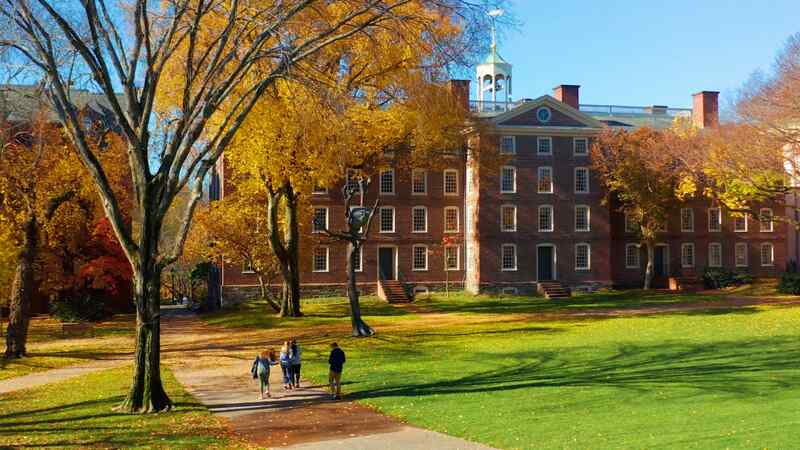
Brown's campus sits on College Hill. The Main Green, ringed by old brick buildings, is the center of student life, and Thayer Street, just beside campus, is where students go for cheap food, coffee and late-night study breaks. First-years live together in residence halls on campus, and most undergraduates stay in university housing for several years before some move to nearby apartments.
For international students, Brown runs the Office of International Student and Scholar Services (OISSS), which handles I-20s, visa advice and work permission, plus an orientation before classes start. Because Brown is small, international students tend to know each other quickly, and cultural groups span Africa, South Asia, the Middle East and beyond.
One thing worth knowing: in December 2025, a shooting on campus during exam week left two people dead and nine injured, almost all of them students, and Brown cancelled the rest of its final exams. It shook the whole community. Brown, like every US campus, has emergency alert systems, and it's wise to sign up for them and take part in safety briefings during orientation. You'll find more on this in the news section.
Is Brown really the "easy" Ivy League school? No. Brown admitted about 5.3% of applicants for the Class of 2030. The Open Curriculum removes general education requirements, but concentrations still have demanding courses, and students must complete about 30 courses to graduate.
What does the Open Curriculum mean in practice? You choose almost all of your courses outside your concentration, with no required list of science, language or humanities subjects. You can also take any course pass/fail. Advisers help, but you plan your own path.
Can I design my own major at Brown? Yes. If none of Brown's 80-plus concentrations fits, you can propose an Independent Concentration with faculty support.
Is Brown need-blind for international students? Yes, starting with the Class of 2029. Brown meets full demonstrated need for international students who apply for aid when they apply for admission.
How much does a year at Brown cost in 2026-27? Tuition is $74,568. With housing, meals, fees and Brown's estimate of indirect costs, the full budget is about $99,984 before aid.
Can international students apply to the PLME? Yes. International students can apply to the eight-year PLME through the Common Application. Ask Brown's admission office about aid for the medical school years before committing.
What English score do I need for Brown? Brown's minimums include IELTS 8.0, TOEFL 105 (or 5.5 on the new scale from January 2026), Duolingo 130 and PTE 75. Check whether your schooling exempts you.
Does Brown require the SAT for international applicants? Yes. The SAT or ACT is required, with no minimum score. Early Decision applicants must test by October and Regular Decision applicants by December.
What is the Brown-RISD Dual Degree? A five-year program in which students earn a Brown bachelor's degree and a Bachelor of Fine Arts from the Rhode Island School of Design. Admission is separate and highly selective.
Brown rewards applicants who already know what they want to explore. So start with that question, not with the essay prompts. Write down three subjects you would take at Brown even if nobody required them, then check that each one exists in the Focal Point course catalog. If you can do this easily, the Open Curriculum probably suits you.
Next, open the Net Price Calculator with your family's real numbers. Brown University international students who plan to ask for aid must say so when they apply, because the full-need promise depends on it. Book your SAT or ACT date early too, since testing is required again and a late score is a common reason files stay incomplete.
If Brown sits on your list together with five or six other schools, our free matching tool on universityfinder.org sorts them by your budget, your English score and the subject you want to study. It takes a few minutes, and it shows you where Brown is a reach and where you have a safer fit.
One more thing about who stands behind this guide. universityfinder.org is a member of Acadex (Acadex University Admission Association), and members follow one shared rule set on how students are briefed about the host country's legal requirements before they travel: visa conditions, work limits and what happens if you drop below full-time study. For an applicant heading to the US, that briefing is often worth more than any ranking table.
Official Brown pages to bookmark
Sources
Brown University News, "Brown admits 2,564 students to the Class of 2030" (26 March 2026): https://www.brown.edu/news/2026-03-26/admitted-students-class-2030
Brown University News, "FY27 tuition, fees and salaries" (9 February 2026): https://www.brown.edu/news/2026-02-09/fy27-tuition-fees-salaries
Brown Admission, International applicants and financial aid: https://admission.brown.edu/international/financial-aid
Standardized testing policy, Brown Admission: https://admission.brown.edu/first-year/standardized-tests
Questions from international applicants, Brown Admission: https://admission.brown.edu/ask/international-applicants
Program in Liberal Medical Education, International applicants: https://plme.med.brown.edu/admission-aid/international-applicants
The Brown Daily Herald, need-blind admission for international students from the Class of 2029 (January 2024): https://www.browndailyherald.com/article/2024/01/brown-transitions-to-need-blind-admissions-for-class-of-2029-international-students
Indirect costs and what they mean, The Brown Daily Herald (March 2026): https://www.browndailyherald.com/article/2026/03/brown-estimates-students-pay-2878-in-indirect-costs-heres-what-that-actually-means
White House plan to freeze $510 million at Brown, The Brown Daily Herald (April 2025): https://www.browndailyherald.com/article/2025/04/what-you-need-to-know-about-the-white-houses-plan-to-freeze-510-million-at-brown
Brown takes out a $300 million loan, The Brown Daily Herald (April 2025): https://www.browndailyherald.com/article/2025/04/brown-takes-out-300-million-loan-amid-federal-funding-uncertainty-budget-deficit
GV Wire, Brown president steps down (3 August 2026): https://gvwire.com/2026/08/03/brown-universitys-president-who-clashed-with-trump-over-funding-steps-down/
NPR via HPPR, shooting at Brown University (13 December 2025): https://www.hppr.org/npr-news/2025-12-13/2-killed-and-9-injured-in-brown-university-shooting-person-of-interest-now-in-custody
KTUL, Brown declines to join the federal compact (15 October 2025): https://ktul.com/news/nation-world/brown-university-declines-to-join-trumps-compact-academic-excellence-higher-education-speech-president-freedom-funding-research-october-15-2025
NY1, Brown's $50 million agreement with the federal government (30 July 2025): https://ny1.com/nyc/all-boroughs/news/2025/07/30/brown-university-trump-federal-funding-50-million
QS, US performance in the QS World University Rankings 2027: https://www.qs.com/insights/us-performance-in-the-qs-world-university-rankings-2027
Wikipedia, MEF University: https://en.wikipedia.org/wiki/MEF_University
Kadir Has University, international undergraduate tuition and scholarships: https://www.khas.edu.tr/inter-tuition-fee-and-scholarships-for-undergraduate-programs/
Istanbul Bilgi University, international tuition and fees: https://www.bilgi.edu.tr/en/international/international-admissions/tuition-and-fees/
Dekker, I. (2020), academic thriving in open curricula, Curriculum Journal: https://consensus.app/papers/details/a1050e09271d5ba5973b2801634443d5/?utm_source=claude_desktop
Generic skills in open and interdisciplinary programs, Dekker, I. (2024), Tertiary Education and Management: https://consensus.app/papers/details/797c9766acae562cb3666b70963e3489/?utm_source=claude_desktop
Checked against Brown's official admission and news pages on 1 October 2026 by the universityfinder.org editorial team, an Acadex member. Fees and policies change every year, so confirm the final numbers on Brown's site before you pay any deposit.