Uskudar University Ranking 2026 - Global Standing and Academic Recognition

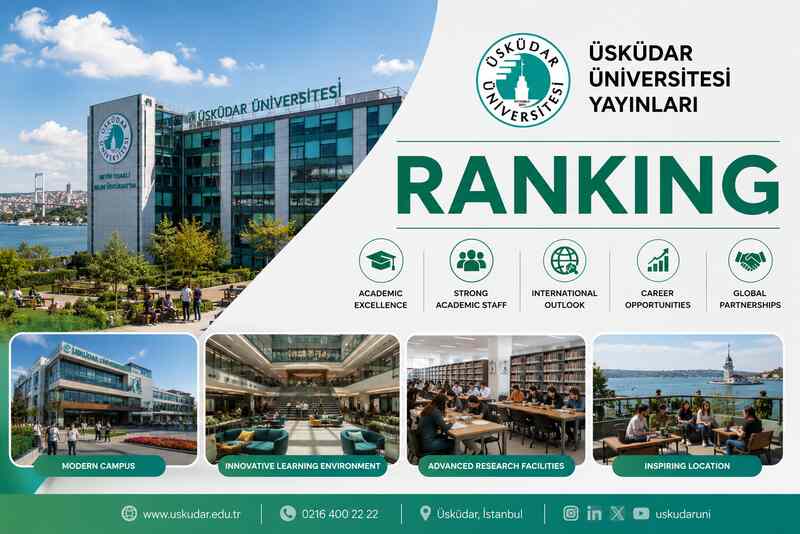
Most ranking articles about Turkish private universities tell the same story: medicine, engineering, citation counts, hospital beds. Uskudar University is genuinely different. It's built around brain sciences neuroscience, psychiatry, behavioral medicine, psychology and that focus shows up in its ranking profile in specific, measurable ways that a generic comparison table won't capture.
Founded in 2011 by the NP Group, the same organization behind NP Istanbul Brain Hospital Turkey's first private neuropsychiatric hospital Uskudar entered its first year of academic operation with a pre-existing clinical research infrastructure that most private universities spend a decade building from scratch. That head start matters for understanding where the university sits in 2026, and where it's realistically heading over the next five years.
Uskudar University Rankings at a Glance 2026
Ranking System | Global Position | Turkey Position | What It Measures |
|---|---|---|---|
THE World University Rankings 2026 | 1,500+ band | 13th among foundation universities | Teaching, research quality, citations, international outlook, industry |
THE Impact Rankings 2024 | Confirmed inclusion | 1st among private Turkish universities | UN Sustainable Development Goals alignment |
QS Europe University Rankings — Western Asia 2026 | 79th in Western Asia | Confirmed | Regional comparative: Turkey, Iran, Caucasus |
SCImago Institutions Rankings 2025 | Confirmed global inclusion | 58th in Turkey | Pure bibliometric research output Scopus data |
EduRank 2026 | 2,918th globally | 59th in Turkey | 4,306 publications / 38,903 citations |
Webometrics 2026 | ~2,892nd globally | ~85th in Turkey | Web visibility and digital academic footprint |
URAP Turkey 2025–2026 | Confirmed national inclusion | Confirmed Turkey position | METU-developed academic performance metric |
UniRank 2026 | Confirmed global | Confirmed Turkey position | Web analytics and engagement |
A few things stand out immediately. The THE 1,500+ band is Uskudar's first-ever appearance in the THE World University Rankings confirmed in Uskudar's own official announcement, which explicitly notes this as a first-time entry driven by increasing publication and research performance. First-time THE inclusion, for a 14-year-old private university, is meaningful. And the 79th position in the QS Western Asia regional rankings is the number that tells you most about international recognition in the specific geographic market most of Uskudar's international students come from.
The THE Entry; What Getting Into the Rankings for the First Time Actually Signals
Getting into the THE World University Rankings at all requires crossing minimum thresholds for publication volume, citation activity, and data submission. THE uses 18 performance indicators across five pillars Teaching, Research Environment, Research Quality, International Outlook, and Industry. A university that doesn't produce sufficient indexed publications across enough fields simply doesn't appear on the list, regardless of how old it is or how much it invests in marketing.
Uskudar crossed those thresholds in 2026 for the first time. The 1,500+ band is a wide category, but the fact of inclusion is the data point that matters it confirms Uskudar's Scopus-indexed research output has reached the volume and citation levels that THE's methodology requires for a calculable score.
A 2023 study published in Scientific Reports (PMC10468493), examining the relationship between bibliometric indicators and university ranking positions across THE, QS, ARWU, and US News, found that the weight of scientometric (citation-based) parameters ranges between 20% in QS and 75% in US News and that THE sits closer to the citation-intensive end of that spectrum. Entry into THE therefore confirms measurable citation activity, not just publication volume. A university can publish papers without those papers being cited by international researchers. THE inclusion confirms Uskudar's research is being cited which is a different and stronger signal.
QS 79th in Western Asia; The Most Practically Useful Ranking for International Students
For students from Turkey's primary international student source countries Egypt, Yemen, Libya, Pakistan, Azerbaijan, and other MENA and Central Asian nations the QS Western Asia ranking is actually the most practically useful reference point. It covers Turkey, Iran, the Caucasus region, and parts of Central Asia in a single normalized ranking, which means employers and graduate programs in those markets use it as a regional quality reference.
Uskudar's 79th position in the QS Western Asia 2026 rankings confirmed on QS TopUniversities places it in the upper half of recognized regional universities. QS methodology weights academic reputation (40%), employer reputation (10%), faculty-to-student ratio (20%), citations per faculty (20%), and internationalization metrics (10%). For a university with 400+ Erasmus agreements and a specialized neuroscience identity that attracts international researchers, the academic reputation and internationalization components specifically benefit Uskudar.
THE Impact Rankings; 1st Among Turkish Private Universities
This is the position most Uskudar guides underplay. According to the THE Impact Rankings 2024, Uskudar University ranked 1st among private Turkish universities in the overall Impact Rankings which evaluate alignment with the UN's 17 Sustainable Development Goals, specifically measuring institutional contributions to health and wellbeing, quality education, reduced inequalities, and other SDG targets.
Uskudar confirmed all 17 SDG awards it applied for, making it the only Turkish private university to achieve that across the full SDG spectrum. The SDG 3 (Good Health and Wellbeing) category is particularly relevant for a neuroscience-focused institution the research output from NP Istanbul Brain Hospital's psychiatric and neurological work maps directly onto what THE measures for SDG 3 compliance.
For students choosing Uskudar for psychology, mental health, or behavioral sciences programs, this 1st-among-private-universities Impact ranking is a stronger signal than most comparison guides acknowledge. It confirms institutional investment in exactly the research domains those students plan to work in.
The NP Istanbul Connection; Why a Founding Hospital Changes the Research Profile
Most Turkish private universities are founded first, then build clinical infrastructure gradually. Uskudar is structurally different. It was established by the NP Group, which already operated NP Istanbul Brain Hospital Turkey's first private neuropsychiatric hospital, founded in 2007 along with NP Etiler Medical Center and NP Feneryolu Medical Center. The university came after the hospital, not before.
That sequence matters for research output. NP Istanbul Brain Hospital has been generating indexed neuroscience, psychiatry, and neuroimaging publications since before the university existed. When the university was established in 2011, it inherited an active clinical research pipeline rather than starting one from scratch. The hospital hosts an advanced neuroscience R&D facility with dedicated labs for Alzheimer's research, language and memory studies, schizophrenia, ADHD, depression, and drug abuse with clinical neuroscience lab capacity for experiments involving both patients and healthy volunteers.
A 2024 Scientometrics study published in Springer on subject-normalized comprehensiveness of research-intensive universities found that the main differentiator between research universities isn't mean performance it's whether their coverage is comprehensive or specialized. Specialized universities that concentrate research in identifiable fields tend to produce higher normalized citation impact in those fields than broad universities producing the same total output spread across many disciplines. Uskudar's neuroscience concentration is exactly that kind of specialization the NP Istanbul Brain Hospital generates psychiatry and neuroimaging publications that attract disproportionate international citation interest compared to general medicine output.
This concentration is now also visible in the International Brain Research Consortium (IBRC), which includes Uskudar University and NP Istanbul Brain Hospital alongside Stanford University, Mount Sinai Icahn School of Medicine, Ottawa University, and Tehran University's Atieh Clinical Neuroscience Center. The consortium focuses on neuroimaging, medical big data analysis, and biomarker detection. International co-authorship with Stanford and Mount Sinai produces the kind of internationally cited papers that feed directly into THE's Research Quality pillar and SCImago's citation metrics.
UNESCO TWAS Selection; An Overlooked International Credential
Uskudar holds a specific distinction that very few Turkish private universities can claim: it has been selected by UNESCO TWAS (The World Academy of Sciences) for international scientific doctoral studies support through TÜBİTAK. According to Uskudar's official documentation, it is the only Turkish university with this distinction earned specifically because of its neuroscience, cognitive medicine, and brain research activities.
UNESCO TWAS selection isn't a ranking it's an evaluation by an international scientific body that assessed Uskudar's research quality and determined it meets the standard required for supporting developing-country doctoral researchers. For students considering doctoral programs in neuroscience or behavioral sciences, this credential confirms that an independent international scientific organization has evaluated and recognized the quality of the research environment separate from any commercial ranking system.
EduRank Data; The Publication Count That Tells the Research Story
EduRank's 2026 data attributes 4,306 academic publications and 38,903 citations to Uskudar University's indexed research record. The subject breakdown shows where the research is concentrated: Medicine (2,655 publications / 22,113 citations), Psychology (1,598 publications / 14,757 citations main topics: Psychiatry, Neuroscience, Clinical Psychology), and Biology (2,287 publications / 22,256 citations including significant Neuroscience and Genetics output).
Two things stand out here. First, Psychology and Psychiatry together account for a disproportionately large share of Uskudar's total citation record relative to typical Turkish private universities, where medicine and engineering usually dominate. Second, the Computer Science publications (1,373 publications) are significantly weighted toward AI, Machine Learning, Bioinformatics, and Cognitive Science which reflects the neuroscience-technology intersection that Uskudar's engineering programs specialize in.
A 2023 study in Scientific Reports confirmed that citation-based ranking metrics correlate with disciplinary concentration universities that publish consistently in high-citation fields within their specialty tend to punch above their size in citation-weighted metrics. Uskudar's psychiatry and neuroscience publications appear in journals that are highly cited internationally in those fields, which is why its EduRank position (59th Turkey) is stronger than its Webometrics position (85th Turkey) research citation quality outperforms web presence accumulation.
The 400+ Erasmus Agreements; International Outlook in Practice
Uskudar holds over 400 active Erasmus+ agreements with European universities. In THE's methodology, international co-authorship ratios and international student/faculty proportions directly feed the International Outlook pillar. For a 14-year-old university, 400+ Erasmus agreements is a structural investment in the international research collaboration networks that generate the co-authored publications THE specifically measures.
This is partly why Uskudar's THE entry first-time, at 1,500+ band reflects both research output growth and the international engagement that the Erasmus network enables. Students who choose Uskudar for behavioral sciences or psychology programs gain access to exchange mobility across 400+ European partner institutions, which is also a practical career advantage in fields where European clinical training is valued.
Peer Comparison; Where Uskudar Sits Among Istanbul Private Universities
University | THE 2026 Band | Turkey Position | Key Research Strength |
|---|---|---|---|
Istanbul Medipol | 801–1,000 | 9th Turkey | Multi-field clinical research, 16-year output |
Bahcesehir University | 801–1,000 | 9th Turkey (tied) | BAU Global network, business and engineering |
Istanbul Gelisim | 1,001–1,200 | 16th Turkey / 9th foundation | ABET engineering, SCImago subject dominance |
Uskudar University | 1,500+ band (first entry) | 13th foundation universities | Neuroscience specialization, NP Hospital network, UNESCO TWAS |
Altinbas University | Confirmed | Confirmed | SCImago 11th foundation universities, health sciences |
Biruni University | 1,201–1,500 | Confirmed | TEPDAD accredited 2025, growing hospital output |
Uskudar and Gelisim share the same functional tier in Turkish private university THE rankings both have confirmed THE presence with younger institutional profiles than Medipol or Bahcesehir. But their profiles are completely different. Gelisim's strength is ABET-accredited engineering and subject SCImago dominance in Economics and Civil Engineering. Uskudar's strength is neuroscience specialization, the NP Hospital clinical research pipeline, UNESCO TWAS recognition, and the International Brain Research Consortium with Stanford and Mount Sinai.
For a student choosing between them, the academic profile difference maps directly onto program choice: engineering and social sciences favor Gelisim; psychology, behavioral sciences, neuroscience, and psychiatry-adjacent medicine programs favor Uskudar. The shared THE tier simply reflects that both have crossed similar publication thresholds not that they're academically equivalent for any specific program.
What This Means for Students Considering Uskudar in 2026
Uskudar University ranking in 2026 tells a specific story: a 14-year-old neuroscience-focused private university that has just achieved first-time THE inclusion, holds 79th place in QS Western Asia, ranks 1st among private Turkish universities in THE Impact Rankings, carries UNESCO TWAS recognition, and has an active clinical research pipeline that runs through Turkey's oldest private neuropsychiatric hospital and into international consortia with Stanford and Mount Sinai.
That's not a general-purpose university profile. It's a specifically neuroscience-anchored academic identity and for students choosing psychology, behavioral sciences, cognitive science, psychiatry-related medicine, or neurotechnology programs, that identity is more relevant than a higher overall ranking position at a broader institution.
For full program listings, English-medium options, tuition fees, and 2026–2027 intake details: Uskudar University — Complete University Guide
Verification sources: