Turkish Private University Accreditations Explained - And Why Ranking Alone Will Not Choose the Right University for You

Here's something a lot of students don't realize until it's too late. Two universities can sit next to each other in a ranking table, a few spots apart, and yet one of them is completely wrong for what you want to study. Rankings compare institutions, not programs. And when you're picking a university for medicine, engineering, nursing, or social sciences, what matters most is what that specific faculty has — not where the whole university lands on a list someone made in London.
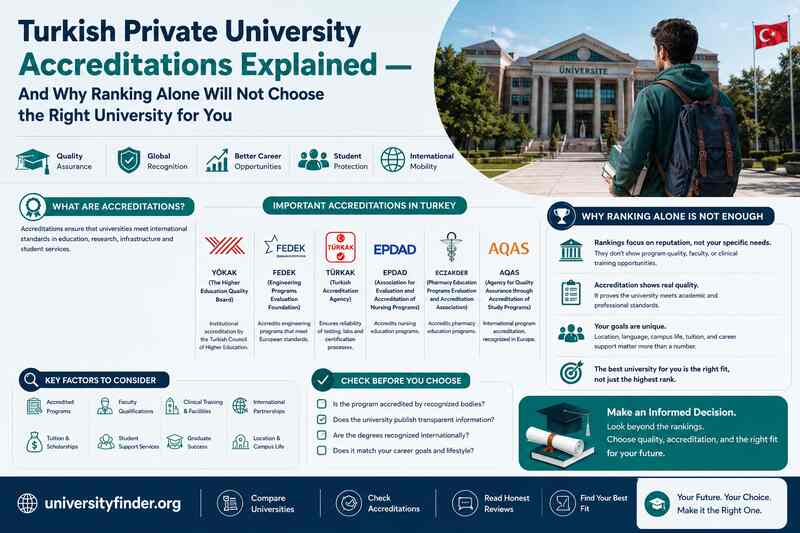
Turkey now has over 200 universities, with dozens of strong Turkish Private University Accreditations attracting international students every year. The options are genuinely good. But choosing well requires understanding something most guides skip: accreditation. Not just whether the university is "recognized" but which accreditation body matters for your program, what it actually proves, and why a degree from an accredited program in the right field is worth far more than a degree from a highly-ranked university whose specific faculty has no external validation at all.
Let me walk you through all of this simply and honestly.
What Is Accreditation and Why It's Not the Same as Ranking
University rankings like QS or THE are calculated using research output, citations, employer reputation surveys, and international student ratios. These things matter for some students particularly postgraduate researchers or students aiming for academic careers. But for most international students choosing a bachelor's degree, especially in applied fields, rankings often measure things that have nothing to do with your daily learning experience or your degree's recognition back home.
Accreditation is different. It's a formal external evaluation of a specific program or institution against defined quality standards. When an accreditation body reviews a faculty of medicine or an engineering department, they're asking specific questions: Does the curriculum meet international standards? Are the clinical training hours sufficient? Are the labs equipped properly? Are students actually learning what the profession requires?
There are two levels to understand:
Institutional accreditation - This means the university as a whole is recognized and approved. In Turkey, all universities public and private must be recognized by YÖK (Yükseköğretim Kurulu), the Turkish Council of Higher Education. YÖK recognition is the baseline. Without it, the university shouldn't be operating. So every legitimate private university in Turkey is YÖK-recognized. That's the minimum, not the achievement.
Program-level accreditation - This is where it gets really important, and where most guides stop explaining things properly. Beyond YÖK, individual programs within universities can earn accreditation from specialized international bodies. These program-level accreditations are what actually affect whether your degree is recognized by employers and professional licensing boards abroad.
For example:
MÜDEK (Association for Evaluation and Accreditation of Engineering Programs) is Turkey's engineering accreditation body, a signatory of the Washington Accord. Engineering programs with MÜDEK accreditation are recognized as equivalent to ABET-accredited programs in the US, Canada, UK, Australia, and other signatory countries. This directly affects your ability to get professional licensure abroad.
AACSB and EQUIS are the two most respected accreditations for business and management schools globally. Only a small percentage of business schools worldwide hold either of these. Koç University is the only Turkish institution with the "Triple Crown" all three major business accreditations (AACSB, EQUIS, and AMBA) which puts it among less than 1% of business schools globally.
TEPDAD and UTEAK are Turkey's medical education accreditation bodies. For medicine specifically, the most important international listing is WDOMS (the World Directory of Medical Schools), which determines whether your Turkish medical degree is recognized for licensing in the country you plan to practice in. Not all Turkish medical universities are listed on WDOMS. Before you apply to any medical program, checking this list is not optional.
EPDAD accredits teacher education programs in Turkey.
EQAR (European Quality Assurance Register) is an umbrella recognition that some Turkish universities have earned, placing them inside the European Higher Education Area (EHEA) framework.
So the honest picture is this: a university's ranking tells you something about its research reputation. Its program-level accreditation tells you whether your specific degree will be professionally and internationally valid. For most international students, the second one matters more.
The Accreditations That Matter Most by Field
Let me break this down by the four main areas students usually ask about.
Medicine and Health Sciences
This is the field where accreditation is most critical — and most likely to go wrong if you don't check carefully.
Turkey has strong private universities for medicine. Istanbul Medipol University, Istinye University, Acıbadem Mehmet Ali Aydınlar University, Yeditepe University, Istanbul Aydin University, and Biruni University are among the most chosen by international students. Medipol specifically has over 49,000 students and affiliates with Joint Commission International (JCI) certified hospitals that kind of clinical access matters because a 6-year medicine program lives or dies on real hospital hours.
But before any of that, you must check two things. First is the medical program listed in WDOMS? Second is it recognized by the medical licensing authority in your home country or the country where you plan to work? These answers vary. A university recognized in Egypt may not be in Pakistan. A degree valid in Jordan may need additional steps for registration in Nigeria. This is genuinely case-by-case, and checking WDOMS directly or asking an advisor who knows your specific situation is essential.
For nursing specifically, the program's affiliation with real hospitals and its compliance with clinical hour requirements set by the Turkish Ministry of Health matters more than the university name.
Engineering
For engineering, the two words to look for are MÜDEK and Washington Accord. Since Turkey became a Washington Accord signatory through MÜDEK in 2011, engineering programs with MÜDEK accreditation are recognized as equivalent to ABET-accredited degrees in 18+ countries including the US, UK, Canada, and Australia.
Not all engineering faculties in Turkish private universities have MÜDEK accreditation. Koç University and Bahçeşehir University (BAU) have direct ABET recognition for some programs. Atılım University has MÜDEK accreditation for a high proportion of its engineering departments one of the highest in Turkey. Istanbul Gelisim University also holds MÜDEK accreditation alongside ENAEE (European Network for Accreditation of Engineering Education) recognition.
The practical message: don't just ask "does this university have an engineering program?" Ask "does this specific engineering department have MÜDEK or ABET accreditation?" The difference in how your degree is recognized internationally can be significant.
Business and Social Sciences
Business programs are a bit more flexible than medicine or engineering in terms of international recognition, but accreditation still matters if you're aiming for international career mobility.
AACSB and EQUIS are the gold standard. Very few Turkish universities hold these Koç University is the standout here. That said, many strong private universities offer solid business programs without holding AACSB accreditation, and for students planning to work in Turkey or in MENA countries, this matters less. What matters more for social sciences students is the curriculum language, faculty quality, and internship or industry connections the program offers.
For psychology, sociology, communications, international relations, and similar programs which are popular at universities like Üsküdar University, Bahçeşehir (BAU), and Istanbul Bilgi University accreditation is less standardized, and what to evaluate shifts toward faculty credentials, course structure, and alumni outcomes.
Ranking Versus Accreditation: What the Table Actually Shows
Here's a direct comparison of well-known private universities in Turkey across fields, to show you what the right questions look like in practice:
University | Location | Key Field Strengths | Relevant Accreditation | Approx. Tuition/Year | English Programs |
|---|---|---|---|---|---|
Istanbul Medipol University | Istanbul | Medicine, Health Sciences, Nursing | YÖK, JCI-affiliated hospitals, EQAR | $10,000–$22,000 (medicine higher) | Yes |
Istinye University | Istanbul | Medicine, Engineering, Business | YÖK, 30+ hospital affiliations via MLP Care Group | $12,000–$29,000 (medicine) | Yes |
Acıbadem Mehmet Ali Aydınlar University | Istanbul | Medicine, Nursing, Health Sciences | YÖK, own hospital network (Acıbadem Hospitals) | $18,000–$35,000 | Yes |
Bahçeşehir University (BAU) | Istanbul | Engineering, Business, Law, Arch. | YÖK, ABET (select programs), MÜDEK | $9,000–$16,000 | Yes |
Istanbul Aydin University | Istanbul | Medicine, Engineering, Business | YÖK, EQAR, EHEA recognition | $7,000–$18,000 | Yes |
Koç University | Istanbul | Business, Medicine, Engineering, Law | YÖK, AACSB + EQUIS + AMBA (business), MÜDEK (eng.), TEPDAD (med.) | $18,000–$30,000+ | Yes |
Istanbul Gelisim University | Istanbul | Engineering, Business, Social Sci. | YÖK, MÜDEK, ENAEE, NAAB (architecture) | $5,000–$9,000 | Partial |
Yeditepe University | Istanbul | Medicine, Dentistry, Engineering, Law | YÖK, UTEAK (medicine) | $10,000–$20,000 | Yes |
Üsküdar University | Istanbul | Psychology, Health Sci., Nursing | YÖK, strong clinical affiliations | $6,000–$12,000 | Partial |
Atılım University | Ankara | Engineering (MÜDEK focus) | YÖK, MÜDEK (multiple departments), ENAEE | $5,000–$10,000 | Yes |
Tuition figures are approximate for the 2026–2027 academic year. Always verify current rates directly with the university, as fees can change each intake cycle.
Four Real Examples: How to Choose by Program
Enough theory. Here's what this actually looks like in practice for four of the most common fields.
Choosing for Medicine
You want a 6-year English-medium medicine program. Here's what to evaluate, in order of importance:
WDOMS listing confirm the university is listed. This is non-negotiable.
Hospital affiliations how many affiliated hospitals are there, how close are they to campus, how early do you start clinical rotations? Istinye University's connection to the MLP Care Group (Liv Hospital, Medical Park) and Medipol's own university hospital are examples of strong clinical infrastructure.
Recognition in your home country check with your home country's medical licensing board. WDOMS is a starting point, not a guarantee.
Tuition reality medicine in Turkish private universities ranges from around $15,000 to over $35,000 per year. This is the program to budget carefully for.
Then ranking once the above are confirmed, compare rankings among the eligible options.
Recommended shortlist for medicine: Istanbul Medipol, Istinye University, Acıbadem, Yeditepe University, Istanbul Aydin University.
Choosing for Engineering
MÜDEK or ABET accreditation, check the specific department, not just the university.
Lab and workshop infrastructure, engineering is hands-on. Campus facilities matter.
Language of instruction, is the program fully in English or mixed? This affects your learning and your career options.
Industry connections, internships, industry projects, and career placement networks.
Recommended shortlist for engineering: Bahçeşehir (BAU), Atılım University (Ankara), Istanbul Gelisim University, Koç University (if budget allows), Okan University.
Choosing for Nursing
Hospital affiliations and clinical hours, Turkey's nursing programs follow Ministry of Health requirements for clinical training. Universities with their own hospital or strong hospital partnerships give you more clinical exposure.
Language of instruction, many nursing programs in Turkey are taught in Turkish. If you need English, your options narrow significantly. Medipol and Acıbadem are among the stronger options with English-medium nursing.
Recognition in your target country, nursing licensing requirements vary widely by country. Check whether the Turkish nursing degree is recognized by the relevant nursing board in your home country or where you plan to practice.
Cost, nursing programs are generally less expensive than medicine, ranging from around $5,000 to $12,000 per year at private universities.
Recommended shortlist for nursing: Istanbul Medipol, Acıbadem, Üsküdar University, Istinye University.
Choosing for Social Sciences
For programs like psychology, international relations, communications, sociology, or business administration — the decision-making looks different.
Curriculum language and depth, for social sciences, the quality of the course content, the faculty's academic background, and the research environment matter more than a specific accreditation stamp.
Internship and industry connections, especially for business and communications, what connections does the university have to Istanbul's corporate sector?
Campus life and student community, social sciences students spend a lot of time in discussion-based classes and group projects. A diverse, active student community makes a real difference.
Location, Istanbul's European and Asian sides both have strong universities. Being in a major city means more internship access.
For business specifically, if you want AACSB recognition, Koç University is the only Turkish option. For most students, a strong program at BAU, Istanbul Bilgi, or Üsküdar without this accreditation is still an excellent foundation.
Recommended shortlist for social sciences: Bahçeşehir (BAU), Istanbul Bilgi University, Üsküdar University, Istanbul Aydin University, Istanbul Nisantasi University.
Why Choosing a University Is Harder Than It Looks Online
Here's the thing that surprises a lot of students once they start researching seriously. You can spend three weeks comparing university websites, reading ranking tables, and watching YouTube videos and still not have a clear answer. Because the information that actually matters is often not public.
Which universities are currently offering scholarship discounts for your nationality? Which ones have quota limitations for international students in your specific program this intake cycle? Which engineering departments at University X currently have MÜDEK accreditation and for which specializations? Is the English-medium nursing program at that university genuinely full English, or does clinical training shift to Turkish? Has a specific medical program's WDOMS listing been recently updated?
These are not questions you can answer from a website. They require direct contact with admissions offices, knowledge of the current intake cycle, and familiarity with how these universities actually operate.
That's exactly where having the right support changes everything.
Why universityfinder.org Is the Right Starting Point; and Not Just a Starting Point
I want to be direct about something. There are many websites and agencies that say they help students choose universities. But most of them match you to whichever university pays them the highest commission, hand you a pre-written document checklist, and consider their job done when you have an admission letter.
universityfinder.org works differently, and I've seen enough of this process to say that the difference is real.
The team behind universityfinder.org has been working with international students in Turkey since 2005 over 21 years on the ground, with two dedicated offices on the European side of Istanbul. One office handles sworn translation and official document notarization. The other focuses specifically on student admission and academic advising. These are not remote advisors guessing about Turkish university requirements. These are people who know the admissions staff at these universities personally, who know which scholarship options are quietly available, and who have helped students from over 40 countries navigate this exact process.
And critically the support doesn't stop when you get your admission letter.
I've said this before but it's worth repeating clearly: the first weeks after you arrive in Turkey are genuinely overwhelming for most international students. If you land in Istanbul without a clear plan, you're figuring out a foreign city, a language barrier, Turkish bureaucracy, university registration deadlines, and course selection all at the same time.
universityfinder.org handles the arrival. Students are received at the airport with VIP transport. The team takes you through final registration at the university, helps you select courses that match your academic plan, and handles document translation for your ikametgah (residence permit) application. These are not extras you pay separately for. They're part of what it means to work with people who actually have on-ground presence and know what international students need in those first critical weeks.
There are no application fees. universityfinder.org is authorized by Turkish private universities and is compensated by the university, not by you. You pay the same university tuition you would pay going direct but you get the full service: from the first advising session to the first day of class and beyond.
Frequently Asked Questions
Q: Is YÖK recognition enough for my degree to be accepted abroad? A: YÖK recognition is the baseline that makes a university legally valid in Turkey but alone, it doesn't guarantee your degree is recognized in another country. What matters additionally is program-level accreditation (MÜDEK for engineering, WDOMS for medicine, AACSB/EQUIS for business) and the bilateral recognition agreements between Turkey and your home country. Always check with the relevant professional body or licensing board in the country where you plan to work or continue studies.
Q: How do I know if a university's medical program is listed in WDOMS? A: You can check directly at wdoms.org by searching for the university name. The listing shows which programs are included and any notes on eligibility for graduates applying for licensing in specific countries. This check should happen before you apply, not after.
Q: Does it matter which city my university is in? A: More than most students initially think. Istanbul gives you the largest hospital networks, the most internship opportunities, the biggest international student community, and the best connections to Turkey's corporate sector. Ankara is better for government-related fields and has some excellent engineering universities. For most international students, Istanbul private universities are the stronger choice especially for medicine, engineering, nursing, and business.
Q: What is the difference between MÜDEK and ABET accreditation for engineering? A: MÜDEK is Turkey's national engineering accreditation body and a full signatory of the Washington Accord since 2011. Any engineering program accredited by MÜDEK is recognized as substantially equivalent to an ABET-accredited program in all other Washington Accord member countries including the US, UK, Canada, and Australia. Some Turkish universities (like Bahçeşehir and Koç) additionally hold direct ABET accreditation for select programs, which gives graduates even smoother recognition in North America specifically.
Q: Can I get a scholarship at a Turkish private university? A: Yes and this is often not as widely publicized as it should be. Government scholarships are available through the Türkiye Scholarships program (YTB), which covers tuition, accommodation, and monthly stipend for eligible students. Beyond that, most private universities offer partial tuition reductions for strong applicants typically 25%–50%. These scholarship allocations fill up per intake cycle, so applying early matters. An experienced advisor who works directly with university admissions offices will know what's currently available in ways that a university website often doesn't show.
Q: How long does the application process usually take? A: For Turkish private universities, the process from submitting your documents to receiving an official admission letter typically takes 2–4 weeks, sometimes faster. The document preparation stage before submission getting your diploma officially translated, notarized, and formatted correctly usually takes 1–2 weeks depending on where you're coming from. Starting the process at least 2–3 months before your intended enrollment date gives you comfortable time for visa applications as well.
Q: Is the nursing program in Turkey taught in English? A: This depends entirely on the university. Several private universities offer nursing in English Istanbul Medipol and Acıbadem are two of the stronger options. Many programs, however, are conducted in Turkish or switch to Turkish for clinical components. Ask specifically and directly before you apply, because the answer matters a lot for your learning and your licensing options.
The Honest Summary
Choosing a university in Turkey for medicine, engineering, nursing, or social sciences is not about finding the best-ranked university on a general list. It's about finding the program with the right accreditation for your specific goals, in a university with the right infrastructure for your field, at a price point that works for your budget, with support that carries you through the arrival and registration process not just the paperwork before you land.
That's a lot of specific information to navigate alone. universityfinder.org is here to help you navigate it properly with people who have the on-ground experience, the university relationships, and the 21+ years of advising history to give you an honest answer about what's right for you. No application fees. No generic placements. Real guidance, right through to your first day of class.
Start your free consultation at universityfinder.org and let's find the program that actually fits.