From Application to Airport: What Really Happens After You Get Your Acceptance Letter in Turkey

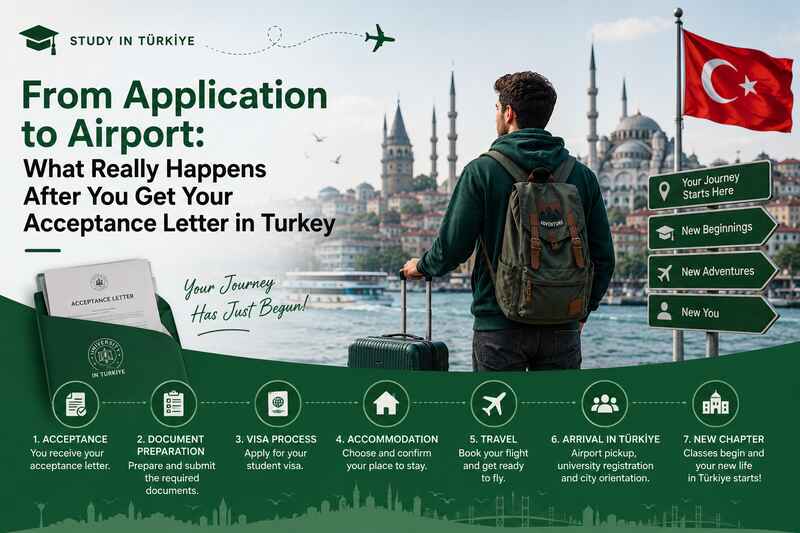
Getting your acceptance letter feels like the finish line. You've been waiting, refreshing your email, maybe telling your family "any day now" for weeks. And then it arrives your university in Turkey wants you.
So what happens next?
Most guides stop right there. They explain the application process in detail, celebrate the acceptance letter, and then offer a vague line like "proceed with visa and registration." That's not enough. Because what comes between getting that letter and actually sitting in your first lecture in Turkey is a sequence of steps that nobody fully explains and where most students hit unexpected problems.
This guide walks you through everything that happens after your Turkey university acceptance letter arrives. Visa preparation, pre-departure tasks, the airport, the first 72 hours, final registration, accommodation contracts, your residence permit all of it, in the right order, with the details that actually matter.
Step 1; Confirm Your Place and Pay the Enrollment Deposit
The moment your acceptance letter arrives, the first thing to do is confirm your intention to enroll. Most private universities in Turkey will ask for a small enrollment deposit to secure your seat this is different from tuition and is usually non-refundable if you later cancel. Amounts vary, but typically fall between $200 and $500.
This deposit locks in your place. Without it, the university may release your spot to another applicant, especially in competitive programs like medicine, pharmacy, or engineering. So don't sit on the acceptance letter for more than a week confirm quickly.
Once confirmed, the university issues your final acceptance letter (the conditional one comes first for students who applied before finishing high school; the final one comes after). This final document is what you take to the Turkish embassy for your visa application.
Also at this stage if you haven't already begin the denklik process (diploma equivalency). You need this before final registration in Turkey, and it takes 2–6 weeks. Starting it after you arrive is a mistake many students make. Start it now, from home, through the Turkish embassy or consulate in your country, or through the e-Denklik system at edenklik.meb.gov.tr.
Step 2; Apply for Your Student Visa (Don't Wait)
With your final acceptance letter in hand, go to the Turkish embassy or consulate in your country and apply for a student visa. This is separate from a tourist e-visa a student visa is specifically for stays longer than 90 days for academic purposes.
What you'll need at the embassy:
Valid passport (minimum 6 months validity beyond your intended stay)
Completed student visa application form
Final acceptance letter from your Turkish university
Passport-size photos (check the exact specifications your embassy requires)
Proof of financial means a bank statement showing you can cover your living expenses; roughly $3,000–$5,000 for the first year is a safe figure
Health insurance valid in Turkey for the duration of your studies
Proof of accommodation in Turkey (rental agreement, dorm booking, or a letter from the university confirming campus housing)
Processing takes 2 to 8 weeks, depending on your country and the embassy's current workload. Some embassies are faster, some much slower. Apply at least 6–8 weeks before your intended travel date. Do not book a flight until your visa is confirmed.
One practical note if your country has a visa-free arrangement with Turkey or you qualify for an e-visa, some students choose to enter on that and apply for their student residence permit directly in Turkey after university registration. This is possible for certain nationalities but carries risk if anything goes wrong. Talk to someone who knows Turkish immigration rules before choosing this path. [internal link: /blog/cost-of-studying-in-turkey-international-students]
Step 3; Sort Your Accommodation Before You Travel
This is where a huge number of students make a costly mistake they arrive in Turkey without confirmed accommodation and spend their first week in an overpriced hotel, scrambling to find somewhere to live.
Your options for student housing in Turkey are:
University dormitories: If your university offers on-campus housing, apply for it as soon as you get your acceptance letter. Spots fill fast, especially at well-known Istanbul universities. Campus dorms are convenient and safe but not always available and not always the cheapest option.
KYK government dormitories: These state-funded dorms are extremely affordable but have strict rules, limited availability, and priority often goes to Turkish students. Worth checking, but don't rely on them.
Private student residences: Purpose-built student housing near university campuses. More flexible, often furnished, and well-suited to international students. Prices range from $150–$400/month depending on city and facility level.
Shared private apartments: Common among students who want more independence. Sharing with 2–3 other students in a city-center apartment can be cost-effective, but you need to read the rental contract carefully. Turkish rental contracts are in Turkish, include clauses about deposit conditions, utility responsibilities, and notice periods none of which are obvious if you can't read them.
Before signing any accommodation contract, have someone who knows the Turkish rental market look at it. Signing without understanding what's in it can lock you into unfair terms you'll be stuck with for a year. At universityfinder.org, we review accommodation contracts for every student we work with before they sign. It costs nothing and saves real problems. [internal link: /services]
Step 4; What Happens at the Airport in Turkey
You've landed. You're at Istanbul Airport (IST) or Sabiha Gökçen (SAW) or wherever your university city's airport is.
Here's what to expect and what to do, in order.
At passport control: Have your passport, student visa, and acceptance letter in your hand luggage not your suitcase. Passport control officers may ask about your purpose of visit, which university you're attending, and your duration of stay. Answer clearly and confidently. If asked, show the acceptance letter. Don't put these documents in your checked bag.
At baggage claim: Follow the signs passport control comes before baggage claim. This sounds obvious but people panic and go the wrong way.
After collecting luggage: This is where students traveling alone face their first real challenge. Istanbul Airport is one of the busiest in the world. Taxis outside major Turkish airports can overcharge new arrivals significantly if you don't know the fixed rate or use a metered cab. The safest options are:
The BiTaksi or iTaksi apps (metered, registered drivers, you can track the route)
Airport shuttle services to central Istanbul or direct to your accommodation
A pre-arranged pickup from a trusted contact
If you're traveling through universityfinder.org, someone meets you at the airport. That's not a marketing line it's literally part of what we do. VIP transfer, directly to your accommodation. For a student arriving alone in a new country for the first time, that first hour matters more than most people realize.
Getting a SIM card: Major Turkish mobile operators (Turkcell, Vodafone, Türk Telekom) have counters at Istanbul Airport arrivals. Get a local SIM immediately. You'll need it to navigate, communicate with the university, and set up everything that follows. Budget around $20–$30 for the SIM and initial credit. Note: foreign SIMs work in Turkey for the first 120 days, after which you'll need to register your phone or get a local SIM anyway.
Step 5; Your First 72 Hours in Turkey
The first three days are the most logistically intense of your entire academic journey. Here's what needs to happen:
Get a Tax Identification Number (Vergi Kimlik No): This is essential and often overlooked. Your Turkish tax ID number is required to open a bank account, purchase health insurance, and complete various official forms. You can get it at any local tax office (Vergi Dairesi) or online via the Revenue Administration website. Bring your passport. It's usually issued on the spot.
Get an IstanbulKart (or equivalent city transport card): If you're in Istanbul, this transport card covers metro, bus, tram, and ferry. You can apply at IstanbulKart application centers or online, but for the student discount rate, you'll need to show university enrollment proof so this may happen in your second week, after registration. In the meantime, load a regular card.
Familiarize yourself with your neighborhood and campus route: Spend time on day one just understanding your physical environment where the nearest grocery store is, how to get to campus, where your university's international students office is located.
Contact your university's international students office: Introduce yourself, confirm your registration appointment, and ask if there are any documents they need you to bring. Don't assume ask explicitly. Missing a single required document can delay your enrollment by days.
Step 6; Final University Registration
This is the most important administrative step you'll take after arriving, and it has to happen before anything else falls into place.
For final registration at your Turkish university, you'll need to bring the following original documents:
Valid passport (original + photocopy of the ID page)
Final acceptance letter
Denklik certificate (diploma equivalency must be complete before registration)
Original high school diploma (with apostille, or embassy authentication)
Official academic transcripts (original, with apostille or certification)
Passport-size photos (usually 4–6, check your specific university's requirement)
Health insurance (valid in Turkey)
Proof of accommodation
Tuition payment confirmation (or payment arrangement)
The registration appointment at most universities takes 1–2 hours if everything is in order. If a document is missing or incorrectly certified, the process stops and you come back which costs you time and can push your course registration deadline.
After final registration, the university issues your student certificate (Öğrenci Belgesi). This document confirms your enrolled status and you'll use it constantly for the residence permit application, for opening a bank account, for getting student discounts, and for the IstanbulKart student rate. Keep multiple printed copies.
Step 7; Apply for Your Student Residence Permit Within 30 Days
This is non-negotiable. Every international student in Turkey must apply for a student residence permit — called öğrenci ikamet izni within 30 days of arriving in the country. Miss this window and you're technically in violation of Turkish immigration law, which means fines and potential complications.
The process works like this:
Apply online at e-ikamet.goc.gov.tr and book an appointment at your local immigration directorate (Göç İdaresi)
Prepare your document file passport, photos, student certificate, health insurance, accommodation proof (rental contract or dorm agreement), and payment for the permit fee and card issuance
Attend your in-person appointment
Provide biometric data (fingerprints)
Receive your ikamet card by mail within 2–4 weeks
While the application is being processed, the appointment receipt serves as temporary proof of your legal status. Don't travel outside Turkey during this window if you leave before receiving the card, you may face entry complications on return.
The first residence permit is typically issued for one academic year. You'll need to renew it annually. At universityfinder.org, we handle every renewal for our students you don't have to track expiry dates or navigate the immigration portal alone each year. We do it. [internal link: /blog/how-to-get-turkish-student-residence-permit]
University Comparison: Registration Requirements Across Popular Institutions
Registration requirements differ slightly between universities. Here's a comparison of what major universities for international students typically ask for during final registration:
University | City | Denklik Required at Registration | Registration Window (Fall) | Key Document Noted |
|---|---|---|---|---|
Istanbul Medipol | Istanbul | Yes | Late August–September | Health insurance mandatory |
Bahçeşehir (BAU) | Istanbul | Yes | August–September | Apostilled diploma required |
Istanbul Aydin | Istanbul | Yes | September | Notarized translations accepted |
Istanbul Gelisim | Istanbul | Yes | September | Student certificate issued same day |
Acıbadem University | Istanbul | Yes | August | Medical program pre-check required |
Istanbul Okan | Istanbul | Yes | August–September | Biometric photos specific format |
Ankara Yıldırım Beyazıt | Ankara | Yes | September | YÖS score submission required |
One thing that's consistent across all of them denklik must be complete before you can finish registration. No exceptions. And if you're at a medical university, the registration process often includes a preliminary academic check to confirm your pre-med background meets program entry standards.
The Things Nobody Warns You About
Beyond the official steps, here are some practical realities that catch students off guard:
Turkish bureaucracy works better in the morning. Immigration offices, notary offices, and tax offices are usually busiest between 9am and 1pm. If you have an appointment, arrive 15 minutes early with everything printed in advance. Offices often close for the afternoon or slow significantly.
You cannot leave Turkey after submitting your residence permit application until you receive the card unless you have a specific travel emergency and obtain a "Müracaat Belgesi" from the immigration office. Plan your first trip home accordingly.
Bank accounts require a residence permit card. Most Turkish banks won't open an account for a foreign student without the ikamet card. So you'll be doing a lot of cash transactions in your first month. Bring enough cash to cover 4–6 weeks of expenses, plus your accommodation deposit.
The university cafeteria is your best friend in week one. It's cheap, it's on campus, and it means you don't have to figure out grocery shopping and cooking while also handling registration, accommodation, and immigration paperwork simultaneously. Prioritize the logistical steps first, settle the lifestyle later.
Your first accommodation might not be your last. A lot of students take the first available housing option just to have somewhere to sleep in week one, then find a better arrangement once they're oriented. That's fine just make sure your first contract doesn't have a heavy penalty for early exit.
Frequently Asked Questions
Q: How long after getting my acceptance letter should I wait before applying for a visa? A: Don't wait at all. Apply for the visa as soon as you have your final acceptance letter in hand. Processing takes 2–8 weeks depending on your country, and you want that buffer in case of delays. Students who wait until 3–4 weeks before their intended travel date regularly miss registration deadlines when visa processing takes longer than expected.
Q: Can I go directly to Turkey without a student visa if I have a visa-free agreement? A: Some nationalities can enter Turkey without a visa and then apply for a residence permit after completing university registration. But this approach carries risk if your registration is delayed or a document is missing, you could overstay your visa-free period. Check your country's specific arrangement and speak to someone who knows Turkish immigration before choosing this route.
Q: What if my denklik isn't ready when I arrive for registration? A: Most universities will allow a short grace period, but they set a hard deadline usually 2–4 weeks after the registration window opens. If you miss it, your enrollment may be cancelled. The way to avoid this entirely is to start the denklik process from home, before you travel.
Q: Do I need to bring cash or can I use my home country bank card? A: Bring cash a few hundred dollars converted to Turkish Lira before you travel is a good safety net. Your home country card will work at ATMs in Turkey but fees can be high. You won't have a Turkish bank account until your ikamet card arrives (usually 3–5 weeks after arrival), so cash carries you through the gap.
Q: What should I do if no one is meeting me at the airport? A: Use the BiTaksi or iTaksi apps for a registered, metered taxi. Avoid unmarked taxis that approach you inside the terminal they are often significantly overpriced. If you're unsure, go to the official taxi rank outside arrivals and insist the meter is running.
Q: What happens if I miss the 30-day residence permit deadline? A: You'll need to pay a fine and may face complications with your immigration status. The amount varies but can be significant. It's completely avoidable apply online in your second week, before the deadline becomes urgent. If you're working with universityfinder.org, we remind you and help prepare your file well before the 30 days are up.
The Part Universities Don't Handle For You
Universities in Turkey do a lot academic advising, course registration, student clubs, library access, health center services. But the practical life of an international student airport arrival, accommodation contract, residence permit, tax ID, bank account setup, transport card, cultural adjustment none of that falls within what a university is set up to do.
That gap is exactly where universityfinder.org operates.
From the acceptance letter to the airport, from registration to the residence permit, from the accommodation contract to course selection and every permit renewal until you graduate that's our scope. Not just the admission. Everything after it.
Apply free, get guided through every step, and arrive in Turkey knowing exactly what to do and who to call. That's the difference between an overwhelming first semester and a genuinely smooth start to your studies abroad.