Topkapi University Ranking 2026 - Honest Guide for International Students

If you've come across Istanbul Topkapi University in your search for affordable Turkish universities, you might also be a little confused. Some websites still call it Ayvansaray University. Others list fees that look too low to be real. And the global ranking numbers vary a lot depending on which website you check.
So let me clear all of that up properly.
Istanbul Topkapi University is a young, genuinely affordable private university in Istanbul with a strong arts and design identity, a growing health sciences faculty, and fees that start lower than almost any other accredited private university in the city. It's not trying to compete with Istanbul Aydin or Medipol on research output and it doesn't pretend to. But for certain students and certain programs, it makes a real case. Let me show you where it stands, what it costs, what it offers, and where it falls short so you can make an informed decision.
The Name Change; Why You See Different Names Online
Before the rankings, a quick clarification that confuses a lot of students.
Istanbul Topkapi University has operated under three names:
Plato Vocational School (2009): its original form, founded by the Ivan Sarayı Educational Foundation in the Balat district of Istanbul
Istanbul Ayvansaray University: its first full university name
Istanbul Topkapi University (2022 to present): the current official name
This is why searches for "Ayvansaray University" and "Ivansaray University" will often redirect to the same institution. If you see older articles or ranking entries using those names, they're the same university at an earlier point in its history. The rebranding to Topkapi named after the famous Topkapi Palace area of Istanbul reflects the university's aim to tie its identity to Istanbul's historical and cultural heritage.
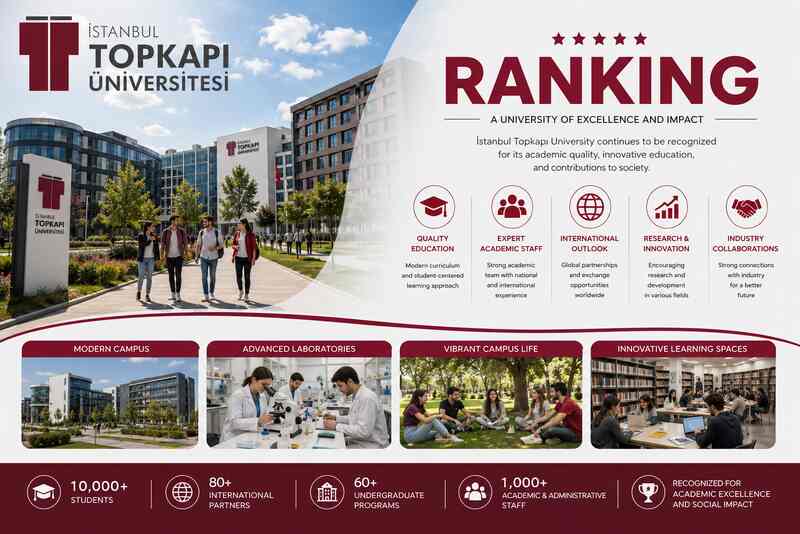
By 2026, the university operates across seven campuses, covering approximately 150,000 square metres across multiple Istanbul districts. It has grown from a single building in 2009 to 37 undergraduate departments, 56 associate degree programs, 36 master's programs, and 2 doctoral programs.
Topkapi University Ranking; The Real Numbers for 2026
Let me go through each ranking system and tell you what it actually measures.
Webometrics 2026 Webometrics places Topkapi at approximately 13,832nd globally and 192nd nationally among Turkish universities. Webometrics measures digital footprint the volume of web pages a university publishes, how often those pages are cited online, and the institution's overall web presence. For a young university that rebranded in 2022 and has been growing rapidly, a modest web-presence score is expected. It will improve as the university publishes more research and builds more indexed web content.
UniRanks 2026 UniRanks gives Topkapi a global rank of 10,879 and a local rank of 183, with a score of 30.87. UniRanks is a composite system that aggregates multiple data points slightly different methodology to Webometrics, hence the different numbers.
Times Higher Education (THE) Topkapi is not currently listed in the THE World University Rankings. THE requires minimum research output and faculty publication thresholds. Given the university's relatively recent full university status and its current focus on teaching quality over research volume, THE eligibility is a future goal rather than a current reality. The university is actively investing in research infrastructure to move toward this.
QS Rankings Topkapi does not currently appear in the main QS World University Rankings or the QS Western Asia regional rankings. Again, this reflects the institution's stage of development, not a fundamental academic problem.
What the rankings actually tell you Topkapi is a genuinely young, teaching-focused private university at the affordable end of Istanbul's private sector. Its global numbers reflect that. What rankings don't tell you is: YÖK-accredited programs, Erasmus+ participation, a JCI-accredited hospital for health students, a multi-campus presence across Istanbul's most culturally interesting districts, and bachelor's fees starting from around $1,750 per year. Those facts matter for a different kind of student than the one chasing a QS ranking.
What Makes Topkapi University Different
1. The Arts and Design Identity
Topkapi is one of the few private Istanbul universities that has genuinely positioned itself around arts, design, and architecture as a core part of its institutional identity not a peripheral faculty. The university describes its teaching model as one where "science, art, and design are interpreted together," which reflects the founding spirit of an institution that grew from a vocational arts school in the Balat district of Istanbul.
The Faculty of Fine Arts, Design, and Architecture sits at the Kazlıçeşme Campus. Balat is one of Istanbul's most historically layered neighborhoods Byzantine churches, Ottoman-era houses, narrow cobblestone streets and the campus environment reflects that cultural depth in ways that a campus in a business park or industrial suburb simply can't.
Research in art and design education consistently reinforces what dedicated creative environments do for students. A 2024 study by Oo et al. published in Thinking Skills and Creativity found that design-based learning significantly improved students' motivation, creativity, and design skills compared to traditional instruction, with 207 participants across two universities. The key mechanism: hands-on, problem-solving-oriented learning within structured studio environments exactly the model that characterizes serious fine arts faculties. For students choosing Topkapi's design programs, the campus setting and institutional commitment to arts matters.
A 2024 study in the Journal of Curriculum and Teaching by Kovalova et al. also found that practical training involving project-oriented workshops and cooperation with art institutions was critical for developing professional and creative skills in higher art education students. Topkapi's architecture and interior design programs, while currently offered in Turkish only, operate within this studio-and-practice model.
2. The Nursing Faculty and Health Sciences
Nursing is among the most internationally popular programs at Topkapi, and it's easy to see why. The Faculty of Health Sciences includes Nursing, Physiotherapy and Rehabilitation, Nutrition and Dietetics, and Psychology. For students from countries where nursing abroad leads to licensing back home, Topkapi's nursing track offers YÖK-recognized training at fees significantly lower than equivalent programs at Medipol or Okan.
What matters for nursing students is the quality of simulation and clinical training not just the classroom. Research in nursing education is clear on this point. A 2025 systematic review by Daneshfar et al. published in BMC Medical Education synthesized 15 studies involving over 1,100 nursing students and found that clinical simulation significantly improved students' clinical decision-making, self-confidence, and knowledge transfer to real practice settings, with high-fidelity simulation and scenario-based interventions being particularly effective for core competencies like CPR and infection control.
A 2019 meta-analysis by La Cerra et al. published in BMJ Open drawing on 33 studies found that high-fidelity patient simulation showed significantly larger effect sizes for both nursing students' knowledge (d=0.49) and clinical performance (d=0.50) compared to any other teaching method. This is the evidence basis for why simulation infrastructure in nursing programs matters so much.
A 2025 study by Yildirim et al. published specifically on Turkish undergraduate nursing education in BMC Nursing found that nursing students in Turkish foundation (private) universities reported high overall scores for program effectiveness and professional competence, but identified gaps in the educational process assessment and clinical biomedical sciences subscales pointing to areas where faculty resources and clinical training infrastructure are the key quality differentiators. For students evaluating Topkapi's nursing program, asking specifically about simulation lab access and clinical placement infrastructure is the right question.
3. The JCI-Accredited Hospital Connection
This is something almost no ranking article about Topkapi mentions clearly: the university's Gaziosmanpaşa Hospital holds Joint Commission International (JCI) accreditation. JCI is the international arm of the Joint Commission the gold-standard hospital accreditation body in the United States and JCI accreditation is recognized globally as a marker of hospital quality and patient safety standards.
For health sciences students, this matters. Hospital-affiliated training at a JCI-accredited facility means clinical placements in an environment that has been independently evaluated against international healthcare quality benchmarks. That's a meaningful difference from placements at a non-accredited facility.
Programs and Fees; What Topkapi Actually Costs in 2026
Here is the full and honest fee picture. Note: Topkapi is genuinely among the most affordable accredited private universities in Istanbul.
Standard Bachelor's Programs (Business Administration, Political Science, International Relations, Economics, Psychology, Sociology)
Most programs: approximately $1,750–$2,500/year (after standard discount)
Psychology (English): ~$2,500/year
Political Science and International Relations (English): ~$2,500/year
Faculty of Health Sciences
Nursing: approximately $3,250/year (Turkish), lower after scholarship
Physiotherapy and Rehabilitation: similar range
Faculty of Engineering
Civil Engineering, Computer Engineering, Software Engineering, Mechanical Engineering, Electrical Engineering: approximately $2,250–$2,500/year note these are Turkish-medium only
Faculty of Fine Arts, Design, and Architecture
Architecture, Interior Architecture, Visual Communication, Graphic Design: approximately $2,000–$2,500/year
Pharmacy
Approximately $10,000/year
Vocational/Associate Degree Programs
Approximately $1,450/year (50% scholarship applied)
Master's Programs
Approximately $3,250–$6,500/year depending on thesis/non-thesis and program
Doctoral Programs
Management Information Systems, Architecture: approximately $4,950/year (after 50% scholarship)
Scholarship structure: International students can typically access at least 50% tuition reduction. A 5% sibling discount is applied for families with multiple enrolled students. Merit-based additional discounts are available. Applications are free of charge.
Important limitation: Topkapi does not currently offer human medicine or dentistry programs. Students looking for those programs need to look at universities like Okan, IAU, Medipol, or Nisantasi.
Accreditation and International Recognition
YÖK: Full accreditation by Turkey's Council of Higher Education. All programs are legally recognized.
JCI (Joint Commission International): Gaziosmanpaşa Hospital, affiliated with the university's health sciences faculty, holds JCI accreditation. This is the international standard for hospital quality and patient safety.
Bologna Process / ECTS: Topkapi is Bologna-compliant and uses the European Credit Transfer System. Graduates receive a Diploma Supplement.
Erasmus+: Active Erasmus+ participant. Students can study one or two semesters at European partner universities with credit transfer and financial support. The university participates in Erasmus student and staff mobility programs.
Farabi: Domestic exchange program between Turkish universities.
Mevlana: Exchange program with international partner universities outside the EU/Erasmus network.
European Countries: Degree recognized across EU member countries through Bologna alignment.
Arab Countries: Recognized in several Arab countries. Verify the current list with the university's International Office for your specific country.
The Seven Campuses; Where You'll Actually Be
One thing that's genuinely useful to know before you apply: Topkapi's campuses are distributed across multiple Istanbul districts, and where your faculty is located affects your daily life significantly.
Kazlıçeşme Campus: Faculty of Economics, Administrative and Social Sciences; Plato Vocational School; Faculty of Fine Arts, Design, and Architecture. This is the main academic hub.
Balat Campus: Preparatory/language school. Balat is one of Istanbul's most atmospheric historic neighborhoods, on the European side near the Golden Horn.
Şişli Campus: Culinary Arts Department and Gastronomy programs. Şişli is a central, commercial district with excellent transport connections.
Levent Campus: Faculty of Sports Sciences. Levent is one of Istanbul's most modern business and residential districts on the European side.
Yenibosna Campus: Practical training facilities. Near the airport on the European side.
The multi-campus structure means the university is present in diverse parts of Istanbul culturally rich historic areas (Balat, Kazlıçeşme), modern commercial zones (Levent, Şişli), and practical training environments. This also means commuting between campuses if your program spans multiple faculties, so check which campus your specific department is based at before finalizing accommodation decisions.
How Topkapi Compares to Peer-Priced Istanbul Universities
University | Webometrics Turkey Rank | Est. Year | Standard Bachelor's (EN) | Signature Programs |
|---|---|---|---|---|
Istanbul Topkapi University | ~192nd | 2009/2022 | $1,750–$2,500/yr | Fine arts, nursing, design, social sciences |
Istanbul Kent University (IKU) | ~178th | 2016 | $2,250–$2,900/yr | Dentistry hospital, gastronomy |
Beykoz University | ~164th | 2016 | ~$1,700–$3,300/yr (after scholarship) | Logistics, aviation, 7+1 internship |
Istanbul Gedik University | ~120th | 2011 | $3,000–$5,500/yr | Music, technical |
Fenerbahce University | ~160th | 2016 | $3,200–$4,200/yr | Sports, pharmacy, Medicana hospitals |
At the price point Topkapi occupies, Beykoz University is probably its closest direct competitor both are similarly positioned in the lowest-cost tier of accredited Erasmus-connected private Istanbul universities. Beykoz is stronger for logistics and aviation students and has a more developed research publication record for a university of the same age. Topkapi has a stronger fine arts identity and the JCI hospital connection for health students.
Kent University (IKU) is similarly priced and has the Taksim dental hospital a major advantage for dentistry students. But Topkapi has programs IKU doesn't (such as sports sciences at the Levent campus) and a more developed fine arts faculty.
Fenerbahce and Gedik cost noticeably more for equivalent programs and are worth the premium only if the specific partnerships or program infrastructure they offer (Medicana for FBU, music for Gedik) are what you're specifically targeting.
Frequently Asked Questions
Q: Is Istanbul Topkapi University the same as Ayvansaray University? A: Yes. The university was formerly known as Istanbul Ayvansaray University (and before that as Plato Vocational School). It officially rebranded as Istanbul Topkapi University in 2022. Older articles, ranking entries, and some agency sites may still use the former names they all refer to the same institution.
Q: Why doesn't Topkapi appear in THE or QS world rankings? A: THE and QS both require minimum research output thresholds a set volume of faculty publications, citation counts, and academic reputation survey responses before a university can generate a ranked score. Topkapi is a teaching-focused university that only reached full university status relatively recently (rebranding in 2022). This is a normal characteristic for young institutions and doesn't reflect on degree validity or teaching quality.
Q: Does Topkapi offer medicine or dentistry? A: No. Topkapi does not currently offer human medicine or dentistry programs. Its health sciences faculty covers Nursing, Physiotherapy, Nutrition and Dietetics, and Psychology. Students specifically seeking medicine or dentistry should look at Okan, IAU, Medipol, Nisantasi, or IKU (dentistry only).
Q: Are engineering programs available in English? A: Currently, engineering programs (Civil, Computer, Software, Mechanical, Electrical) are offered in Turkish only. If you need an English-medium engineering program, universities like Okan, IAU, or Nisantasi are better options.
Q: What does the JCI accreditation of Gaziosmanpaşa Hospital mean for students? A: JCI (Joint Commission International) is the global gold standard for hospital quality and patient safety accreditation, recognized in over 100 countries. For health sciences students who do clinical placements through this hospital, it means training in an environment that has been independently verified against international benchmarks — a meaningful quality signal for nursing, physiotherapy, and health management students.
Q: How affordable is Topkapi really for international students? A: Very affordable by Istanbul private university standards. Most English-medium bachelor's programs come in at approximately $1,750–$2,500/year after the standard international student discount. With a 50% scholarship, this drops further. Living costs in Istanbul average $400–$500/month for a student budget. It's consistently one of the lowest-fee Erasmus-connected private universities in Istanbul.
Q: Can Topkapi graduates work in Arab countries? A: Degrees are recognized in several Arab countries. Verify your specific country's recognition requirements directly with the university's International Office, as this can vary.
Final Take; Who Should Consider Topkapi University?
Let me be direct. Topkapi University is not the right choice if you need a QS-ranked institution, a THE band on your CV, or a research-heavy environment with strong publication output. For those goals, universities like Okan, IAU, or Medipol are better fits.
But Topkapi makes a genuine case for a specific type of student:
You want a fine arts, design, architecture, or interior design degree in Istanbul's historic neighborhoods, at fees that don't require significant family sacrifice
You're studying nursing or health sciences and want an accredited program connected to a JCI-certified hospital, at Istanbul's lowest fee point in that field
You have a tight budget and want a genuine Erasmus-connected, YÖK-accredited degree with access to Istanbul's full cultural and professional ecosystem
You're studying social sciences, psychology, political science, or economics in English and want to be in Istanbul without paying mid-range Istanbul private prices
For those students, the low global ranking number is genuinely secondary. The degree is valid, Erasmus opportunities are real, the campus locations in historically rich Istanbul districts are an asset, and the fees starting from around $1,750/year are hard to beat anywhere in the city.
Read more at: Topkapi University - Honest Guide for International Students
universityfinder.org has a free university matching tool tell us your program, budget, and academic background and we'll compare Topkapi against the full range of Istanbul private universities that fit what you're actually looking for.