What Does a Study Abroad Agency Actually Do? (The Honest Answer for Students in 2026)

So you're thinking about studying abroad, probably in Turkey, and someone told you to "just use an agency." But what does that actually mean? What do these people do? Do you even need one? And how do you know if the one you're talking to is actually good?
These are fair questions. Honestly, a lot of students get confused about this not because they're not smart, but because the industry itself isn't very transparent. Some agencies do a lot. Some do almost nothing but send your documents to a university. So let me explain what a legitimate study abroad agency does, what separates a great one from an average one, and what you should definitely be watching out for when you're choosing who to trust with something this important.
What a Study Abroad Agency Is (And What It Isn't)
Let's start with the basics. A study abroad agency is a company or consultancy that helps international students apply to, get accepted into, and sometimes settle into universities in another country. The "sometimes" part is important because that's where the differences become really big.
Some agencies are basically middlemen. They take your documents, send them to a university they have a commission agreement with, and that's more or less it. You get an admission letter, they get paid by the university, and you figure out the rest on your own.
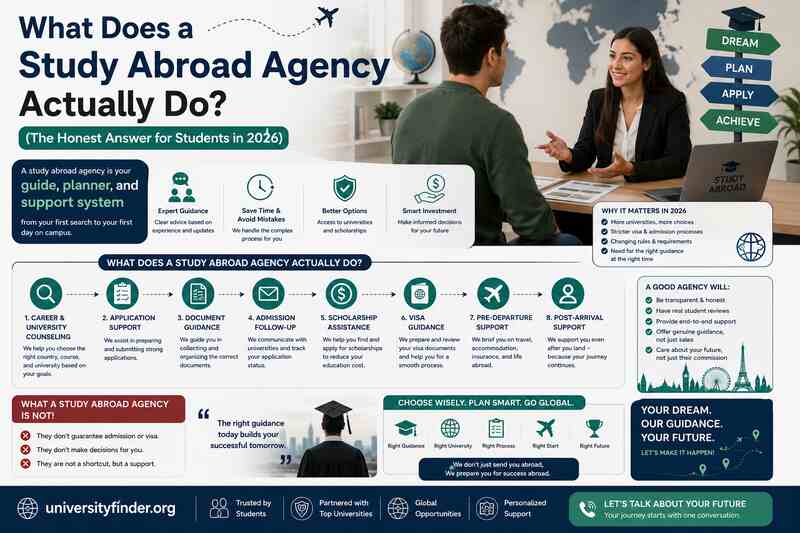
A proper, full-service agency is completely different. It starts from helping you choose the right university for your specific goals, grades, budget, and program not just any university they happen to work with. Then they handle the application process, help with documents, guide you on the student visa, and this is the part a lot of agencies skip they actually support you after you land in the country.
Think about it this way. You arrive in a new country, maybe you don't speak the local language, maybe you've never been there before. Who picks you up from the airport? Who takes you to register at the university? Who helps you get your student residence permit (ikametgah) sorted in those first confusing weeks? A good agency handles all of that. A middleman doesn't.
The Core Services a Real Study Abroad Agency Provides
Let me walk you through what a proper study abroad agency should be doing for you, step by step.
University matching and academic advising
This is where it starts. Not every university is right for every student. Your grades, your budget, your field of study, your language level all of these matter. A good agency sits with you (or talks with you online), reviews your academic background honestly, and tells you what's realistic. They don't just push the university that pays them the highest commission. If your grades are not strong enough for a certain program, they tell you upfront.
At universityfinder.org, I've seen so many students come to us after getting placed somewhere completely wrong wrong program, wrong city, wrong tuition level for their budget. The matching step, when done properly, saves you years of regret. Take it seriously.
Document preparation and application support
International university applications involve a specific set of documents your high school or bachelor's diploma, transcripts, passport copies, sometimes English language certificates, motivation letters, and more. Each document usually needs to be notarized, translated into Turkish (officially, by a sworn translator), and prepared in a specific format.
A proper agency handles all of this or at least walks you through every single step. They know what the university wants, so you don't spend weeks going back and forth trying to figure it out yourself.
Scholarship and fee guidance
Turkey in particular has a lot of scholarship options from Türkiye Scholarships (YTB), which is the government's flagship scholarship program for international students, to individual university discounts and partial fee reductions. A good agency knows which programs you're eligible for and helps you apply in time.
Worth knowing: a legitimate agency in Turkey doesn't charge you application fees. The university pays the agency a commission when students enroll. So if someone is asking you to pay $500 or $1,000 just to apply that's a red flag, not a service.
Visa guidance
After acceptance, you need a student visa. The process involves getting your acceptance letter authenticated, applying at the Turkish consulate or embassy in your country, and submitting the right documents. An experienced agency has done this process hundreds of times. They know what each consulate typically asks for, what mistakes cause delays, and how to avoid them.
On-ground support after arrival - the part most agencies skip
Here's where you really see the difference between agencies that care and ones that don't. What happens after you land?
At universityfinder.org, from what I've seen working with Turkey-based teams that do things properly, the best on-ground support includes: airport pickup (with proper transport, not just "someone will meet you"), help with final university registration and course selection, document translation for your ikametgah (residence permit) application, and someone who actually answers your calls in those first stressful weeks.
Most agencies stop the moment you have your admission letter. The really good ones the ones students actually recommend to their friends back home stay with you through registration, through course selection, and through the first semester if needed. That's a completely different level of service, and it's rare.
What Separates a Good Agency from a Bad One
This part is important. The study abroad industry unfortunately has some bad actors in it. Here's what to watch out for.
Red flags:
They charge you money just to apply. Again a proper agency in Turkey is paid by the university, not by you.
They promise you admission to programs you're clearly not qualified for ("100% guaranteed admission" to a medical school when you barely passed high school biology is not a real guarantee).
They pressure you to decide fast. Legitimate agencies give you time to think. High-pressure tactics are a classic warning sign.
They don't know the universities they're recommending. Ask them specific questions how many campuses does the university have, what's the English percentage of the curriculum, is the program recognized by YÖK? If they can't answer confidently, be careful.
They have no on-ground presence in the country. An agency that only operates from outside Turkey and has no actual team or office there can't support you properly after arrival.
Green flags:
They have a licensed, registered office in Turkey (verifiable through official records).
They've been operating for multiple years and have real student testimonials not just marketing copy.
They offer services clearly and without hidden costs.
They have staff who have personally helped students through arrival, registration, and residence permit processes.
They answer your questions honestly, including the uncomfortable ones about visa rejection risks, program difficulty, or degree recognition in your home country.
Why the On-Ground Experience Makes All the Difference
Let me tell you something that a lot of guides skip over. The first 2-3 weeks after you arrive in a new country are genuinely hard. Even for students who did their research, even for ones who feel prepared. The combination of jetlag, administrative paperwork, a language barrier, an unfamiliar city, and university bureaucracy all at once is overwhelming.
Students who arrive with proper on-ground support someone who meets them at the airport, takes them to the university to finalize registration, helps translate the documents for the ikametgah, explains which forms to sign and why settle in faster, make fewer mistakes, and are generally much happier in their first semester.
Students who arrive with just an admission letter and a phone number that takes two days to respond are the ones who post frustrated messages in Facebook groups asking for help.
I've seen this pattern repeat enough times to say confidently: the on-ground service is not a luxury extra. It's one of the most important things to ask about before you choose who to work with.
Comparing Universities in Turkey: What Your Agency Should Help You Decide
A big part of what a proper study abroad agency does is help you compare your options honestly. Turkey has over 200 universities, so here's a simplified comparison of some well-known private universities for international students, to show you the kind of decision-making a good agency should guide you through:
University | City | Annual Tuition (approx.) | Language | Key Strength |
|---|---|---|---|---|
Istanbul Medipol University | Istanbul | $10,000–$18,000 | English | Large hospital network, strong medicine/health programs |
Bahçeşehir University (BAU) | Istanbul | $9,000–$15,000 | English | Research focus, active campus life |
Istanbul Aydin University | Istanbul | $7,000–$12,000 | English / Turkish | Cost accessibility, wide program range |
Istanbul Gelisim University | Istanbul | $5,000–$9,000 | English / Turkish | Affordable fees, good for business and engineering |
Üsküdar University | Istanbul | $6,000–$10,000 | English / Turkish | Psychology, health sciences focus |
Tuition ranges are approximate for the 2026–2027 academic year. Always confirm current figures directly with the university or through your agency.
Now here's the thing just reading a table like this won't tell you which one is right for you. That's what a proper agency is actually for. Medipol is strong for medicine and nursing, but it's more expensive. Gelisim is much more affordable and fine for many programs, but it's less well-known internationally. BAU has a strong reputation for business students who want an English-heavy environment. Your agency should know these differences and match them to your specific goals not just put you wherever they have the easiest placement relationship.
A Word About Agency Fees and How They Actually Work
I want to be really clear about this because it confuses a lot of students.
Most legitimate agencies working with Turkish private universities do not charge the student anything. Zero. The university pays the agency a recruitment commission when a student enrolls. That commission is built into the university's budget it doesn't get added to your tuition. You pay the same tuition whether you came through an agency or applied directly.
So what does this mean for you? It means you should be able to get full application support, document help, admission guidance, and often visa advice completely free of charge. No service fees, no application processing fees, no "file handling" charges.
Universities in Turkey especially private ones actively work with authorized agencies because they help recruit international students from dozens of countries. An agency with a long track record and authorization from multiple universities has direct contacts in the admissions offices, which can actually speed up your application and sometimes get you better scholarship options.
When an agency charges you a large fee on top of all this, ask yourself: what are they actually giving you that justifies that cost? In most cases, the honest answer is: not much.
Frequently Asked Questions
Q: Do I actually need a study abroad in Turkey agency or can I apply to Turkish universities directly? A: You can apply directly to Turkish universities most private ones have online portals and will accept direct applications. But an agency helps you avoid common mistakes in your documents, navigate the scholarship options you might not know exist, and gives you support for visa and post-arrival steps that are genuinely complicated to handle alone. If you've done detailed research and feel confident, going direct is possible. For most students, especially those applying from outside Europe, having a good agency significantly reduces stress and errors.
Q: How do I know if a study abroad agency is legitimate and not a scam? A: Check a few things. Do they have a verifiable physical office in Turkey? Can you find real student reviews on Google or social media, not just testimonials on their own website? Do they charge you fees just to apply if yes, that's suspicious. Are they licensed or registered? A legitimate agency can show you proof of registration. Also just talk to them do they answer your questions honestly, or do they only tell you what you want to hear?
Q: What if I need help after I arrive in Turkey? Will my agency still support me? A: This depends on the agency. Ask this question directly before you commit to working with anyone. Some agencies stop at the admission letter. The ones worth working with will help you with airport pickup, final university registration, course selection, and your ikametgah (residence permit) paperwork. Don't assume ask specifically what happens after you arrive.
Q: Can an agency help me get a scholarship to study in Turkey? A: Yes, a good one can. There are official government scholarships (Türkiye Scholarships / YTB) with their own application process, and there are also university-specific discounts and partial scholarships. Agencies that work directly with universities often know which scholarship slots are still open, what the requirements are, and how to package your application to give you the best chance.
Q: Is it true that study abroad agencies in Turkey don't charge students? A: For the most part, yes. Legitimate agencies working with accredited Turkish private universities are paid through university commission, not student fees. So the service from application to admission letter should be free for you. There are exceptions, like if an agency offers premium services such as test prep or separate visa filing services. But the core study abroad in Turkey agency service, getting you admitted to a university, should not cost you anything.
Q: What documents do I need to apply to a Turkish university through an agency? A: Generally you'll need your high school diploma (or bachelor's degree for master's programs), official transcripts, a copy of your passport, passport-size photos, and sometimes an English language certificate. Some programs have additional requirements. Your agency will give you a full checklist specific to the university and program you're applying to.
So, What's the Bottom Line?
A good study abroad in Turkey agency is not just a form-filler or a middleman. It's a team that knows the universities, knows the visa process, knows what documents Turkish institutions actually want and stays with you even after your flight lands.
The difference between an agency that just sends your papers and one that meets you at Istanbul Airport, walks you into your university to finalize registration, helps translate your documents for your residence permit, and checks in on you during your first weeks that difference is enormous. It can be the difference between a smooth, exciting start to your international education and a stressful, disorienting mess.
universityfinder.org connects students with trusted, on-ground support for studying in Turkey. No application fees. No hidden charges. Just honest guidance from people who actually know the process from your first question all the way to your first day of class.