Kadir Has University Ranking 2026 - The Full Guide for Students Who Want a Research University

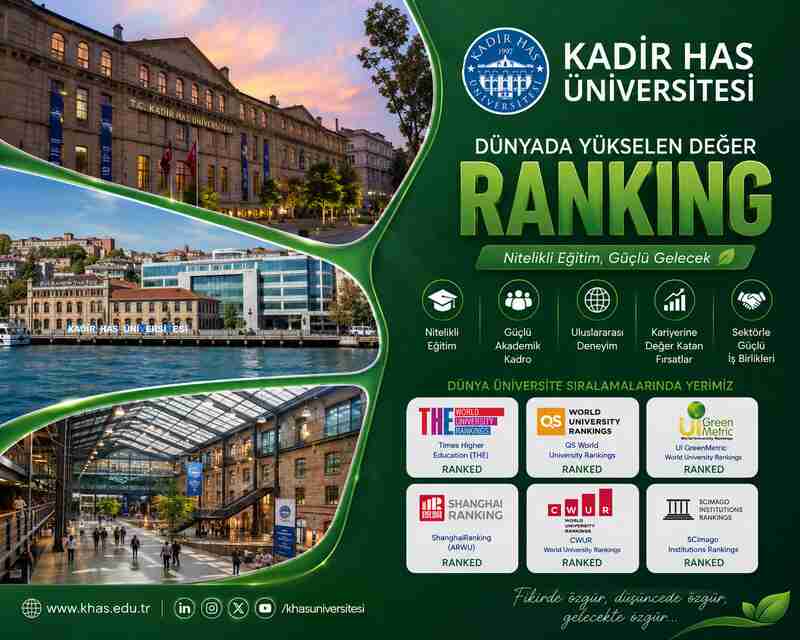
Kadir Has University KHAS, is a genuinely unusual institution. It's small by Istanbul private university standards: just 4,800 students. It occupies a 19th-century tobacco factory on the Golden Horn. It placed 28th globally and 1st in Turkey for Peace, Justice, and Strong Institutions in THE Impact Rankings. And it built a teaching model the Core Program that replaces first-year lectures with interdisciplinary, project-based learning co-designed with industry mentors.
For international students comparing Istanbul private universities, KHAS sits in a completely different tier from most institutions on this list. It's not trying to compete on size or breadth of programs. It's competing on research quality, academic depth, and a teaching model that the research evidence consistently supports.
Let me give you the full ranking picture, the specific numbers that matter most, and what the unusual features of this university actually mean for your degree.
Kadir Has University Ranking; Every Major System for 2026
Times Higher Education (THE) World University Rankings 2026 KHAS is placed in the 601–800 band globally, with a specific score placing it at approximately 715th worldwide. THE is widely considered the most credible international research-weighted ranking system. Among 109 Turkish universities that appear in THE's 2026 table, KHAS ranks 7th in Turkey overall and 4th among foundation (private) universities in the country.
Within the THE ranking breakdown, KHAS's strongest sub-score is in Research, where it placed 500th worldwide notably better than its overall position. This reflects a faculty that is publishing and being cited at a level more consistent with much larger institutions.
THE Interdisciplinary Science Rankings 2026: 251st globally This is the result that stands out most and gets the least attention from competitor articles. Among universities globally evaluated specifically for interdisciplinary scientific research research that crosses traditional disciplinary boundaries KHAS placed 251st in the world. For context: this is a top-250 global ranking in a specific research category, achieved by a university with fewer than 5,000 students. It tells you something concrete about the research culture at KHAS: faculty across engineering, natural sciences, social sciences, and design are collaborating across boundaries in ways that produce cited interdisciplinary work.
THE Impact Rankings 2026: 201–300 band globally THE Impact Rankings measure universities against the UN's 17 Sustainable Development Goals. KHAS placed in the 201–300 band overall among 2,318 institutions worldwide. At the individual SDG level, the results are exceptional:
Peace, Justice and Strong Institutions (SDG 16): 28th globally, 1st in Turkey
Gender Equality (SDG 5): 29th globally, 2nd in Turkey
Quality Education (SDG 4): 101–200 band globally, 2nd among Turkish foundation universities
Decent Work and Economic Growth (SDG 8): 201–300 band globally, 1st among Turkish foundation universities
Reduced Inequalities (SDG 10): 201–300 band globally
Partnerships for the Goals (SDG 17): 201–300 band globally
Sustainable Cities and Communities (SDG 11): 301–400 band globally
Industry, Innovation and Infrastructure (SDG 9): 401–600 band globally
The SDG 16 result 28th in the world for Peace, Justice, and Strong Institutions is remarkable for a private university in Istanbul. It's driven by KHAS's Center for International and European Studies, its Faculty of Law's research activity, its policy research outputs, and its institutional commitments to rule-of-law and governance research.
QS Europe University Rankings, Western Asia 2026 KHAS is ranked #51 in Western Asia in the QS 2026 rankings one of the strongest QS regional results among Istanbul private universities. Earlier QS Europe data (2025 ranking) placed it in the 551–600 band in Europe and 45th in Western Asia.
EduRank 2026 EduRank places KHAS at 46th in Turkey and 2,399th globally based on 3,389 academic publications and 39,841 citations. The citation count (nearly 40,000) is notably high for a university of KHAS's size, reflecting high-impact rather than merely high-volume research. Subject-level results:
International Relations and Diplomacy: 419th globally one of the best IR/Diplomacy subject rankings among Turkish private universities
Economics: 54th in Turkey, 2,131st globally a top-55 result nationally
Business: 58th in Turkey, 2,354th globally competitive with the broader private sector
Computer Science: 70th in Turkey, 2,894th globally strong for a small university
Engineering: 97th in Turkey, 3,345th globally
Mathematics: 82nd in Turkey, 2,725th globally
Liberal Arts & Social Sciences: 106th in Turkey, 3,114th globally Philosophy, Political Science, Law, Sociology, Linguistics
URAP 2025 The Turkish University Ranking by Academic Performance places KHAS 7th among foundation universities and 3rd among foundation universities without a medical school giving a clean apples-to-apples comparison with peer institutions that don't have the research boost that medical faculties typically provide.
Shiksha Popularity Ranking 2025 Places KHAS at 5th in Turkey and 644th globally reflecting strong reputation among students actively researching Turkish universities.
University Guru Meta-Ranking Aggregating across 11 different ranking systems, University Guru places KHAS at approximately #37 among Istanbul universities in its composite a position reflecting consistent performance across multiple evaluation frameworks.
The synthesis KHAS is the most research-intense private Turkish university relative to its size. Top-7 nationally in THE, top-50 in QS Western Asia, top-250 globally in Interdisciplinary Science, and top-30 globally in two SDG categories. For a university with fewer than 5,000 students, these results represent an extraordinary concentration of research output and citation impact.
The Campus; A 19th-Century Tobacco Factory on the Golden Horn
The physical setting of KHAS is one of the most distinctive of any university in Turkey, and it deserves more than a passing mention.
The Cibali campus occupies a building originally constructed in 1884 by the Ottoman Armenian architect Hovsep Aznavur as a tobacco factory. For nearly 70 years it was operated by TEKEL, the state-owned tobacco company. After a period of abandonment, the Kadir Has Foundation established in memory of the late Turkish industrialist and philanthropist Kadir Has secured a 29-year lease from TEKEL in 1997 and undertook an extensive, award-winning restoration project.
The restored campus received the Europa Nostra Award in 2003 the European Union's highest honour for cultural heritage conservation. The award recognized the exemplary restoration work that preserved the building's original 19th-century Ottoman industrial architecture while converting it into a fully functional university.
Inside the campus sits the Rezan Has Museum named after Kadir Has's wife which is notable for housing an 11th-century Byzantine cistern, one of the very few remaining Byzantine structures outside Istanbul's old city walls, and the ruins of an Ottoman-era bath. The museum is an integrated part of the campus, accessible to students and the public.
The campus spans over 45,000 square metres of indoor space along the Golden Horn, walking distance from the Grand Bazaar, Hagia Sophia, the Blue Mosque, and Topkapi Palace. For students who care about living in a culturally rich and historically significant environment rather than a suburban campus complex this location is genuinely irreplaceable.
A Selimpaşa campus also exists, and the university has additional facilities in Bahçelievler, but the Cibali/Kadir Has campus is the academic heart of the institution.
The Core Program; KHAS's Most Important Differentiator
Every university in Istanbul offers degrees. KHAS offers something different in its first year: the Core Program.
Here is what it actually involves. In the first academic term, all students regardless of faculty or intended major share a common interdisciplinary curriculum. Engineering students sit alongside law students, communication students alongside architecture students. The curriculum focuses on critical thinking, ethical reasoning, creative problem-solving, and understanding the social and scientific forces shaping the contemporary world.
In the second semester, the New Education Model activates: project-based learning replaces traditional exam-heavy coursework. Each student receives both an academic mentor and an industry mentor professionals from KHAS's partner companies who co-design the curriculum and guide student projects through real-world challenges. Students learn not by memorizing content for tests, but by building things, solving problems, and producing outputs that industry partners actually evaluate.
The research support for this model is strong. A 2020 systematic review by Guo et al. in the International Journal of Educational Research — the most-cited review of project-based learning in higher education, with over 1,024 citations — found that project-based learning consistently improves cognitive, behavioral, and affective student outcomes in higher education, with students reporting stronger knowledge acquisition and skill development compared to traditional instruction. The behavioral outcomes skills and engagement were particularly robust across studies.
A 2023 study by Balleisen et al. in Higher Education examining a large university's applied, interdisciplinary, project-based research program found that participation in applied project-based learning contributed to skill development in research, teamwork, and critical thinking; developed closer faculty-student relationships; increased graduation-with-distinction rates; and contributed to career discernment that shaped students' post-graduate trajectories. These are exactly the outcomes KHAS's Core Program and New Education Model are designed to produce.
A 2025 study by Naseer et al. in Scientific Reports found that industry-enriched project-based learning significantly improved student employability skills by 25% and increased engagement by 30% and satisfaction by 35% compared to standard curricula the first study to bring this model systematically into higher education at scale. KHAS's assignment of both academic and industry mentors to every student implements exactly the "industry engagement" dimension this research identifies as the key driver.
A 2024 study by González-Cespón et al. in Education Sciences found that interdisciplinary project-based learning that brought together students from biology, engineering, and humanities on shared real-world projects significantly improved students' transferable skills — including knowledge acquisition, self-directed learning, problem-solving, critical thinking, communication, and teamwork. Students and faculty showed high satisfaction with the approach. KHAS's Core Program, which brings engineering, law, communication, and design students into a shared first-year curriculum, is built on exactly this interdisciplinary premise.
Research Centers; Where KHAS's Academic Ambitions Are Most Visible
KHAS has six specialized research centers, and they reveal the university's deliberate research identity:
1. Centre for Energy and Sustainable Development Focused on renewable energy transition, climate policy, and sustainability research directly connected to KHAS's strong SDG performance in Quality Education and Decent Work.
2. Istanbul Studies Center Research on Istanbul's history, urban development, cultural heritage, and the city's role in regional politics. Given the campus's location in one of Istanbul's most historically significant districts, this center has a geographic advantage no suburban university can match.
3. Sports Studies Research Center Academic research on sports science, sports policy, and physical culture.
4. Gender and Women's Studies Centre Directly connected to KHAS's #29 globally, 2nd in Turkey ranking for SDG 5 (Gender Equality) in THE Impact Rankings. This center has a documented research record that is being recognized at the global level.
5. Center for International and European Studies Policy research, international relations scholarship, and EU-Turkey studies connected to KHAS's IR/Diplomacy EduRank position (419th globally) and its Faculty of Law's research output.
6. Centre for Cybersecurity and Critical Infrastructure Protection This is the most forward-looking and commercially relevant center. It conducts research on cyber threats, critical infrastructure vulnerabilities, digital policy, and cybersecurity governance. For engineering and computer science students, access to a dedicated cybersecurity research center is a meaningful academic resource and it reflects KHAS's deliberate positioning in a field of rapidly growing global demand.
Research in cybersecurity education consistently shows why dedicated institutional research infrastructure matters. A 2022 study by Aldaajeh et al. in Computers & Security with 117 citations found that national cybersecurity education programs are most effective when they map cybersecurity skills and competencies to specific strategic goals using established frameworks like NICE. KHAS's dedicated cybersecurity center provides exactly the kind of structured, framework-oriented research environment that produces industry-ready graduates rather than treating cybersecurity as a module inside a general computer science program.
A 2025 study by Nyale et al. in Industry and Higher Education on digital skills gaps found that significant discrepancies exist between academic curricula and industry needs in data science, AI, and cybersecurity, with limited practical experience being the key gap, and recommended enhanced industry-academia collaboration as the primary solution. KHAS's combination of cybersecurity research center, industry mentor program, and project-based curricula directly addresses all three gaps this study identifies.
The Five Faculties; Programs and What They Offer
KHAS runs five faculties, which reflect its deliberately focused, boutique university model:
Faculty of Engineering and Natural Sciences
Computer Engineering (English)
Electrical-Electronics Engineering (English)
Industrial Engineering (English)
Mechatronics Engineering (English)
Molecular Biology and Genetics (English)
Engineering programs hold MÜDEK accreditation the internationally aligned Turkish engineering accreditation body. The Psychology program holds accreditation from the Turkish Psychological Association (TPD).
Faculty of Economics, Administrative and Social Sciences
Business Administration (English)
Economics (English)
International Relations (English)
Political Science and Public Administration (English)
International Trade and Finance (English)
Management Information Systems (English)
Psychology (English)
Faculty of Communication
Advertising (English)
New Media (English)
Radio, Television and Cinema (English)
Visual Communication Design (English)
Faculty of Art and Design
Architecture (English)
Industrial Design (English)
Interior Architecture and Environmental Design (English)
Theatre (Turkish)
Faculty of Law
Law (30% English, 70% Turkish)
All programs except Law (and Theatre) are fully English-medium. The 16.5% international student rate with 750+ international students from 83 countries means the English-medium programs have a genuinely diverse classroom environment.
Fees for International Students (2026)
Here's the honest fee picture:
Bachelor's Programs
Most English-medium programs: approximately $5,400–$7,125/year
Computer Engineering (English): approximately $6,000/year
Business Administration (English): approximately $6,000/year
Architecture (English): approximately $6,000/year
Mechatronics Engineering (English): approximately $6,000/year
Law (Turkish/partial English): approximately $6,000/year
Master's Programs
Approximately $9,000/year (thesis and non-thesis tracks available)
Doctoral Programs
Approximately $16,500/year
Scholarships:
Merit-based scholarships of 25%–75% tuition reduction are available for high-achieving international applicants
Sports scholarships for student athletes
Double major and minor programs available at no additional tuition surcharge
Fees are higher than many Istanbul private universities KHAS is priced at a premium consistent with its research positioning. For context: this is comparable to Okan University ($4,000–$4,500/year for engineering) and higher than Nisantasi ($2,450–$3,000/year). But KHAS's research depth, SDG rankings, THE band, and QS Western Asia position (#51) are all significantly stronger than these comparators.
Living costs in Istanbul average $500–$1,000/month for students. KHAS's Golden Horn location puts students in one of the city's most affordable (historically working-class) districts, with excellent public transport connections.
How KHAS Compares to Peer Istanbul Private Universities
University | THE 2026 | QS Western Asia | EduRank Turkey | Standard Bachelor's (EN) | Signature Strength |
|---|---|---|---|---|---|
Kadir Has University | 601–800 (7th in Turkey) | #51 | 46th | $5,400–$7,125/yr | THE Interdisciplinary 251st, SDG 16 28th globally, Core Program, tobacco factory campus |
Istanbul Okan University | 1501+ | #79 | 77th | $4,000–$4,500/yr | ABET+MÜDEK engineering, own hospital |
Istanbul Kultur University | 1501+ | #79 | 64th | $3,000–$4,500/yr | IR/Diplomacy 899th globally, MÜDEK |
Nisantasi University | Not listed | #38 | 78th | $2,450–$3,000/yr | EAAE comms, aviation simulation |
Istanbul Aydin (IAU) | 1501+ | #35 West Asia | 39th | $4,000–$6,500/yr | Large campus, medicine, strong EduRank |
The comparison that stands out most: KHAS's THE band (601–800, 7th in Turkey) is dramatically stronger than all these comparators, which cluster in the 1501+ range or below. Its QS Western Asia position (#51) is the second-strongest in this list. Its EduRank position (46th in Turkey) is lower than IAU (39th) but higher than IKU, Okan, and Nisantasi consistent with the pattern of a research-active small university.
What KHAS doesn't have: medicine/dentistry programs (which is why IAU and Okan attract health students), aviation programs (Nisantasi, Okan), ABET engineering (Okan), or the lowest possible fees (Nisantasi, Beykoz). For students who don't need those specific things and want the highest-ranking, most research-active private Istanbul university they can access, KHAS is the clear choice.
Frequently Asked Questions
Q: What is Kadir Has University's THE ranking for 2026? A: KHAS is placed in the 601–800 band globally (approximately 715th) by Times Higher Education in the 2026 World University Rankings ranking 7th in Turkey and 4th among Turkish foundation universities. Its strongest THE sub-score is in Research (500th globally). It also placed 251st globally in THE's Interdisciplinary Science Rankings 2026.
Q: What does KHAS's SDG 16 ranking of 28th globally mean? A: SDG 16 is "Peace, Justice and Strong Institutions." THE evaluates universities on how their research, teaching, and institutional practices contribute to this UN goal covering rule of law research, access to justice, governance scholarship, and institutional transparency. Ranking 28th globally and 1st in Turkey means KHAS is among the leading universities in the world for documented contributions to this specific goal. It reflects the Faculty of Law's research profile, the Center for International and European Studies, and the university's institutional commitments.
Q: Why is KHAS so small (only 4,800 students)? A: It's a strategic choice, not a limitation. KHAS deliberately maintains a boutique scale that enables small group teaching, close faculty-student relationships, and the mentored project-based learning model that the Core Program requires. The research shows this model produces better student outcomes than large lecture-hall approaches and KHAS has built its entire academic identity around it.
Q: What is the Core Program and why does it matter? A: The Core Program is a compulsory first-semester interdisciplinary curriculum where all students regardless of major share a common learning experience focused on critical thinking, ethics, and scientific literacy. From the second semester, a project-based New Education Model replaces traditional exams with real industry-mentored projects. Research consistently shows this model improves cognitive and behavioral student outcomes, increases graduation quality, and improves career readiness more than traditional curricula.
Q: Does KHAS offer medicine or health science programs? A: No. KHAS does not offer medicine, dentistry, nursing, or pharmacy. Its health-adjacent programs are in Molecular Biology and Genetics (engineering faculty) and Psychology. Students targeting clinical health programs should look at Okan, IAU, Medipol, or Halic.
Q: How does KHAS's cybersecurity center work for students? A: The Centre for Cybersecurity and Critical Infrastructure Protection conducts active research on cyber threats and digital governance. Students in Computer Engineering or Electrical-Electronics Engineering can participate in research groups from their first year, collaborate on funded projects, and work alongside faculty with specialized cybersecurity expertise a level of research engagement not typically available at larger, less research-focused private universities.
Q: Are KHAS degrees recognized internationally? A: Yes. KHAS is YÖK-accredited, Bologna-compliant (ECTS credits, Diploma Supplement), and has partnerships with over 200 universities worldwide through Erasmus+ and bilateral agreements. Engineering programs hold MÜDEK accreditation. The degree is recognized across EU countries and in many countries globally through Turkey's international agreements.
Final Verdict; Who Should Seriously Consider KHAS?
Let me be direct.
Kadir Has University is the strongest private research university in Istanbul relative to its size. The THE 601–800 band, the top-30 global SDG rankings, the top-250 global Interdisciplinary Science ranking, the QS Western Asia #51 these are results that no other Istanbul private university at a comparable price point can match.
But it's not for everyone. No medicine. No aviation. Fees at the upper end of the private Istanbul market. A small campus that emphasizes depth over breadth. You can't get lost in a crowd at KHAS in a class of 4,800, faculty know who students are, and the project-based model requires active engagement rather than passive attendance.
KHAS is the right choice if:
You want the highest-ranked private university in Istanbul (by THE standards) with a research-active faculty and a globally recognized SDG performance
You value interdisciplinary, project-based education with both academic and industry mentors over traditional exam-based teaching
You're studying International Relations, Law, Computer Engineering, Business, Economics, or Communication all of which have strong EduRank subject positions at KHAS
You want to do your degree in an architecturally extraordinary campus a restored 1884 Ottoman tobacco factory on the Golden Horn, with a Byzantine cistern under the museum in walking distance from Istanbul's most historic sites
You are interested in cybersecurity, policy research, or governance fields where KHAS's dedicated research centers give you something most Istanbul private universities can't offer
universityfinder.org has a free matching tool share your program, budget, and academic profile and we'll compare KHAS against every other Istanbul private university that fits your specific situation.