Istanbul Aydin University Ranking Explained - What the Numbers Mean for You in 2026

If you're trying to figure out where Istanbul Aydin University actually stands globally and more importantly, what that means for your degree you've probably already noticed something a bit confusing. Search for "Istanbul Aydin University ranking" and you get a different number from every website. One says #1201, another says #2226, another says #1354. So what's going on?
Let me break this down properly, because understanding why the numbers differ is actually more useful than memorizing any one figure. And once you see the full picture, you'll be in a much better place to decide if IAU is the right choice for you.
Istanbul Aydin University ranking depends entirely on which agency you're looking at and each agency measures something different. That's not a bug. It's just how the global university ranking system works. So instead of giving you one number and calling it a day, let's go through each major ranking system, see what IAU scored, and then talk about what it actually means for your future.
Why Rankings Differ So Much; and How to Read Them
Before we get into the actual numbers, you need to understand one thing: no single ranking tells the whole story. QS, Times Higher Education (THE), U.S. News, EduRank, Webometrics they all measure different things, and they weight those things differently.
QS, for example, puts a lot of weight on academic reputation surveys and citations per faculty. THE focuses more on teaching environment, research output, and international outlook. Webometrics is almost entirely about digital presence how many web pages the university has, how often they're cited online. EduRank focuses on raw research output and citation impact.
So if you're asking "which ranking is real," the answer is all of them are and none of them alone is the complete picture. What you want to do is look at a few different systems together, see where the university consistently performs, and then check whether the accreditations (which actually guarantee your degree is valid) are in place.
With that said, let me show you where IAU actually stands.
Istanbul Aydin University Ranking Across Major Systems (2026)
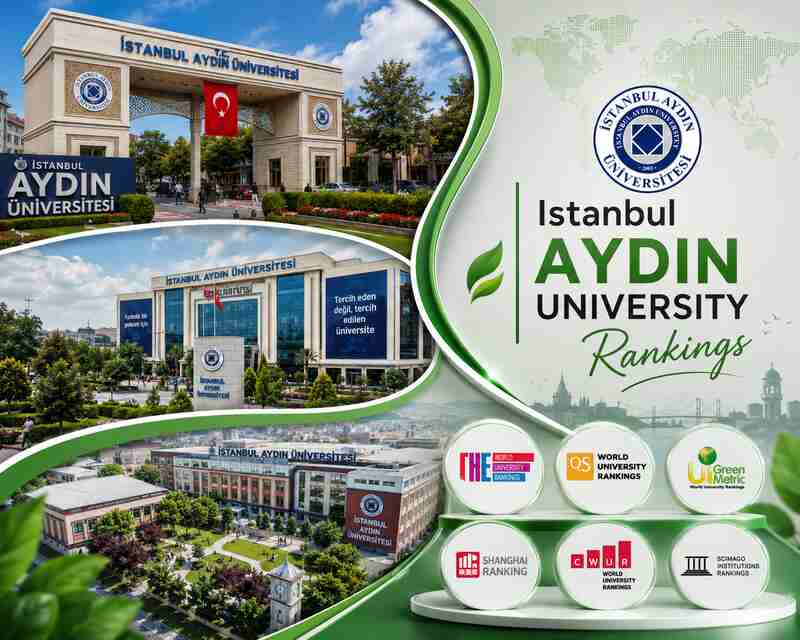
Here's a simple breakdown. IAU appears in several major global ranking systems for 2026, and the results tell an interesting story:
QS World University Rankings 2026 IAU is placed in the #1201–1400 band globally. That's out of roughly 17,000 recognized universities worldwide. So making it into QS at all puts IAU ahead of the majority of universities that don't appear on QS at all. That said, it's not at the top end of QS and that's worth being honest about.
Times Higher Education (THE) World University Rankings 2026 In the main THE ranking, IAU falls in the 1501+ category. So similar tier to QS, present on the list, growing, but still in the broader band rather than the top 1000.
THE Engineering Rankings 2026 Here's where it gets interesting. IAU's engineering faculty specifically is ranked 1001–1250 globally by THE which is noticeably better than the overall university rank. If you're planning to study engineering, that's a useful signal.
THE Impact Rankings 2026–2027 This one doesn't get enough attention. THE's Impact Rankings measure how universities are doing against the UN Sustainable Development Goals not just research output but real-world contribution. IAU's results here are actually strong: ranked 301–400 globally for clean energy, 401–600 for industry, innovation and infrastructure, and 14th in Turkey for combating poverty. These aren't vanity rankings they reflect the university's research and institutional direction.
U.S. News & World Report Best Global Universities IAU comes in at #1354 globally here, with 13 separate indicators used to calculate the score. Research output and citation impact play a big role.
EduRank 2026 EduRank places IAU at #2226 out of 14,131 universities globally and critically, 39th out of 175 universities in Turkey. So locally, inside Turkey, IAU is in the top quarter of all universities in the country. That's a meaningful benchmark when you're thinking about the value of the degree in the Turkish job market or within Turkish graduate programs.
Webometrics This one fluctuates but generally places IAU around 36th–39th nationally, with a global figure around 1,800–2,200 depending on the update cycle.
So what does all this tell you? IAU is consistently a mid-tier global university with above-average national standing. It's not in the same league as Boğaziçi or Koç (Turkey's most elite institutions), but among private universities the fairer comparison for IAU it holds a solid position.
Where IAU Stands Among Private Universities in Turkey
This is actually the most useful comparison for most international students, because the public state universities in Turkey (ITU, Boğaziçi, Istanbul University) have very different admission processes, languages, and student demographics.
Among private/foundation universities in Turkey, IAU is regularly ranked in the top 5 in Turkey by U.S. News across 45 evaluated Turkish institutions. EduRank puts it 39th nationally across all 175 Turkish universities but when you narrow it to private foundations specifically, that position looks much better, because many of the institutions ranked higher are large, research-heavy state universities.
It also helps to know that IAU has over 43,000 students, including around 6,000 international students from 125+ countries. That's one of the larger international student populations of any private university in Turkey. The scale matters bigger international intake usually means better support infrastructure, more English-medium programs, and more experience handling foreign students' needs.
Istanbul Aydin University Accreditation; More Important Than the Ranking Number
Here's something most ranking articles completely skip, but it's honestly the thing that matters most for your degree's value: accreditation.
A university's global ranking tells you roughly how prestigious it is. But accreditation tells you whether your specific degree is actually recognized in your country or in international professional fields. Those are two different questions.
IAU has a solid set of accreditations across multiple faculties:
YÖK: All programs are recognized by Turkey's Council of Higher Education. This is the baseline requirement.
MÜDEK: Engineering programs carry this accreditation, which is equivalent to ABET recognition internationally. If you're doing engineering, this matters a lot.
FEDEK: Covers arts, sciences, languages, history, health sciences.
ADEE: The Association for Dental Education in Europe granted this in 2018. Dentistry graduates can pursue professional registration in EU countries.
EPDAD: Education and teaching programs.
JCI: The Joint Commission International accreditation for the dentistry hospital. This one signals the training hospital meets international clinical standards.
AACSB: The business school holds membership with AACSB-aligned principles.
WDOMS: The medical program is listed in the World Directory of Medical Schools, which is essential for graduates who want to sit licensing exams or practice medicine in many countries.
The WDOMS listing for medicine is especially important. Without it, a medical degree from a Turkish university may not be valid for licensing exams in countries like Canada, the UK, or parts of the Gulf. IAU's medicine degree passing this threshold means graduates have a viable pathway to international licensing though you'll still need to verify specifics for your home country.
How IAU Compares to Peer Universities in Turkey
Let me put this in a table so it's actually easy to use when you're comparing your options:
University | QS 2026 | Turkey Rank (EduRank) | Tuition/Year (Bachelor's, EN) | Key Strength |
|---|---|---|---|---|
Istanbul Aydin (IAU) | 1201–1400 | 39th | $4,000–$6,500 | Medicine, engineering, large intl. community |
Bahçeşehir (BAU) | 1001–1200 | ~30th | $7,000–$12,000 | Media, law, strong Erasmus network |
Istanbul Medipol | 1201–1400 | ~35th | $6,000–$18,000 | Health sciences, hospital training |
Istanbul Okan | 1401+ | ~50th | $4,000–$7,000 | Aviation, transport, engineering |
Üsküdar University | 1401+ | ~55th | $4,000–$7,500 | Psychology, neuroscience |
A few things to note from this table. IAU and Medipol sit in roughly the same QS band, but IAU's bachelor's fees are generally lower especially outside medicine. BAU has a slightly stronger QS position but costs noticeably more. Okan is cheaper but ranked lower and has a narrower program range.
So if you're comparing costs, IAU gives you decent rankings without the premium price tag that some competitors charge. And if you're specifically doing medicine or dentistry, IAU's combination of WDOMS listing + ADEE accreditation + competitive (for the program type) fees puts it in a genuinely competitive position.
What IAU's Research Output Actually Looks Like
Rankings that factor in research (QS, THE, EduRank) are partly measuring the university's academic output. So it's worth knowing what IAU is actually researching.
EduRank tracks IAU's publication and citation record across disciplines. The university has produced over 8,400 academic publications with more than 83,704 citations. In terms of subject-level performance, the standout fields are:
Liberal Arts & Social Sciences: 39th in Turkey, 2140th globally (4,104 publications)
Medicine: 76th in Turkey, 2474th globally (3,453 publications)
Engineering: 100th in Turkey, 3421st globally (2,568 publications, focus on materials science, electrical engineering, AI)
Computer Science: 89th in Turkey, 3304th globally (strong output in AI and machine learning)
These figures are useful context. Engineering at IAU, for instance, publishes actively in relevant fields (AI, cyber security, materials science), which aligns with the MÜDEK accreditation and THE's engineering-specific ranking showing IAU performing better in that faculty than overall.
If research output matters to you—say, you're considering a master's or PhD, or you want to work under an academically active supervisor this subject-level data is more useful than the overall university rank.
Frequently Asked Questions
Q: Is Istanbul Aydin University ranking good enough for an international career? A: For most career paths, yes especially if you're in a field where the specific accreditation matters more than the university's name recognition. MÜDEK for engineering, ADEE for dentistry, WDOMS for medicine these are the credentials that open doors internationally, and IAU has them. For fields like business or computer science, employers in most countries care about your skills and degree validity, not your university's QS band.
Q: How does IAU rank inside Turkey specifically? A: EduRank places it 39th out of 175 universities in Turkey, which puts it in the top quarter nationally. Among private foundation universities specifically (a fairer peer group), its standing is stronger. It consistently appears in the top 5 Turkish private universities in U.S. News evaluations.
Q: Is a degree from Istanbul Aydin University recognized abroad? A: It depends on the country and field. The YÖK accreditation covers Turkey itself. For engineering, MÜDEK is internationally aligned. For medicine, WDOMS listing means graduates can pursue licensing exams in many countries, including in Europe and North America (subject to additional exams). The dentistry ADEE accreditation opens doors in the EU. Always verify the specific recognition requirements for your destination country before enrolling.
Q: Does IAU's ranking affect Erasmus exchange opportunities? A: IAU is a full Erasmus+ participant with partnerships at over 450 international universities. Erasmus eligibility isn't determined by rankings it's based on institutional agreements. So even though IAU isn't in the top 500 globally, its Erasmus network is extensive and students regularly go on exchange to European universities.
Q: Is Istanbul Aydin University good for medicine specifically? A: Medicine at IAU costs around $22,000–$25,000 per year and is taught in English. The program is WDOMS-listed (essential for international licensing pathways) and the dentistry hospital holds JCI accreditation. The medicine faculty ranks 76th in Turkey for research output. Compared to many private Turkish medical programs, IAU is a mid-to-upper option in terms of infrastructure and international validity.
Q: What are the tuition fees at IAU for 2026–2027? A: For the 2026–2027 academic year, bachelor's degrees generally range from $4,000 to $6,500 per year depending on program and language of instruction. Medicine runs up to $25,000 and dentistry around $23,000. Master's programs range roughly $3,500–$8,500. Associate degrees start from around $3,000. These figures are consistent across multiple agency sources but always confirm with the university directly before applying.
So Should Rankings Be the Main Thing You Look At?
Honestly, no. Rankings are a useful starting point they tell you roughly how the university sits relative to others in terms of research output and reputation. But they don't tell you:
Whether your specific program is accredited for your career path
What the campus life is actually like for international students
Whether you'll get proper support when you arrive (not just an acceptance letter)
Whether the city is affordable and easy to live in
IAU's QS band of 1201–1400 doesn't tell you that Istanbul is one of the most livable, affordable, and culturally rich cities in Europe or Asia. It doesn't tell you that IAU runs a student exchange program with 450+ universities. It doesn't tell you that engineering at IAU has a better specific ranking than its overall score suggests.
Use rankings as one input. Then look at accreditations for your field, talk to current students if you can, and check what support you'll actually get on the ground after you arrive.
Read more at: Istanbul Aydin University - Supreme Guide
universityfinder.org has a free university matching tool, just share your program goals, budget, and grades, and we'll match you with the best options for your specific situation across Turkey's private universities.