Halic University Ranking 2026 - The Complete Guide for International Students

Most university ranking guides about Halic University give you one or two numbers and call it done. This one won't. Because Halic is an unusual institution founded by a children's cancer charity, sitting along Istanbul's Golden Horn, running everything from veterinary medicine to a full conservatory and a single number doesn't come close to capturing what this university actually is.
Let me give you the full ranking picture across every major system, explain what each number means, cover what makes Halic genuinely different from other Istanbul private universities, and use peer-reviewed research to back up the programs that deserve most attention: veterinary medicine, nursing, and the conservatory.
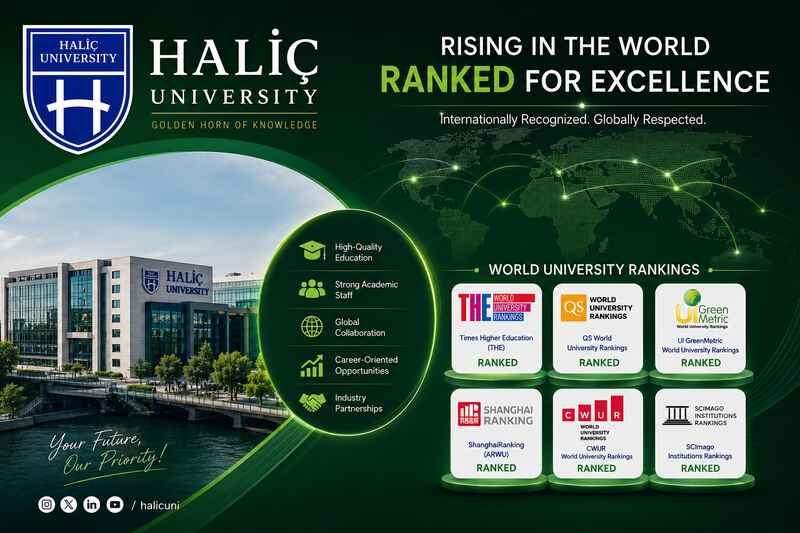
Halic University Ranking - All Systems for 2026
Times Higher Education (THE) World University Rankings 2026 Halic University appears in the 1001+ band globally by THE meeting the minimum research output and teaching thresholds required to qualify for THE ranking at all. More significantly, in THE's Impact Rankings which measure universities against the UN Sustainable Development Goals Halic ranks among the Top 200 globally for Reducing Inequalities and in the 1001–1500 band overall for sustainability and social development contributions. The Reducing Inequalities placement is a genuinely strong result. It puts Halic in the top 200 universities in the world for this specific SDG, competing with institutions far larger and better-resourced. For a foundation university built on a children's charity mission, this result is not accidental.
QS Europe University Rankings Western Asia 2026 QS places Halic at #131 in Western Asia in the 2026 QS Europe University Rankings. QS is globally recognized by employers and graduate admissions offices. The Western Asia #131 position confirms Halic as a QS-evaluated, regionally-placed institution important for CV recognition and graduate school applications in countries that reference QS tables.
EduRank 2026 EduRank is the most detailed research-output-based picture. It places Halic at 70th in Turkey and 3,328th globally based on 2,238 academic publications and 14,732 citations. The 2026 update shows improvement from the 2025 figure of 77th nationally. The subject-level breakdown is where the real data lives:
Plastic Surgery: 1,086th globally Halic's single strongest subject ranking, reflecting active clinical faculty
Medicine overall: 113th in Turkey, 3,745th globally 1,109 publications (Pathology, Psychiatry, Surgery, OB-GYN, Physical Therapy)
Computer Science: 121st in Turkey, 4,400th globally 702 publications (AI, Machine Learning, Cybersecurity, Telecommunications)
Liberal Arts & Social Sciences: 127th in Turkey, 4,012th globally 1,074 publications (Philosophy, Political Science, Law, Sociology, History)
Biology: 129th in Turkey, 4,788th globally 943 publications (Genetics, Biochemistry, Paleontology, Neuroscience, Immunology)
Engineering: 131st in Turkey, 4,879th globally 636 publications
The national rank of 70th overall (and improving) puts Halic in the top 40% of Turkish universities by research output a solid position for a private foundation university with roughly 10,000 students.
University Guru Meta-Ranking Aggregating across multiple ranking systems, University Guru places Halic at #27 among Istanbul universities and in the top 30% nationally a composite position that reflects consistent, if not elite, performance across different methodologies.
UniRanks 2026 UniRanks places Halic at 5,352nd globally a lower number reflecting the web-presence weighting that tends to penalize smaller, less digitally dominant institutions.
Webometrics 2026 Webometrics places Halic at approximately 6,609th globally and 138th in Turkey. This is among the lower positions in Halic's ranking portfolio, again reflecting Webometrics' heavy reliance on web citation volume.
The synthesis Halic is a consistently top-70 Turkish university by research output (EduRank), THE-placed and Impact Rankings-active, QS Western Asia-listed at #131, and top-200 globally for the Reducing Inequalities SDG. For a private foundation university of this size in Istanbul, that's a multi-system confirmed profile that places it clearly in the serious mid-tier of Turkish private higher education — above Topkapi and Kent University, broadly comparable to Nisantasi, and below the top-tier of IAU, Okan, and Medipol.
The Founding Story; A University Built on a Children's Charity
Most articles about Halic mention the founding date (1998) and move on. But the institution behind the university changes how you understand its mission.
Halic University was established by the Bizim Lösemili Çocuklar Vakfı the Foundation for Children with Leukemia in accordance with Turkish Higher Education Law No. 2547. The foundation was originally created to provide care and treatment for children with leukemia in Turkey, a country where access to specialized pediatric oncology care has historically been limited.
A university founded by a children's cancer charity isn't structured the same way as one founded by a business conglomerate or real estate company. Its institutional values the 8:4 student-to-instructor ratio cited in THE's university profile, the strong performance in the Reducing Inequalities Impact Rankings, the emphasis on health sciences all flow from this founding purpose. The university describes its mission explicitly as "serving the public through educational services and scientific research."
For international students, this context matters. The campus culture at a mission-driven foundation university tends to be different from a commercially-motivated institution. International students at Halic have noted in published reviews that professors are "approachable and kind," that clinical practice in nursing begins early, and that the environment emphasizes real learning over performance metrics.
The university is located along Istanbul's Golden Horn (Haliç) the historic inlet dividing the European side of Istanbul — which gives its name to the institution. The Golden Horn campus provides direct access to Istanbul's historic peninsula, Byzantine and Ottoman-era architecture, and the Beyoğlu district's cultural and commercial life. It's a genuinely distinctive location, unlike the suburban or industrial-zone campuses of many Istanbul private universities.
The Unusual Program Mix; What Makes Halic Different
Halic has one of the broadest and most unusual program combinations of any Istanbul private university. Here are the programs that competitors never cover properly:
1. The Conservatory Halic operates a full Conservatory offering music performance, composition, and music education. This is rare among private Turkish universities most offer music as a module within fine arts faculties, but a dedicated conservatory implies performance training, ensemble work, studio practice, and professional performance opportunities throughout the degree.
Research on conservatory education consistently shows that the performance-centred, studio-based model produces different kinds of graduates than conventional university programs. A 2022 paper by Sternberg et al. in the Journal of Intelligence found that the conservatory model develops not just technical skills but a wide range of cognitive, affective, and conative skills that are valuable for any student entering any professional field including resilience, deep practice, feedback integration, and creative problem-solving. For music students specifically, being in Istanbul a city with a thriving classical, jazz, and folk music scene, with concert halls, theaters, and professional ensembles means the conservatory training extends naturally into real-world performance opportunities.
A 2019 study by Bartleet et al. in Music Education Research found that preparing conservatory graduates for portfolio careers — rather than assuming a single linear performance trajectory — is the most important thing higher music education can do, given that most musicians sustain themselves through a combination of performance, teaching, composing, and music-adjacent roles. Istanbul's creative economy provides exactly the multi-role professional environment this research recommends for graduate development.
2. School of Fisheries and Aquaculture This is genuinely unusual. Halic is one of the very few private Turkish universities to operate a School of Fisheries and Aquaculture. Istanbul's location on the Bosphorus, surrounded by the Black Sea, Marmara Sea, and Aegean, makes this a legitimate and geographically meaningful program rather than an arbitrary addition. Aquaculture, fisheries management, and marine biology are growing fields globally particularly as climate change and food security become pressing international concerns.
3. Faculty of Veterinary Medicine (VEDEK-Accredited) Halic has a Faculty of Veterinary Medicine one of the rarest program types among Istanbul private universities. The program holds VEDEK accreditation the Turkish veterinary medicine program accreditation body. Finding veterinary medicine at an affordable private Istanbul university is genuinely unusual. Most students targeting vet studies in Turkey look at state universities (Ankara University, Istanbul University) or go abroad.
Research on veterinary clinical education emphasizes the critical importance of practical workplace training. A 2025 study by Drzemalla et al. published in Frontiers in Veterinary Science found that 73% of veterinary students were satisfied with the quality of practical year training when it was well-supervised, but veterinarians consistently noted deficits in students' practical skills compared to theoretical knowledge pointing to supervised clinical placements as the decisive quality differentiator between veterinary programs. For students evaluating Halic's vet faculty, asking specifically about the clinical placement structure and hospital/clinic partnerships is the right question.
A 2024 systematic review by Veenema et al. in Frontiers in Veterinary Science covering 103 studies of simulation-based veterinary education found that competence and knowledge were the most frequently measured outcomes, with static and screen-based simulators being most effective for procedural training and clinical reasoning respectively. For vet students, the simulation laboratory infrastructure is as important as the clinical placement program — and both should be assessed before choosing a program.
4. School of Nursing (HEPDAK-Accredited) Nursing at Halic is accredited by HEPDAK the Turkish nursing education accreditation body. The program is available in both English and Turkish and is among the most popular programs for international students. Clinical practice begins early in the program, and the Istanbul environment offers rich clinical placement possibilities across the city's diverse hospital network.
A 2025 study by Yildirim et al. in BMC Nursing specifically studying Turkish undergraduate nursing education — found that nursing students in Turkish foundation universities reported high overall scores for program effectiveness and professional competence, with the lowest scores observed in clinical biomedical sciences and educational process assessment. This signals that for nursing programs in Turkey, the quality of clinical infrastructure and practical assessment design is what separates strong programs from weaker ones.
The Accreditation Stack; What Halic Holds in 2026
Halic has one of the most diverse accreditation portfolios of any Istanbul private university reflecting the breadth of its program offering:
Accreditation | What It Covers |
|---|---|
YÖK | All programs national baseline |
MÜDEK | Engineering programs (Computer, Software, Electrical, Industrial, Civil) |
MIAK | Architecture and design programs |
DEPAD | Dentistry |
HEPDAK | Nursing sciences |
VEDEK | Veterinary medicine |
ECZAKDER | Pharmaceutical sciences |
İLEDAK | Telecommunications engineering |
FEDEK | Literature, history, foreign languages (Arts & Sciences faculty) |
EPDAD | Faculty of Education |
DEDAK | Language sciences and literature |
ZIDEK | Faculty of Agriculture (Fisheries and Aquaculture) |
STAR | Humanities and Social Sciences faculties |
Bologna / ECTS | EU credit transfer system, Diploma Supplement issued to graduates |
Erasmus+ | Full participant, exchange at European partner universities |
This is one of the longest accreditation lists of any private Turkish university 12+ program-specific accreditations covering almost every faculty. For students, this matters because each accreditation is a quality signal for its specific field.
International recognition: Halic degrees are recognized across EU countries (Bologna alignment), Saudi Arabia, Jordan, and Palestine (as of 2024 confirmation). Verify your specific country's requirements with the International Office before enrolling.
Programs and Fees for International Students (2026)
Here's the honest fee picture across Halic's main programs:
Standard Bachelor's Programs (Business, Social Sciences, Engineering, Arts)
Most programs: approximately $4,800–$5,000/year (listed price)
After standard international discount: approximately $4,000/year
Architecture, Computer Engineering, Nursing, Psychology, Molecular Biology: in the $4,800–$5,000 band
Medicine
English medium: approximately $20,000–$21,000/year (after typical discount from listed $21,000)
Turkish medium: approximately $15,000–$16,000/year (after discount from listed $16,000)
Nursing (English/Turkish)
Approximately $4,000–$5,000/year
Veterinary Medicine
Contact International Office for current fee structure vet programs typically priced at a premium above standard bachelor's
Conservatory
Performance, composition, and music education programs contact International Office for fees
Master's Programs
Approximately $2,250–$4,000 per semester depending on program
Important notes: Fees are paid by semester. Discounts are routine for international students, especially those applying through recognized partners or early in the intake cycle. Academic merit-based scholarships are available after the first year for students maintaining strong GPAs. Full scholarships covering tuition plus living are not routinely available partial tuition waivers are more common.
The Teaching Environment; What 8:4 Student-to-Instructor Ratio Means
One detail that appears in THE's official Halic University profile and is ignored by everyone else: the university maintains an 8:4 student-to-instructor ratio meaning for every 8 students, there are 4 academic contact points. This is essentially a 2:1 student-to-faculty interaction ratio, which is remarkably low by any standard and reflects the university's stated commitment to small-group learning.
To put that in context: most Turkish private universities operate with student-faculty ratios of 10:1 or higher. A 2:1 effective contact ratio if accurately maintained suggests that seminars, tutorials, and direct faculty interaction are genuinely more accessible at Halic than at larger, lecture-hall-dominated institutions. For students who learn better with direct professor contact rather than 200-person lecture halls, this is a meaningful differentiator.
The university also maintains more than 30 student clubs spanning artistic, educational, and sports categories a normal student life infrastructure for a 10,000-student institution.
Halic's THE Impact Rankings; The Result Nobody Covers
Let me give this its own section because it's legitimately significant and completely ignored in competing articles.
In THE's Impact Rankings 2026 the global ranking that evaluates universities against the UN's 17 Sustainable Development Goals Halic University ranks among the Top 200 universities globally for SDG 10: Reducing Inequalities. The university also falls in the 1001–1500 band overall for the Impact Rankings.
Top 200 globally means Halic sits alongside large research universities that have been working on this metric for years. For a private Istanbul university with ~10,000 students, this is an outstanding result in this specific category. It directly reflects the institution's founding mission born from a charity for children with leukemia, the university's institutional DNA is oriented toward reducing healthcare and educational inequalities rather than maximizing revenue.
For students who care about institutional values who want to be part of a university that has documented, internationally verified commitments to social progress rather than just marketing slogans this result is worth paying attention to.
How Halic Compares to Peer Istanbul Private Universities
University | EduRank Turkey | THE Band | QS Western Asia | Standard Bachelor's (EN) | Signature Programs |
|---|---|---|---|---|---|
Halic University | 70th | 1001+ (Top 200 Reducing Inequalities) | #131 | ~$4,000/yr (after discount) | Medicine, vet med, conservatory, fisheries, nursing |
Nisantasi University | 78th | Not listed | #38 | $2,450–$3,000/yr | Aviation, EAAE comms, medicine |
Istanbul Kultur University | 64th | 1501+ | #79 | $3,000–$4,500/yr | IR/Diplomacy, engineering, law |
Istanbul Okan University | 77th | 1501+ | #79 | $4,000–$4,500/yr | ABET engineering, own hospital, career program |
Istanbul Aydin (IAU) | 39th | 1501+ | #35 West Asia | $4,000–$6,500/yr | Medicine, engineering, large campus |
Halic's EduRank national position (70th) sits between IKU (64th) and Nisantasi/Okan (77th–78th) a solid mid-table placement. Its THE Impact Rankings Top 200 result for Reducing Inequalities is stronger than any of these comparators' individual SDG results. Its QS Western Asia position (#131) is lower than Nisantasi (#38) and IKU (#79), reflecting QS's heavy weighting on academic reputation surveys where smaller universities tend to underperform.
The real differentiator: Halic has programs that none of these competitors offer veterinary medicine, a full conservatory, a School of Fisheries and Aquaculture, and a Golden Horn location that puts students literally in one of Istanbul's most historically significant areas.
Frequently Asked Questions
Q: What is Halic University's THE ranking for 2026? A: Halic appears in the 1001+ band in the main THE World University Rankings 2026. More notably, it ranks in the Top 200 globally for Reducing Inequalities in the THE Impact Rankings one of its strongest international results, reflecting its social mission as a charity-founded university.
Q: What is Halic's QS ranking? A: Halic is placed at #131 in Western Asia in the 2026 QS Europe University Rankings, confirmed on QS TopUniversities. It does not appear in the main QS World University Rankings global band table.
Q: Is Halic University's veterinary medicine program recognized internationally? A: Halic's veterinary faculty holds VEDEK accreditation the Turkish veterinary education quality body. For international professional registration, verify recognition with the veterinary licensing body in your specific country before enrolling, as vet degree recognition requirements vary significantly between countries.
Q: What makes Halic different from other Istanbul private universities? A: Four genuine differentiators: a full Conservatory (not just a music module), a Faculty of Veterinary Medicine with VEDEK accreditation (extremely rare among Istanbul private universities), a School of Fisheries and Aquaculture (unique among private Istanbul universities), and a founding by a children's leukemia charity that shapes its institutional values and its Top 200 SDG Reducing Inequalities ranking.
Q: How does the 8:4 student-instructor ratio work? A: Per THE's official profile, Halic maintains classes at an 8:4 student-per-instructor contact ratio roughly 2 students per faculty contact point. This means seminars, tutorials, and direct professor access are significantly more available than at larger Turkish universities, where 10:1 or higher ratios are common.
Q: Does Halic have Erasmus+ exchanges? A: Yes. Halic is a full Erasmus+ participant. Students can study one to two semesters at European partner universities with credit transfer and financial grant support.
Q: Are Halic degrees recognized in Arab countries? A: Halic degrees have been confirmed as recognized in Saudi Arabia, Jordan, and Palestine as of 2024. Verify your specific country's requirements with the university's International Office.
Final Verdict; Who Should Consider Halic University?
Here's the direct answer, the way I'd give it to a student asking me in person.
Halic University is not the right choice if you need a top-50 national EduRank position, a QS main ranking table entry, or the largest campus in Istanbul. For those goals, IAU, Okan, or Medipol are stronger choices.
But Halic makes a compelling case for a specific type of student:
You want to study veterinary medicine in Istanbul at a private university Halic is one of the very few that actually offers it with proper accreditation
You're a music student who wants a full conservatory experience in one of Europe and Asia's greatest music cities
You're studying medicine, nursing, or health sciences and want a university with a charitable founding mission, a low student-instructor ratio, and a campus on Istanbul's Golden Horn
You care about studying at a university that has a Top 200 globally for Reducing Inequalities rating which tells you something real about how it operates
You want fisheries, aquaculture, or marine biology in a city literally surrounded by seas an option that simply doesn't exist elsewhere in Istanbul's private sector
universityfinder.org has a free matching tool share your program, budget, and background, and we'll compare Halic against every private Istanbul university that fits what you're actually looking for.