Fenerbahce University Ranking 2026 - What You Need to Know Before You Apply

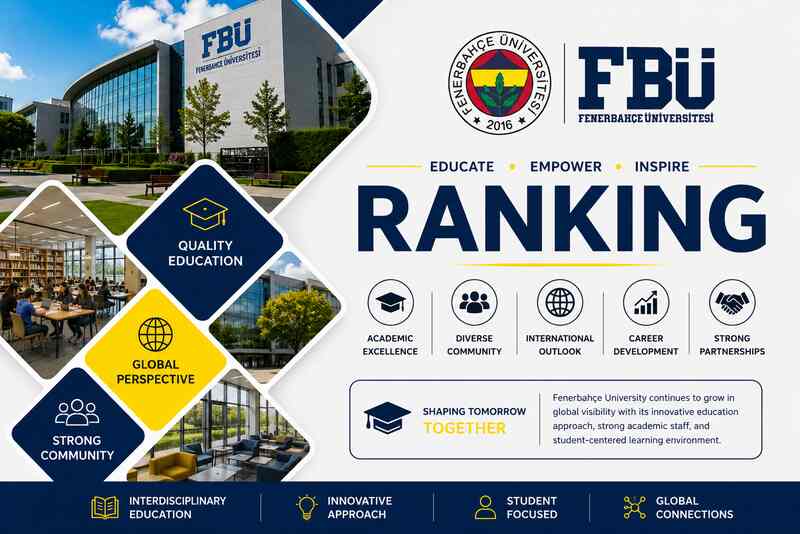
Fenerbahce University is probably one of the more unusual universities you'll come across while researching Turkey. It's young founded in 2016. It's connected to a 100-year-old football club. It runs health programs through a private hospital network. And if you search its ranking, you'll get numbers that look low on global tables but tell a very different story when you dig into the details.
So let me just walk you through it properly.
This guide covers the real Fenerbahce University ranking picture for 2026, what makes this institution different from other Istanbul private universities, the actual fees and programs that attract international students, what the research says about studying health sciences and sports in Turkey, and how FBU compares to peer institutions at similar price points.
Fenerbahce University Ranking - The Honest Numbers for 2026
Let's start with what the numbers actually show.
EduRank 2026 EduRank places Fenerbahce University at 160th in Turkey and around 9,017th globally out of more than 14,000 ranked universities. On EduRank's own scale, it also appears at approximately 9,793rd depending on which metrics are weighted. This reflects where the university is in terms of research output it's a young institution, and research citation volume accumulates over time.
Webometrics Webometrics, which measures digital presence and online citations, places FBU at approximately 10,699th globally and around 177th nationally. Again, these numbers reflect a university that started admitting undergraduates only in 2019–2020, not one that has been publishing for decades.
AD Scientific Index The AD Scientific Index, which measures the H-index and citation impact of individual faculty members, shows FBU ranking around 9,000th globally, with consistent improvement from 2024 to 2026. This upward trend is the signal to pay attention to the research profile is growing.
Times Higher Education (THE) Impact Rankings Here's where FBU shows up in a more positive light. The university has been recognized in THE's Impact Rankings the system that evaluates how universities are contributing to the UN's Sustainable Development Goals. FBU appears in categories including Quality Education, Gender Equality, Reducing Inequalities, and Sustainable Cities and Communities. These aren't ranking bands but category inclusions, and they signal that the university is actively engaging with internationally measurable standards.
YÖK Employment Data The Standout Metric This is the number that actually deserves the most attention. According to the 2025 Turkish University Monitoring and Evaluation General Report published by YÖK, Fenerbahce University ranked:
1st in Turkey for highest employment rate of associate degree graduates within six months of graduation (44.42%)
10th in Turkey for rate of publications in Web of Science indexed journals through national collaboration (69.70%)
10th in Turkey for highest international student rate (22.86%)
12th in Turkey for highest rate of graduates entering employment within six months (43.42%)
That first-place employment figure is remarkable for a university of this age. It tells you something that no global ranking number can: graduates are actually getting jobs quickly. For international students thinking about the practical value of a Turkish degree, that outcome data matters far more than where FBU sits in EduRank.
Why the Numbers Look Low; and Why That's Not the Full Story
If you've looked at rankings before, you'll know that the systems most students use (QS, THE, U.S. News) weight research output very heavily. A university that has been publishing research for 50 years will always rank higher than one that has been running for 8–9 years, regardless of teaching quality, employment outcomes, or student satisfaction.
Fenerbahce University admitted its first undergraduates in 2019–2020. So right now in 2026 it has only been producing graduates for a few years. Research output is naturally limited because you need time to build faculty publication records, citation counts, and funded research projects.
But the YÖK employment data tells a different story. Students are leaving FBU and getting jobs faster than graduates of most other Turkish universities. That's not a coincidence it's directly connected to what FBU was designed to do from day one.
The Fenerbahce–Medicana Model: What It Actually Means for You
Fenerbahce University wasn't set up by an education ministry or a standard foundation. It was co-founded by Fenerbahçe Sports Club — one of Turkey's oldest and most recognized sports organizations, founded in 1907 and Medicana Health Group, a private hospital network that has been operating in Turkey since 1992 and committed $100M in the university's first year of student admission.
This co-founding structure is not just branding. It creates real, contractual benefits for students:
For health sciences students: Practical training placements in Medicana hospital facilities. Nursing, physiotherapy, pharmacy, and health management students rotate through real clinical environments as part of their program not optional extras organized last-minute, but structured partnerships between the university and a working hospital group. Research in pharmacy education consistently shows that hospital-integrated clinical training significantly improves graduate competency compared to classroom-only learning. A 2024 study in the Journal of Advances in Medicine and Medical Research by Aschenbrenner et al. found that pharmacy students who completed hospital internships showed measurable gains in clinical knowledge compared to their pre-internship baseline. The Medicana partnership is FBU's structural answer to exactly this building clinical exposure into the degree from day one.
For sports sciences students: Access to Fenerbahçe Club's sports facilities and professional network. The Club has 100+ years of sports management, athletics, and organizational experience. Students in sports management, sports psychology, and physical education programs can access training environments, coaches, and industry contacts that simply don't exist in a standard university setting.
Final year in the USA: FBU has agreements with several American universities including Morgan State University and Fort Hays State University giving eligible students the option to complete their final academic year in the United States. For students thinking about international career development, that's a concrete and underused differentiator.
What the Research Says About the Programs FBU Focuses On
Since you asked for academic references, let me bring in some of the published research relevant to FBU's core program areas.
Sports Sciences Education
FBU places a specific emphasis on sports sciences a field with growing career opportunities across Turkey and the MENA region. Research published by Turhan et al. (2023) in Physical Education of Students found that sports science students' future career expectations differ significantly by department and age group, with Sports Management students showing notably different trajectories from coaching-track students. This matters for FBU applicants: your program choice within the Faculty of Sports Sciences shapes your career path in real ways, not just academically.
A related study by Döşyılmaz et al. (2021) published in Physical Education of Students examined career awareness and professional career values among athlete-students in Turkish sports science faculties, finding that career awareness was at moderate levels overall which the authors interpreted as a signal for universities to provide more structured career guidance. FBU's Career Center and its institutional link to the Fenerbahçe Club's professional network directly addresses this gap.
Pharmacy and Clinical Education
FBU's Faculty of Pharmacy is one of the most popular departments among international students. The clinical training pathway through Medicana hospitals is particularly relevant here.
A 2022 systematic review by McMullen et al. in Research in Social & Administrative Pharmacy found that competency-based pharmacy education programs — where clinical training is embedded into the degree curriculum — produce better-aligned graduates than traditional lecture-based models. FBU's hospital partnership approach aligns with exactly this model, giving pharmacy students documented clinical exposure before graduation.
A 2024 systematic review published in BMC Medical Education by Ni et al. also found that interprofessional education — where pharmacy students learn alongside other health professions students in clinical settings — significantly improves collaborative competency and professional readiness. The Medicana clinical environment, which involves multiple health professions, naturally supports this kind of cross-professional learning.
International Students in Turkish Universities
For context on FBU's international student environment (22.86% international student rate, placing it 10th nationally), it's worth knowing what research says about studying in Turkey.
A 2022 study by Yılmaz et al. published in SAGE Open surveyed 413 international students across Turkish universities and found that service quality dimensions — particularly assurance and empathy from academic staff — and socio-cultural support significantly predicted international student satisfaction. For prospective FBU students from Africa, the Middle East, and Asia, this is a useful benchmark: the quality of your support experience at Turkish universities is shaped significantly by how well staff communicate and how proactively the institution addresses cultural adjustment.
A 2024 study in the European Journal of Psychology and Educational Research by Alnajjar et al. also found that the primary motivations for international students choosing Turkey were quality and diversity of higher education, historical and cultural heritage, affordability, and ease of living — all factors that apply directly to FBU's location in Istanbul's Ataşehir district.
Fenerbahce University Programs and Fees for 2026
Here's a practical breakdown of programs and what they cost for international students in 2026:
Faculty of Pharmacy
Pharmacy (English): approximately $7,500–$8,400/year (after scholarship discount)
Pharmacy (Turkish): approximately $13,000/year standard (check current rates)
Faculty of Health Sciences
Nursing (English): ~$4,000/year
Nursing (Turkish): ~$3,000/year
Physiotherapy & Rehabilitation (English): ~$4,000/year
Psychology (English): ~$4,000/year
Faculty of Engineering & Architecture
Computer Engineering, Industrial Engineering, Architecture, Interior Architecture & Environmental Design: approximately $3,200–$4,200/year
Faculty of Economics, Administrative and Social Sciences
International Finance, Business Administration, Political Science & International Relations, Management Information Systems: generally $3,200–$4,500/year range
Faculty of Communication
Communication and Media Studies, Public Relations: approximately $3,200–$4,000/year
Faculty of Sports Sciences
Sports Management, Sports Sciences: approximately $3,000–$4,000/year
Vocational School of Health Services
Associate degree programs: approximately $2,000–$4,000/year
Postgraduate
Master's programs (Business Administration, Mathematical Sciences, Nursing, Political Science): approximately $2,250–$7,500/year
Note: FBU offers installment payment options. A 25% discount applies to students who enroll with FBU as their first-choice university (excluding pharmacy). Scholarships are available for GPA-high students, athletes, and staff/alumni family members.
How Fenerbahce University Compares to Peer Istanbul Universities
Let me put this in a table so you can make real comparisons:
University | Est. Year | Turkey Rank (approx.) | Bachelor's Tuition (EN) | Signature Strength |
|---|---|---|---|---|
Fenerbahce University (FBU) | 2016 | ~160th nationally | $3,200–$8,400/yr | Sports, pharmacy, Medicana hospital access |
Beykoz University | 2016 | ~164th nationally | ~$1,700–$3,300/yr (after scholarship) | Logistics, aviation, 7+1 internship |
Istanbul Topkapı University | 2016 | ~150th nationally | $2,000–$4,500/yr | Health sciences, nursing |
Istanbul Nisantasi University | 2010 | ~100th nationally | $3,500–$6,000/yr | Design, arts, communication |
Üsküdar University | 2011 | ~55th nationally | $4,000–$7,500/yr | Psychology, neuroscience |
FBU and Beykoz were both founded in 2016, both are growing their research profiles, and both rank in a similar national band. The main difference in character: Beykoz built its identity around logistics and aviation; FBU built around sports sciences and health. If your program is pharmacy, nursing, physiotherapy, or sports management, FBU's institutional partnerships give it a concrete edge over most similarly-priced competitors.
Üsküdar ranks higher nationally and has a stronger research footprint in psychology and neuroscience, but costs noticeably more. Nisantasi is a reasonable comparison if you're interested in design or communication programs.
Practical Details; Applying to Fenerbahce University
Location: Ataşehir campus, Asian side of Istanbul. Modern facilities in a central location with good transport access. Note that FBU doesn't have on-campus dormitories, it has partnerships with nearby accommodation providers.
Application: Standard documents required high school diploma, transcript, passport copy, language proficiency certificate. Application deadlines: Fall intake usually July 31, Spring intake December 31. Acceptance rate is moderate (approximately 50–60%), making it accessible without being a guarantee.
Language: Most popular programs are available in English. Language support is available for students who need it.
Accreditation: YÖK-accredited, Bologna Process compliant (ECTS credits), Erasmus+ participant with European university partners in Germany, France, Spain, and Italy. Recognized in Arab countries including Libya, Egypt, Yemen, Lebanon, Sudan, and Morocco. Graduates receive a Bologna-aligned Diploma Supplement.
Erasmus+: Students can spend one or two semesters at European partner universities with credit transfer and financial grant support.
Frequently Asked Questions
Q: Is Fenerbahce University ranked in QS or THE? A: Not in the main QS World University Rankings or THE World University Rankings for 2026 these require minimum research output thresholds that FBU, as a university that only started admitting students in 2019, hasn't yet accumulated. It does appear in THE Impact Rankings categories (Quality Education, Gender Equality, Reducing Inequalities, Sustainable Cities). This is expected for a university this young and doesn't reflect on teaching quality or graduate outcomes.
Q: Is Fenerbahce University accredited? A: Yes. It's fully accredited by YÖK (Turkey's Council of Higher Education) and recognized by the EU (through Bologna/ECTS compliance) and multiple Arab countries. Program-specific accreditations in engineering and business are in place; confirm current status for your specific program on the university's official site.
Q: What makes FBU different from other Istanbul private universities? A: Three things most universities don't have: a co-founder relationship with Medicana Health Group (structured clinical training for health students), a co-founder relationship with Fenerbahçe Sports Club (sports program access and industry network), and a final-year pathway to US partner universities. These aren't marketing claims they're contractual partnerships built into the institution.
Q: Is pharmacy at FBU worth it? A: Pharmacy at FBU gives you English-medium instruction, Medicana hospital clinical rotations, and a competitive fee structure (around $7,500–$8,400/year with scholarship). Research shows hospital-integrated pharmacy training improves clinical competency significantly — and FBU's Medicana partnership is specifically designed to provide that. Verify recognition with your home country's pharmacy licensing body before enrolling.
Q: What is FBU's employment rate? A: According to YÖK's official 2025 University Monitoring and Evaluation report, FBU ranked 1st in Turkey for associate degree graduate employment within 6 months (44.42%), and 12th nationally for bachelor's degree employment within 6 months (43.42%). These are officially published figures, not self-reported estimates.
Q: Does FBU have Erasmus+ exchanges? A: Yes. FBU participates in Erasmus+ with European partners including German, French, Spanish, and Italian universities. Students can study abroad for one to two semesters with full credit transfer. Additional bilateral agreements extend to partner universities in Asia and North America.
Final Verdict; Is Fenerbahce University Worth It?
Let me give you a direct answer the way I'd give it to a friend.
Fenerbahce University is not going to impress anyone with a global ranking number right now. It's 2026 and the university has only been running for about seven years those numbers are exactly what you'd expect for an institution that age.
But here's what the numbers don't tell you: it ranked first in Turkey for graduate employment. It has a real hospital network backing its health programs. It has a 100-year-old sports organization backing its sports programs. Its international student rate puts it in the top 10% nationally. And it's giving some students the option to finish their final year in the United States.
For students targeting pharmacy, nursing, physiotherapy, sports management, or related fields in Istanbul and who want practical, employment-focused training without paying the premium prices of longer-established universities Fenerbahce University deserves serious consideration.
universityfinder.org has a free university matching tool share your program, budget, and academic background and we'll help you compare FBU against the full range of private Istanbul universities that fit your situation.
Read more at: Fenerbahce University - International Students Guide