Eastern Mediterranean University Ranking 2026 - ABET Engineering and THE 601–800 in Famagusta

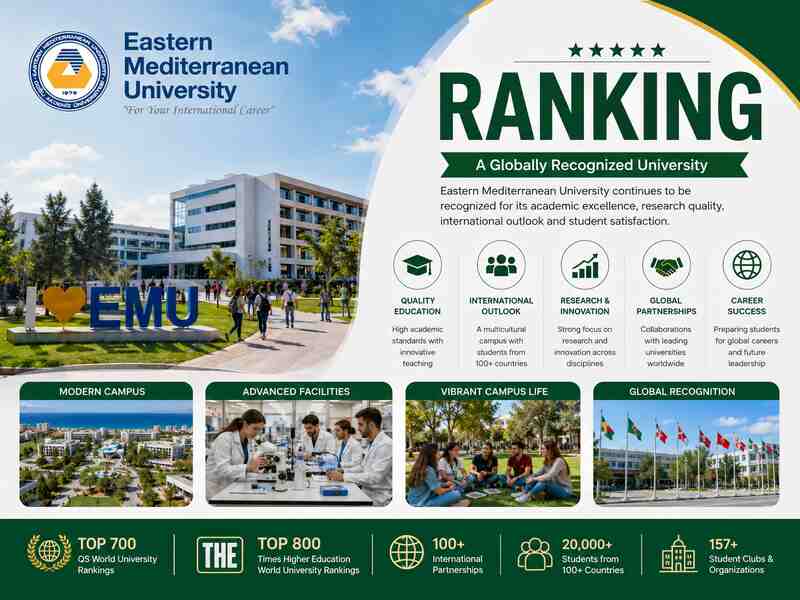
If you're trying to figure out Eastern Mediterranean University ranking and what it actually means for your degree, there's one thing worth saying upfront: EMU is one of those universities where a single credential ABET accreditation across eight engineering programs, carries more practical career weight for engineering students than most of the ranking numbers combined. But the ranking numbers are also genuinely strong, and they deserve a clear-eyed breakdown.
EMU was founded in 1979 in Famagusta as the first university in the Turkish Republic of Northern Cyprus (TRNC). It now enrolls around 20,000 students from 108 nationalities, with faculty from 32 countries. It's a state university not a foundation/private institution which is relevant context when comparing it against Istanbul's private universities. And in 2026, it holds positions across more independent ranking systems than most universities in its geographic category.
Let's go through the full picture.
Eastern Mediterranean University Rankings at a Glance 2026
Ranking System | Global Position | Regional/National Position | What It Measures |
|---|---|---|---|
THE World University Rankings 2026 | 601–800 band | 1st in Northern Cyprus / 5th tier among Turkish universities | Teaching, research quality, citations, international outlook, industry |
THE Business & Economics 2026 | 301–400 band | 1st in TRNC / 2nd band in Turkey | Business and economics faculty research output |
THE Hospitality & Tourism Management | Top 44th globally | 1st in TRNC, 1st in Cyprus | Subject-specific hospitality research output |
THE Young University Rankings | 151st worldwide | 1st in TRNC / 4th in Turkey | Universities founded in the last 50 years only |
THE Impact Rankings | 301–400 band | 1st in TRNC / Cyprus / 5th in Turkey | UN Sustainable Development Goals alignment |
QS World University Rankings 2026 | 691st globally | 1st in TRNC / 9th among Turkish QS universities | Reputation, citations per faculty, student/faculty ratios, international outlook |
QS International Student Diversity | 13th in the world | 1st in TRNC | Proportion and diversity of international students |
QS International Students | 19th in the world | 1st in TRNC | International student ratio |
QS EECA Rankings | Confirmed inclusion | Confirmed regional | Eastern Europe & Central Asia comparative |
SCImago Institutions Rankings | Confirmed global inclusion | 1st in TRNC | Bibliometric research output from Scopus data |
Webometrics 2026 | ~1,296th globally | 1st in TRNC | Web visibility and digital academic footprint |
US News Best Global Universities | Confirmed inclusion | 1st in TRNC | Research output, reputation, citations |
ABET Accreditation, 8 programs | Internationally recognized | 1st in TRNC for ABET engineering | Career recognition: USA, Canada, Gulf states |
That's a lot of systems, and EMU appears on all of them. The 601–800 THE position is the headline number but there are several more specific figures that tell you more than the overall band does.
THE 601–800 Band; What EMU's Position Actually Means in Context
EMU's position in the 601–800 band of Times Higher Education World University Rankings 2026 places it in a tier most students don't immediately associate with a small-island university in Northern Cyprus. To understand why it's there, you need to look at what THE actually rewards.
THE uses 18 performance indicators grouped across five areas: Teaching, Research Environment, Research Quality (citation impact), International Outlook, and Industry. The 601–800 band entry is confirmed in EMU's official announcement on the 2026 THE results, which also confirmed a 301–400 global band in Business and Economics — placing EMU 1st in the TRNC and 2nd band in Turkey in that subject. The 301–400 Business & Economics position in particular reflects research citation output from a faculty that, relative to the university's size, is punching significantly above what the overall band suggests.
Two pillars drive EMU's THE performance most visibly. The first is International Outlook where EMU's 86.6-point THE International Outlook score is among the highest recorded for any university in the Turkey/Cyprus region. This reflects the proportion of international students (students from 108 countries), international faculty (from 32 countries), and the share of research papers produced with international co-authors. With a campus where international students form the dominant majority, EMU's metrics on this dimension are structurally strong.
The second driver is subject-specific citation quality. The THE Young University Rankings 151st position which only considers universities founded within the last 50 years — is based on the same THE methodology as the main ranking but filters out century-old institutions. EMU's 151st position here, confirmed as 4th among Turkish universities in 2024, reflects that per year of operation, EMU's research citation output is among the strongest in its founding-year cohort globally.
The comparison with Istanbul's private universities is relevant here. Medipol sits in the THE 801–1,000 band. Bahcesehir is also 801–1,000. Istanbul Gelisim is 1,001–1,200. EMU, at 601–800, sits one full band above Turkey's highest-ranked private universities on THE a fact rarely mentioned in Turkey-focused study abroad content, but verifiable directly from THE's published data.
QS 691st; A Specific Number, Not a Band
EMU's 691st position in the QS World University Rankings 2026 is notable for being the first confirmed QS entry from any university in the TRNC — and for being a specific rank rather than a band, which means QS has enough data on EMU to calculate a precise score across all indicators.
According to EMU's official QS 2026 announcement, the areas where EMU scored highest in the QS methodology were citations per faculty (25% of QS total score), international student ratio (23.6%), and internationalization of faculty (21.2%). Together these three pillars explain most of EMU's QS position and they reflect the same structural strengths that drive the THE International Outlook score.
The two QS internationalization sub-metrics are particularly striking: 13th in the world for International Student Diversity and 19th in the world for International Students. These aren't Northern Cyprus positions or regional positions these are global positions, placing EMU ahead of most universities worldwide on the diversity and proportion of its international student body. For students from outside Turkey who want a genuinely multicultural academic environment, those numbers reflect something real about daily campus life in Famagusta.
QS's methodology has been studied in academic literature. A 2019 paper examining global university rankings and their impact on internationalization noted that QS's heavy weighting of internationalization metrics (the International Faculty Ratio and International Student Ratio together account for 10% of QS total score) significantly advantages universities that are geographically or institutionally structured to attract diverse international populations which describes EMU exactly. The 691st position should be understood partly in this light: EMU's QS rank is driven by genuine citation performance and genuine internationalization, not reputation surveys.
The ABET Credential; Why This Matters More Than Any Ranking for Engineers
Here's the thing most ranking comparisons miss entirely: for engineering students specifically, the ABET accreditation profile is the credential that determines post-graduation career options in the most concrete way.
ABET; the Accreditation Board for Engineering and Technology, based in the US currently accredits eight undergraduate engineering programs at EMU: Computer Engineering, Electrical and Electronic Engineering, Civil Engineering, Mechanical Engineering, Industrial Engineering, Management Engineering, Mechatronics Engineering, and Software Engineering. This is confirmed on EMU's accredited programs page and verifiable through ABET's own database.
Why does eight programs matter? Because ABET accreditation is recognized by engineering licensing bodies in the USA (through NCEES the National Council of Examiners for Engineering and Surveying), Canada (through Engineers Canada under the Washington Accord), and Gulf engineering authorities including Saudi Arabia's SAJE, UAE's Society of Engineers, and Kuwait's Engineers Association. The Washington Accord established in 1989 and now covering 20 signatory countries provides mutual recognition of ABET-standard engineering degrees. A graduate of an ABET-accredited program can typically apply for Professional Engineer status in Washington Accord countries without the additional credential evaluation that non-accredited international degrees require.
A published overview of ABET accreditation standards, available through micronanoeducation.org (ABET Paper Proof, 2022), notes that ABET accreditation provides quality assurance that a program prepares graduates who meet the needs of the applicable profession and verifies that the student's education meets the global standard for technical education. That's not marketing language it's the functional purpose of the accreditation, and it's what licensing boards in ABET-recognizing countries use to determine whether to accept a degree without additional review.
A 2020 study published in PLOS ONE (PMC7498038) on critical success factors for sustained ABET accreditation found that universities maintaining multi-program ABET accreditation develop institutional infrastructure particularly in faculty research activity and student outcome assessment that produces higher engineering research citation rates over time. This is part of why EMU's engineering faculty contributes to THE citation performance: ABET's continuous improvement cycle requires faculty to stay current in their fields through research publication.
EMU with eight ABET-accredited programs is one of only a handful of universities in the entire Eastern Mediterranean region with this depth of engineering accreditation. That's a practical differentiator for students planning careers in the Gulf, North America, or any country that checks ABET status for professional licensing.
Subject Rankings; Hospitality, Architecture, Civil Engineering
Beyond the overall THE band and QS position, EMU holds several specific subject positions worth highlighting for students choosing by field:
Hospitality & Tourism Management: EMU ranks 44th globally and 19th in Europe for this subject 1st in both the TRNC and the whole of Cyprus. For students targeting hospitality careers, a top-50 global subject ranking from a specific program is more relevant than any overall university band.
Architecture: EMU ranks 332nd globally and 124th in Europe for Architectural Engineering, with MIAK (Turkey's Architecture Accreditation Board) accreditation. The Interior Architecture program also holds AQAS (German quality assurance) accreditation in both Turkish and English delivery.
Business & Economics: The confirmed THE 301–400 global band in Business & Economics placing EMU 2nd among Turkish universities in the subject ranking band reflects a Faculty of Business and Economics with research output substantially stronger than EMU's overall band might suggest.
Civil Engineering: EMU holds a top 151–200 QS civil engineering ranking globally, consistent with the ABET-accredited Civil Engineering program's research output requirements.
Peer Comparison — Northern Cyprus and Turkey Private University Context
University | THE 2026 Band | QS 2026 Position | Key Differentiator |
|---|---|---|---|
Eastern Mediterranean University | 601–800 | 691st | 8 ABET programs, 46 years of operation, 13th globally international diversity |
Near East University (TRNC) | 601–800 | Not confirmed in main QS table | JCI-accredited hospital, health sciences citation strength |
Cyprus International University (TRNC) | Not confirmed THE | Confirmed Webometrics | Rising trajectory, youngest in TRNC group |
Istanbul Medipol (Turkey comparison) | 801–1,000 | Confirmed | Health sciences citations, TEPDAD accredited medicine |
Bahcesehir University (Turkey comparison) | 801–1,000 | Confirmed | BAU Global network, international outlook |
Istanbul Gelisim (Turkey comparison) | 1,001–1,200 | Confirmed | 2nd Turkey Research Quality, ABET engineering |
The most practically useful comparison here is between EMU and the Istanbul private universities. EMU at THE 601–800 sits one band above Medipol and Bahcesehir (both 801–1,000), and two bands above Gelisim (1,001–1,200). By THE's research-weighted methodology, EMU currently ranks higher globally than all the private Turkish universities commonly marketed to international students considering Istanbul. That fact rarely appears in study-abroad content focused on Turkey but it's verifiable directly from THE's published 2026 data.
For students deciding between Northern Cyprus and Istanbul, that doesn't automatically make EMU the better choice program fit, campus environment, living costs, and post-graduation geography all matter. But if THE ranking band is a factor in your decision, the comparison favors EMU.
Campus, Programs, and What 108 Nationalities Looks Like in Practice
EMU's 2,200-acre campus in Famagusta is the largest university campus in Northern Cyprus by a significant margin. The 12 faculties cover Architecture, Arts and Sciences, Business and Economics, Communication and Media Studies, Dentistry, Education, Engineering, Health Sciences, Law, Medicine (joint program with Marmara University, Turkey), Pharmacy, and Tourism. Programs run primarily in English, with some Turkish-medium options.
The ACPE (Accreditation Council for Pharmacy Education) and PCN (Pharmacists Council of Nigeria) accreditations for Pharmacy, TEPDAD accreditation for the Medicine joint program, and SABAK accreditation for Health Sciences programs round out the accreditation profile beyond ABET meaning multiple professional fields at EMU carry internationally recognized quality certifications, not just engineering.
Tuition for 2026–2027, after standard scholarship applications, runs from approximately $2,900 for Economics and social sciences programs up to $12,500 for Medicine and $8,750 for Dentistry, with Engineering starting around $3,100. Most international students receive a 50% tuition scholarship on admission, making the effective cost considerably lower than published list prices.
What the Ranking Picture Means for Your Decision
Eastern Mediterranean University ranking in 2026 tells a consistent story across systems: a 46-year-old state university in Famagusta that has accumulated the research output, international student diversity, and accreditation infrastructure needed to sit in THE's 601–800 band, QS's 691st position, and top-20 global positions for international student metrics.
For engineering students specifically, the eight ABET-accredited programs are the credential that matters most for career recognition in the US, Canada, Gulf states, and Washington Accord countries. For hospitality students, a global top-44 subject ranking in Hospitality & Tourism Management is a stronger signal than any overall band. For students who care about campus internationalization, being 13th globally for International Student Diversity is a verifiable data point about what the campus community actually looks like.
No ranking tells you everything. But across multiple independent systems, EMU's position is consistently stronger than most study-abroad content about the Turkey/Cyprus region suggests.
Verification sources: