How Much Does It Really Cost to Study in Turkey? Full Breakdown for International Students (2026–2027)

Let me be straight with you when I first started helping students understand Turkey's education costs, most of them came in with completely wrong numbers. Some thought it was basically free. Others heard scary figures that made them panic. The reality? It's somewhere in between, and it actually depends a lot on choices you make before you even land at the airport.
So let's go through the cost of studying in Turkey step by step, in a way that actually makes sense. We'll cover tuition, accommodation, daily life, visa fees, and those small costs no one talks about the ones that catch students off-guard in their first semester.
Turkey hosts over 300,000 international students as of 2026, and that number keeps growing. That tells you something. Students from Pakistan, Nigeria, Egypt, Indonesia, and dozens of other countries are choosing Turkey not just because it's affordable, but because the value-to-cost ratio is genuinely hard to beat.
Tuition Fees: Public vs Private Universities in Turkey
This is where most students start, and honestly, it's where the biggest difference exists.
Public universities in Turkey are funded by the state, so fees are lower. But here's the catch admission is competitive. Most public universities require you to pass entrance exams like YÖS (the foreign student exam) or submit SAT scores. If you qualify, tuition for international students at public universities generally runs from $500 to $7,000 USD per year, depending on the program and whether you study in Turkish or English. English-taught programs cost a bit more, usually in the $1,500–$4,000 range at public institutions.
Private universities are more accessible. No entrance exam for most programs just your high school diploma and maybe a language test. Fees at private universities in Turkey for the 2026–2027 academic year typically fall between $2,450 and $9,000 USD per year for standard bachelor's programs. Some top private universities in Istanbul charge more for English-medium programs in business, engineering, or health sciences.
The big exception is medicine and dentistry. These programs cost significantly more everywhere. At private universities, medicine in English runs from $12,500 to $44,000 USD per year, depending on the university and ranking. That sounds like a lot, but compare it to the UK (40,000+ GBP per year) or the United States (60,000+ USD), and suddenly Turkey's numbers look completely different.
Master's programs are generally more affordable usually between $2,250 and $8,000 USD per year at private institutions, and lower at public ones.
One thing worth knowing: many private universities in Turkey offer scholarship discounts that can reduce tuition by 20–50%, sometimes more. These aren't always advertised loudly, so you need to ask specifically when you apply. [internal link: /universities/scholarships-turkey]
A Closer Look: What Different Programs Actually Cost
Let me give you some real numbers broken down by program type, so you can budget realistically.
Bachelor's programs (private universities, 2026–2027):
Engineering (English): $3,000–$7,000/year
Business Administration (English): $3,500–$8,000/year
Architecture: $2,500–$6,000/year
Pharmacy (English): $8,000–$14,000/year
Medicine (English): $12,500–$44,000/year
Dentistry (English): $12,000–$35,000/year
Nursing (English): $4,000–$8,000/year
Bachelor's programs (public universities, 2026–2027):
Most programs (Turkish): $500–$2,500/year
English-medium programs: $1,500–$4,000/year
Medicine (Turkish): $3,000–$7,000/year
Master's programs:
Private universities: $2,250–$8,250/year
Public universities: $600–$3,000/year
These are ranges, not fixed prices. Each university sets its own fees within guidelines from YÖK (Turkey's Higher Education Council). So always verify with the specific university or let an agency like universityfinder.org confirm the exact figure for your chosen program before you apply. [internal link: /apply]
The Real Cost of Living in Turkey as a Student
Tuition is only part of the picture. The monthly cost of living is what most students underestimate or, sometimes, overestimate.
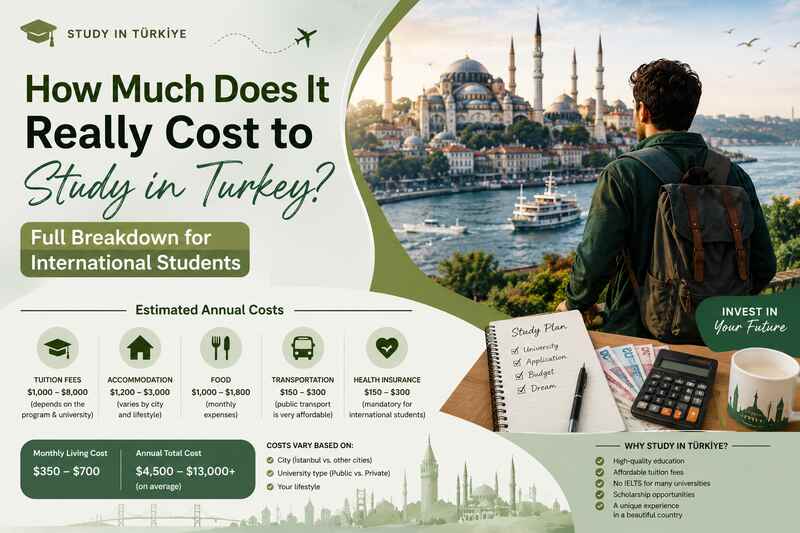
The honest average? Most international students in Turkey spend between $400 and $800 USD per month on everything combined. That includes rent, food, transportation, phone, and some personal spending. Students in smaller cities like Konya, Kayseri, or Sakarya spend closer to $350–$500. Students in central Istanbul spend closer to $600–$900.
Let me break it down:
Accommodation: The cheapest option is a KYK government dormitory these are state-subsidized and cost almost nothing, but spots are limited and priority usually goes to Turkish students. University dormitories are the next step, usually $80–$200/month. Private student residences or shared apartments in most cities run $150–$400/month. In central Istanbul near major universities, private apartments can push $500+ if you're living alone.
Food: Eating in Turkey is genuinely cheap. A full meal at a local restaurant might cost $3–$6. Monthly groceries for a student who cooks at home run about $100–$200. University cafeterias are even cheaper sometimes a full meal for under $1.
Transportation: Public transport in Turkey is excellent and affordable for students. Monthly transit passes in Istanbul or Ankara cost around $10–$25 with a student card. You can honestly get around most Turkish cities for very little money.
Utilities and internet: If your accommodation doesn't include utilities, add around $30–$60/month. Internet packages run $10–$20 monthly.
Health insurance: This one is mandatory not optional. You'll need health insurance to get your student residence permit. Private plans for young international students cost roughly $30–$100 per year, or you can enroll in the general health insurance system for a small fee. [internal link: /student-visa-turkey]
Books and materials: Budget around $100–$200 per academic year. Many programs in Turkey don't require expensive textbooks professors share materials digitally, which helps.
Visa and Residence Permit Costs
A lot of guides skip this section. Don't let it surprise you.
Student visa: If your country requires one, expect to pay $50–$100 depending on your nationality. Some nationalities get visa-free access or can enter with an e-visa.
Residence permit (ikametgah): This is what lets you legally stay in Turkey as a student after you arrive. The first application fee is roughly $50–$75 for most nationalities, plus the cost of health insurance (required for the application). There's also a card issuance fee of around $20. Renewals cost roughly the same annually.
Translation and notarization of documents: You'll need certified translations of your high school diploma, transcripts, and passport for university registration. This typically costs $50–$150 depending on how many documents you have and which city you're in.
Here's where having proper support really matters. At universityfinder.org, we help students understand every document they need before they leave home so there are no surprises at the immigration office. And once you arrive, we help with the actual residence permit application process, not just the advice part. [internal link: /services]
University Comparison: What Different Budgets Actually Buy You
Let's look at how costs compare across several popular universities for international students in Turkey. This should help you match your budget to a real option.
University | City | Program | Annual Tuition (USD) | Language | Key Strength |
|---|---|---|---|---|---|
Istanbul Medipol | Istanbul | Medicine | $18,000–$25,000 | English | Hospital network, clinical hours |
Bahçeşehir (BAU) | Istanbul | Engineering | $5,000–$8,000 | English | Campus life, research partnerships |
Istanbul Aydin | Istanbul | Business | $3,500–$6,000 | English/Turkish | Affordability, central campus |
Istanbul Gelisim | Istanbul | Nursing | $4,000–$6,500 | English | Health sciences focus |
Ankara Yıldırım Beyazıt | Ankara | Law | $2,000–$4,000 | Turkish | Public university, low fees |
Atatürk University | Erzurum | Medicine | $3,000–$6,000 | Turkish | Public, very affordable |
Koç University | Istanbul | Business/Engineering | $15,000–$20,000 | English | Top ranking, strong alumni network |
There's something for almost every budget here. A student who wants a fully English-medium medical degree at a well-connected Istanbul university will pay in the $18,000–$25,000 range. A student who is comfortable studying in Turkish and wants to minimize cost can find excellent public university programs for under $3,000 per year. And many students fall somewhere in the middle private university, English medium, mid-tier pricing.
The honest advice I give students: don't just look at the cheapest option or the most famous name. Look at what the program actually offers clinical partnerships for medicine, internship access for business, lab quality for engineering and then match that to what you can comfortably pay. [internal link: /university-rankings-turkey]
Hidden Costs Most Students Don't Plan For
This is the section that actually saves students money, so read it carefully.
Airport transfer on arrival: Taxis in Istanbul can be expensive if you don't know the city. Students who arrive without a contact or pickup often overpay, sometimes significantly. Having someone meet you changes this.
Accommodation deposit: Most landlords or private residences ask for 1–2 months deposit upfront. Budget for this before you arrive.
Registration fees: Some universities charge administrative or registration fees on top of tuition usually $100–$300 per semester. Ask about this before signing anything.
Turkish language course: If your program is in English but you want to function daily in Turkey, taking a basic Turkish course (TÖMER or equivalent) is genuinely helpful. These courses cost $100–$300 for a semester.
Phone SIM and plan: Budget $20–$30 for setup and $15–$25/month for a local plan.
Course materials and lab fees: In programs like medicine, nursing, or engineering, there may be lab fees or practical session costs not covered in standard tuition.
If you apply through universityfinder.org, we walk you through a detailed pre-departure budget checklist so you don't show up in Turkey with the wrong amount of money in your account. It's a small thing, but it makes your first week a lot less stressful. [internal link: /apply-free]
Total Annual Cost: A Realistic Summary
Let me put this all together for three different student profiles.
Budget student (public university, Turkish-medium, shared housing, smaller city):
Tuition: $800–$2,000/year
Living costs: $350–$450/month = $4,200–$5,400/year
Visa and documents: ~$300 one-time
Total first year: $5,500–$8,000
Mid-range student (private university, English-medium, shared apartment, Istanbul or Ankara):
Tuition: $3,500–$6,000/year
Living costs: $500–$700/month = $6,000–$8,400/year
Visa and documents: ~$400 one-time
Total first year: $10,000–$15,000
Premium student (top private university, English-medium medicine, private room, Istanbul):
Tuition: $18,000–$25,000/year
Living costs: $700–$900/month = $8,400–$10,800/year
Visa and documents: ~$400 one-time
Total first year: $27,000–$36,500
Even the premium number is substantially lower than equivalent medical programs in Europe or North America. That's the core reason Turkey keeps attracting more international students every year, even as fees gradually increase.
Frequently Asked Questions
Q: Is studying in Turkey actually cheaper than Europe? A: Yes, in most cases significantly so. Even mid-tier private university tuition in Turkey for English-medium programs is lower than public university fees in many EU countries. And the cost of living comparison is even more dramatic students regularly spend 30–50% less per month in Turkey than in Germany, France, or the Netherlands.
Q: Do I need to show proof of funds to get a student visa? A: Yes. Turkish immigration typically wants to see that you can cover your living costs for the duration of your stay. The exact amount varies by country of application, but having a bank statement showing $3,000–$5,000 is generally safe for a first-year student. Your acceptance letter from the university is also required.
Q: Can I work part-time to cover my living costs while studying in Turkey? A: Technically, international students can work up to 24 hours per week after their first year of study, but it requires a work permit. In practice, not all students pursue this due to language barriers and course workload. Don't plan your entire budget around part-time income treat it as a bonus if it happens.
Q: Are tuition fees paid once per year or per semester? A: Most private universities in Turkey allow semester-based payment so you pay roughly half the annual fee at the start of each semester. Some universities also offer installment plans or early-payment discounts of around 5%. Ask about payment options when you receive your acceptance letter.
Q: What happens if I get a scholarship does it cover everything? A: It depends on the scholarship. The Turkish government's Türkiye Scholarships program (YTB) covers tuition, accommodation, health insurance, and a monthly stipend essentially a full package. University merit scholarships usually cover only tuition discounts (20–100%), with living costs still on you. Always read the scholarship terms carefully before deciding.
Q: Is the cost of medicine in Turkey worth it compared to other countries? A: For most students, yes. A full 6-year medical degree in Turkey at an English-medium private university can cost $75,000–$150,000 total less than a single year of medical school in the US, and less than 2–3 years in the UK. The degrees are internationally recognized and graduates are working in hospitals across Europe, the Gulf, and North America.
So, Where Does This Leave You?
Turkey's cost of studying is genuinely competitive not just as a talking point, but when you actually run the numbers. The combination of affordable tuition, low living costs, strong English-medium programs, and a welcoming environment for international students makes it one of the better decisions a student can make in 2026.
But knowing the numbers is just the starting point. Knowing which university fits your budget, which program has the right accreditation for your home country, and what documents you need to prepare that's where most students need proper help.
universityfinder.org helps you with all of it, completely free of charge. No application fees, no hidden charges. Just real guidance from people who work with international students in Turkey every day from the moment you're curious about applying to the moment you sign your accommodation contract after landing. If you're ready to figure out exactly how much your specific program will cost and how to apply, start here. [internal link: /apply]