Biruni University Ranking 2026 - Global Standing of Istanbul's Rising Medical University

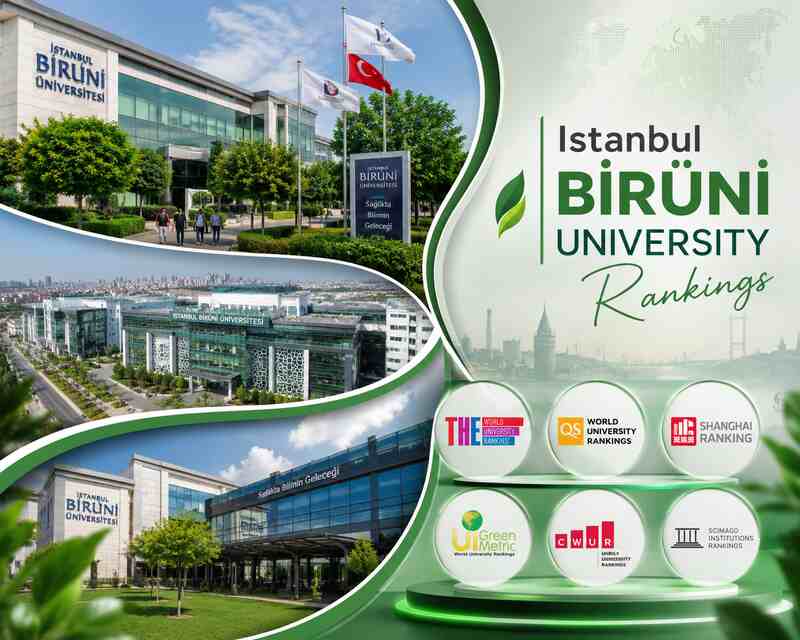
Here's something most ranking comparison pages won't say directly: if you're trying to understand Biruni University ranking, you first need to understand what ranking systems are actually measuring and why a university founded in 2014 is structurally disadvantaged on most of them regardless of how good its programs actually are.
That's not an excuse. It's just how bibliometric-based ranking algorithms work, and ignoring it produces misleading comparisons. So before we go through the numbers, let's set the context properly. Then we'll look at where Biruni actually sits in 2026, what it means, and most importantly for medicine, dentistry, and pharmacy students, which credential carries more practical career weight than any global ranking position.
Biruni University Rankings at a Glance 2026
Ranking System | Global Position | Turkey Position | What It Measures |
|---|---|---|---|
Times Higher Education (THE) 2026 | 1,201–1,500 band | Confirmed Turkey inclusion | Teaching, research, citations, international outlook, industry |
US News Best Global Universities | 1,563rd globally | Confirmed inclusion | Research output, academic reputation, citations |
Webometrics 2026 | Confirmed global presence | Mid-tier Turkey position | Web visibility and academic digital footprint |
UniRank 2026 | Confirmed global inclusion | Confirmed Turkey position | Web analytics and engagement metrics |
TEPDAD Accreditation (WFME recognized) | N/A, accreditation, not ranking | Faculty of Medicine accredited | Medical education quality against WFME global standards |
WDOMS | Listed with ECFMG eligibility | Confirmed | Critical for Gulf states, US, and international licensing |
YÖK Recognition | N/A | Fully recognized | Prerequisite for all downstream international recognition |
Two things stand out immediately. First, Biruni has now achieved a confirmed THE World University Rankings position (1,201–1,500 band globally) which is a meaningful milestone for a university that's only been operating for about 12 years. Second, and more relevant for most students reading this: TEPDAD accreditation and WDOMS listing with ECFMG eligibility are the credentials that actually determine whether your medical degree opens doors internationally. We'll come back to both.
Why University Age Changes the Ranking Picture Completely
Most global ranking systems THE, QS, SCImago, URAP heavily weight research publication volume and citation accumulation over multi-year periods. THE's research quality pillar, for instance, measures citation impact across publications indexed in Scopus. SCImago pulls five years of bibliometric data. US News uses a 13-indicator model that includes global research reputation and citation output.
A university that's been publishing faculty research since 1998 has had 28 years to build that citation record. One that opened in 2014 has had 12. The math doesn't favor newer institutions and it's not supposed to. These systems weren't designed to evaluate potential; they were designed to measure accumulated output.
A 2023 study published in PLOS ONE (PMC10468493) analyzing the relationship between bibliometric indicators and university ranking positions found that citation-based metrics correlate strongly with institutional age in younger national systems, partly because early-career researchers at newer universities haven't yet reached the peak publication output years (typically 8–15 years post-PhD). This creates what researchers describe as a compounding disadvantage for newly established institutions competing in age-agnostic ranking tables.
That analysis maps almost exactly onto what you see when you compare private Istanbul medical universities by founding year. Istanbul Medipol (founded 2009) now appears in the THE 801–1,000 band. Altinbas (founded 2008 as Kemerburgaz University) ranks 11th among Turkish foundation universities on SCImago. Biruni, founded in 2014, sits in the THE 1,201–1,500 band and holds a US News position of 1,563rd globally. Istinye (founded 2015) sits at around 2,329th on Webometrics. Istanbul Atlas (founded 2018) is still in early-stage ranking territory.
The pattern is consistent: each additional year of research operation produces measurable improvement in citation accumulation, which feeds directly into ranking position. Biruni is on that trajectory. It's just 12 years in rather than 17.
THE 2026 Inclusion; What It Actually Means
Getting into THE World University Rankings at all within 12 years of founding is not a given. THE uses 18 performance indicators grouped into Teaching, Research Environment, Research Quality, International Outlook, and Industry. Entry into the rankings requires threshold levels of research output and data submission, so the 1,201–1,500 band isn't just a number, it's confirmation that Biruni has crossed minimum publication and citation thresholds THE requires for inclusion.
Biruni's rector Prof. Dr. Adnan Yüksel noted at the 2025 TEPDAD accreditation ceremony that the university ranked 4th among 208 Turkish universities in published articles per faculty member in that cycle. That's a research productivity figure, not a citation-weighted one, but it signals something important: Biruni's faculty output per head is strong relative to its size. As those publications accumulate citations over the next 5–7 years, the ranking position should continue to move.
The US News 1,563rd global position reinforces the same picture. US News uses 13 indicators including global and regional research reputation, publications, citations, and international collaboration. Appearing on that list at all, this early in the university's existence, is consistent with active research output rather than passive institutional presence.
What Matters More Than Global Ranking: The Accreditation Question
For students choosing Biruni specifically for medicine, dentistry, or pharmacy, here's the thing most ranking guides miss: the credential that actually determines whether your degree works internationally isn't a Webometrics or THE position. It's TEPDAD accreditation with WFME recognition, and WDOMS listing with ECFMG eligibility.
Let's explain each one clearly.
TEPDAD (Tıp Eğitimi Değerlendirme ve Akreditasyon Derneği) is Turkey's national medical education accreditation body. It evaluates Faculty of Medicine programs against WFME global standards the same standards used by accrediting agencies in the US, UK, Canada, and the EU. TEPDAD was first recognized by WFME in 2013 and renewed for ten years in 2023, making it one of only a small number of non-Western accrediting agencies with sustained WFME recognition.
A published evaluation of TEPDAD's accreditation program in BMC Medical Education (PMC11484364) confirmed that TEPDAD is recognized not only by WFME but also by Turkey's Higher Education Quality Council (YÖKAk), ÖSYM (the national university entrance exam body), and both major Turkish medical education associations. That breadth of cross-recognition is what gives a TEPDAD accreditation its career weight.
Biruni University's Faculty of Medicine achieved TEPDAD accreditation in 2025. The accreditation certificate was presented by TEPDAD President Prof. Dr. İskender Sayek at a formal ceremony at Biruni's Reyhan Conference Hall. This is documented on the university's own website and verifiable through TEPDAD's official accredited programs list.
Why does TEPDAD accreditation matter so much for international students specifically?
Because from 2024, ECFMG — the Educational Commission for Foreign Medical Graduates, which governs the eligibility of international doctors to sit USMLE exams and enter US residency requires all international medical graduates to come from institutions accredited by a WFME-recognized agency. No WFME-recognized accreditation means no ECFMG pathway, regardless of how the university performs on Webometrics. It's a binary requirement: you either have it or you don't.
Biruni now has it. Several other private Turkish medical universities particularly newer ones don't yet. That distinction carries more practical career weight for a student planning to practice in the US, Canada, Gulf states, or any country where ECFMG certification is a downstream requirement, than a difference of 500 positions on a web visibility ranking.
The WFME recognition of TEPDAD and WDOMS listing with ECFMG eligibility together form what is effectively a two-layer international passport for Biruni medicine graduates. YÖK recognition Turkey's Higher Education Council is the base layer that makes everything else possible, and Biruni holds that fully as well.
Peer Comparison; Private Istanbul Medical Universities Founded 2009–2018
University | Founded | THE 2026 Position | Webometrics Turkey | Key Credential |
|---|---|---|---|---|
Istanbul Medipol | 2009 | 801–1,000 band | ~17th Turkey | TEPDAD accredited, WDOMS listed |
Altinbas University | 2008 | Confirmed THE inclusion | Confirmed | SCImago 11th foundation universities |
Uskudar University | 2011 | Confirmed THE inclusion | ~58th Turkey | Neuroscience research focus |
Biruni University | 2014 | 1,201–1,500 band | Mid-tier Turkey | TEPDAD accredited 2025, WDOMS listed |
Istinye University | 2015 | Confirmed THE inclusion | ~34th Turkey | Hospital network, active research expansion |
Istanbul Atlas University | 2018 | Early-stage | Early-stage Turkey | Youngest in group, trajectory comparison |
A few things jump out from this table.
Medipol, as the oldest and most research-intensive in this group, leads on THE band and Webometrics both expected given its 16+ years of publication accumulation. Altinbas leads on SCImago specifically because of its health sciences research concentration at the Bakirkoy campus. Istinye, founded just one year after Biruni, is ahead on Webometrics partly because of its large private hospital network driving research volume and online content.
But Biruni holds the TEPDAD accreditation that Istinye and Atlas don't yet hold, which is the specific credential medicine students need if they're planning careers in the US, Gulf region, or Canada. And on a research productivity basis, articles per faculty member, Biruni's 4th-place position among 208 Turkish universities suggests the citation accumulation needed for further ranking improvements is already being generated. It just hasn't aged long enough yet to fully show in bibliometric ranking tables.
The Biruni Campus and Clinical Infrastructure
Ranking numbers aside, it's worth knowing what the academic environment actually looks like, because ranking positions don't capture infrastructure quality directly.
Biruni's main campus is in the Zeytinburnu district on Istanbul's European side, with the Topkapi campus hosting core health faculties. The university operates a 153-bed hospital confirmed by THE as a recognized clinical training facility, with specializations in obesity surgery, corneal transplantation, and cardiovascular surgery, so medicine students get exposure to specialized surgical cases from early in their program. There's also a functioning Dental Hospital for dentistry students, and Biruni Technopark hosts over 300 startups with a research and development center (BAMER) that supports faculty research output.
The university offers 90+ programs across Faculties of Medicine, Dentistry, Pharmacy, Health Sciences, Education, Engineering and Natural Sciences, and Applied Sciences. English-medium options exist across medicine, dentistry, pharmacy, physiotherapy, and biomedical engineering, which is why international students from over 88 countries are enrolled, primarily targeting health sciences programs at tuition around $21,000 per year for medicine and dentistry.
What the Ranking Trajectory Tells You
So where does this leave you if you're evaluating Biruni?
The honest answer is: Biruni University ranking will look better in 2028 than it does in 2026, and better still in 2030. That's not speculation, it's the consistent pattern across every comparable private Istanbul medical university that has been operating for 10+ years. Each year of publication output adds to the citation base that ranking algorithms measure. Biruni is already in the THE 1,201–1,500 band and #1,563 on US News with just 12 years of research history. That trajectory, combined with the 4th-place publication output rate per faculty, suggests continued upward movement.
But for students making a decision now, the TEPDAD accreditation achieved in 2025 is the more immediately actionable credential. It's not a projection, it exists today, it's verified, and it directly determines ECFMG eligibility and international licensing pathways in the countries most international medicine students care about.
Rankings matter. But for a health sciences student choosing between private Turkish medical universities, the question of whether the degree lets you sit licensing exams in your target country matters more than whether the university sits at 1,500th or 2,000th on a web visibility index.
For program-specific tuition, intake dates, scholarship options, and detailed faculty breakdowns: Biruni University — Complete University Guide
Verification sources: