Beykoz University Ranking 2026 - What You Actually Need to Know Before You Apply

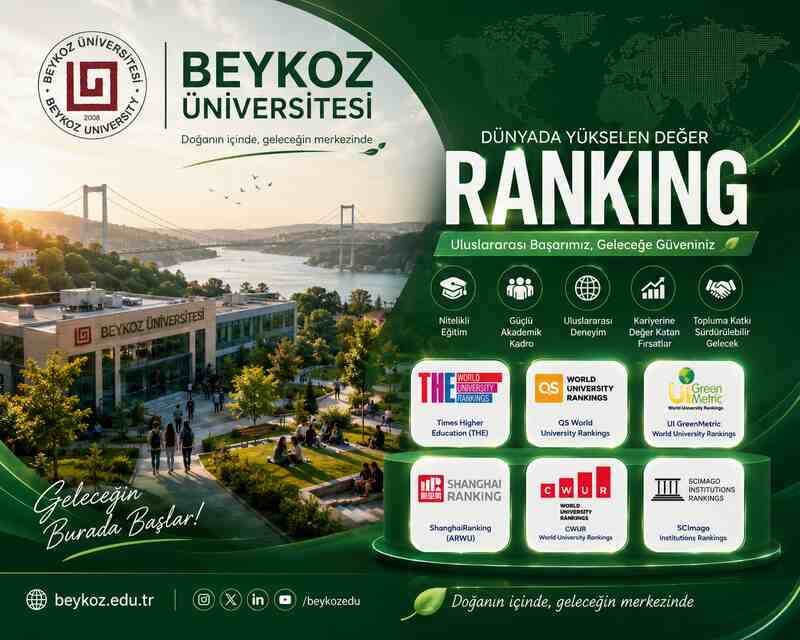
Let me be straight with you from the start: if you're searching "Beykoz University ranking" and expecting to find a neat number between 200 and 500, you're going to be confused by what you find. Different websites will tell you different things some say it's top 200 in Turkey, others place it around 8,000–9,000 globally on Webometrics. Some don't list it in major global tables at all.
But here's the thing that confusion is actually very normal for a university founded in 2016. Beykoz is young. And young universities behave differently in global rankings than established ones, for reasons that are completely understandable once you know how ranking systems actually work.
So in this guide I'll walk you through the real Beykoz University ranking picture across different systems, explain what it means for you as a student, and help you decide if Beykoz is the right fit especially if you're targeting logistics, aviation, business, engineering, or design programs in Istanbul.
First, Why Is Beykoz University's Ranking "Low" on Some Lists?
This is the question most students have but nobody explains properly. So let me do it.
Beykoz University was officially founded in September 2016 and admitted its first undergraduates in the 2017–2018 academic year. That makes it one of the newer private universities in Turkey. And in the world of global rankings, age matters a lot.
Big ranking systems like QS, Times Higher Education (THE), and U.S. News rely heavily on research output and citations. That means they count how many academic papers a university's faculty have published, and how many times those papers are cited by other researchers. A university that's been around for 8–9 years simply hasn't had enough time to build the publication volume of a university that's been running for 30 or 50 years.
So when you see Beykoz ranked globally around #8,000–9,000 on Webometrics (which measures web presence and digital research visibility) or not appearing in QS/THE yet, it's not a sign the university is low quality. It's just a sign that it's still accumulating the research output that feeds those rankings. Most of the private universities students compare Beykoz to were in the same position 10–15 years ago.
What you should actually be looking at instead is:
Is it YÖK-accredited? (yes)
Does it follow the Bologna Process? (yes)
Are the programs internationally recognized? (we'll cover this)
What is the teaching model and does it prepare you for work? (this is where Beykoz actually stands out)
Beykoz University Ranking Across Different Systems (2026)
Here's where things stand as of 2026, across the main systems:
Webometrics 2026 Beykoz is placed around #7,600–9,000 globally and within the top 164–200 in Turkey depending on the update cycle. Webometrics measures digital presence, web citations, and online research output and as a newer university, Beykoz is still growing its digital footprint. Its national position in the top 200 out of roughly 207 recognized Turkish universities is actually very close to the middle of the pack.
Times Higher Education (THE) Beykoz appears in THE's database as a recognized institution but has not yet entered the main ranked bands (which typically require minimum research thresholds). This is expected for a university this young. THE notes that Beykoz has 20 undergraduate and 29 master's programs with a practical, student-centred teaching model.
UNIRANKS UNIRANKS places Beykoz at a global score of 38.2, reflecting its early stage of international research visibility. What UNIRANKS does note positively is its encouragement of research and collaborative projects at the student level.
National standing Within Turkey's 207 recognized universities, Beykoz consistently places in the mid-range nationally not at the top, but well ahead of many smaller vocational institutes. Given that it only began undergraduate education in 2017, that trajectory is actually quite decent.
Now, does any of this mean you shouldn't apply? Not really. Because for Beykoz, the ranking numbers are genuinely not the most important thing. Let me explain why.
The One Thing That Sets Beykoz Apart: The 7+1 Internship Model
Most ranking articles about Beykoz mention the numbers and move on. But if I were advising a younger student, this is the section I'd tell them to read carefully.
Beykoz University runs something called the 7+1 internship model for all bachelor's degree programs. Here's what that means in practice:
For every 8 semesters of a bachelor's degree, 1 full semester is spent working in a real industry environment not as an optional extra, not as a "we encourage internships" statement, but as a compulsory, structured, curriculum-integrated requirement.
For four-year high school programs, it's a 6+2 model (two full semesters in industry).
For vocational and associate degree programs, it's 3+1.
This is not common in Turkish private universities. Most universities offer optional internship weeks or a summer placement something students organize themselves, often scrambling in their final year. Beykoz built the internship directly into the degree structure from day one. There's a dedicated Internship Coordination Unit that manages placements, and the university guarantees every student spends at least one semester working in their field before they graduate.
Why does this matter for you as an international student? Because when you go back to your home country or apply for jobs after graduation, you'll have documented, verifiable work experience in Istanbul at real companies in logistics, aviation, tech, or business as part of your official academic record. That's a meaningful advantage, especially if you're coming from a country where a Turkish degree isn't a household name yet.
Beykoz University Accreditation and International Recognition
Let's clear this up simply, because it's what matters most for your degree's validity.
YÖK: Beykoz is fully accredited by Turkey's Council of Higher Education. Every program it offers is recognized under Turkish law. This is the baseline that makes your degree valid.
Bologna Process: Beykoz uses the ECTS credit system (European Credit Transfer and Accumulation System), which means your academic credits are structured to be transferable and recognized across European higher education systems. After graduation, you receive not just a diploma but also a Diploma Supplement and a EuroPass certificate both of which help institutions and employers abroad understand and recognize your degree.
Erasmus+: Beykoz is a full Erasmus+ participant. Students can do one or two semesters at European universities, or apply for Erasmus+ internship programs gaining work experience inside EU-based companies as part of their degree.
Mevlana Exchange: Beyond Erasmus, Beykoz also participates in Turkey's Mevlana program for bilateral exchange with universities in other countries.
International recognition: the degree is recognized in EU countries, several Arab countries (including Egypt, Yemen, Lebanon), and Turkey is a party to international degree recognition frameworks. If you're planning to work or continue studying in these regions, the YÖK accreditation + Bologna compliance combination covers you for most professional and academic purposes. As always: verify with the specific institution or licensing body in your home country before enrolling.
One note worth making honestly: Beykoz does not yet have MÜDEK (engineering accreditation equivalent to ABET) for its engineering programs, as some newer private universities do. That's something worth checking if your career path specifically requires MÜDEK. The university is actively working toward expanding program-level accreditations as it matures.
Programs, Fees, and Scholarships for 2026
Since Beykoz's ranking in the traditional sense is still growing, the question many students ask next is: "OK, but is it affordable?" And here's where it gets genuinely interesting.
Beykoz is one of the most affordable private universities in Istanbul for international students. Here's the honest fee picture for 2026:
Standard bachelor's tuition: $3,400/year (most programs) After the standard 50% international scholarship: approximately $1,700/year Computer Engineering (English-medium): slightly higher, around $3,300/year after scholarship Civil Aviation programs: around $3,200–$5,200/year standard, with scholarships applicable Associate degree programs: $3,400 standard / $1,700 after scholarship Master's programs: ranging from approximately $2,150 to $2,950 per program total
The 50% scholarship is the standard offer for most international student intakes not a special prize you have to compete hard for. So for most students, $1,700 per year is the realistic working cost for a Beykoz bachelor's program.
To put that in perspective: Istanbul Aydin University bachelor's start around $4,000–$6,500/year. Bahçeşehir University goes from $7,000–$12,000. Medipol runs $6,000–$18,000 depending on program. Beykoz is clearly in a different cost category making it especially practical for students from Nigeria, Pakistan, Egypt, and other countries where tuition budget is a real constraint.
Popular programs among international students include: Computer Engineering, Industrial Engineering, Civil Aviation Management, Business Administration, International Trade and Finance, Psychology, Logistics Management, Graphic Design, and Fashion Design.
Most of these are available in English-medium. Students without an English proficiency certificate can take the Beykoz-PROF exam on arrival scoring 60 or above exempts you from the preparatory English program entirely.
How Beykoz Compares to Similar-Price Private Universities in Istanbul
Here's a comparison so you can see the actual trade-offs clearly:
University | Est. Year | Turkey Rank (approx.) | Bachelor's Tuition (EN) | Key Strength |
|---|---|---|---|---|
Beykoz University | 2016 | ~164th nationally | ~$1,700–$3,300/yr (after 50% scholarship) | Logistics, aviation, 7+1 internship model |
Istanbul Gedik University | 2011 | ~120th nationally | $3,000–$5,500/yr | Music, technical vocational tracks |
Istanbul Topkapı University | 2016 | ~150th nationally | $2,000–$4,500/yr | Health sciences, nursing |
Üsküdar University | 2011 | ~55th nationally | $4,000–$7,500/yr | Psychology, neuroscience |
Istanbul Okan University | 2006 | ~50th nationally | $4,000–$7,000/yr | Aviation, engineering, transport |
Looking at this table, a few things stand out. Beykoz is clearly the most affordable option, especially after the scholarship. Üsküdar and Okan rank higher nationally, but they also cost significantly more. If you're specifically targeting logistics or aviation programs, Beykoz has a stronger institutional identity in those fields than most similarly-priced options it literally grew out of a logistics school, so those programs have real industry roots.
The honest trade-off is ranking visibility: Okan and Üsküdar will look slightly better on a global ranking table right now. But if your career is focused on logistics, supply chain, aviation management, or business in the Turkey/Middle East/Africa corridor, Beykoz's specific identity and internship model may actually serve you better than a slightly higher-ranked generalist university.
What Happens After You Apply Practical Things to Know
Let me cover a few things most ranking articles skip entirely.
Application: Beykoz does not charge an application fee for international students. You apply online through the university portal, submit your high school diploma, passport copy, and photo, and wait for an admissions response. There's no YÖS or SAT requirement for most undergraduate programs.
English preparation: If you need it, Beykoz offers an English preparatory year. Alternatively, take the Beykoz-PROF exam on arrival; a score of 60+ exempts you. Preparatory year fees are around $3,800 for international students (check current rates).
Campus life: Beykoz operates multiple campuses in Istanbul's Asian side, in the Beykoz and Kavacık districts. The setting is quieter and more scenic than central Istanbul — it's near the Bosphorus, which is genuinely beautiful. The main social life happens on campus through 44+ student clubs (aviation, logistics, psychology, cinema, chess, e-sports, and more) and off-campus in Istanbul's wider city.
Erasmus mobility: With over 100 international university partnerships and full Erasmus+ membership, exchange opportunities are real and accessible.
Residence permit: Like all Turkish universities, Beykoz supports international students through the ikamet (residence permit) process. You'll need to apply for a student residence permit (öğrenci ikameti) within your first 30 days of arrival.
Frequently Asked Questions
Q: Is Beykoz University officially recognized in Turkey? A: Yes. It's fully accredited by YÖK (Turkey's Council of Higher Education) and all programs are officially recognized under Turkish law. This is the foundational accreditation that validates your degree in Turkey and in countries that have bilateral recognition agreements with Turkey.
Q: Why doesn't Beykoz appear in QS or THE rankings? A: Both QS and THE require minimum levels of research output and academic publication to generate a ranked score. Beykoz, founded in 2016, is still in the early phase of building that output. It's a young university and its absence from these specific tables is a function of age, not quality. Many now-well-ranked universities were in the same position a decade ago.
Q: Is the 7+1 internship model guaranteed for all students? A: Yes. It's compulsory and curriculum-integrated, not optional. The university's Internship Coordination Unit manages placements, and every bachelor's student is guaranteed to spend at least one full semester working in a real workplace related to their field before graduation.
Q: Are Beykoz degrees recognized in Arab countries or Europe? A: Beykoz degrees are recognized in EU countries (through Bologna Process alignment and ECTS credits), and several Arab countries including Egypt, Yemen, and Lebanon. Students also receive a Diploma Supplement and EuroPass certificate alongside their degree, which help international recognition. Always verify specific recognition requirements with professional bodies or universities in your target country.
Q: What's the cheapest English-medium program at Beykoz? A: After the standard 50% international scholarship, most English-medium programs come to around $1,700–$3,300 per year. Business Administration and Logistics programs in Turkish are at the lower end; Computer Engineering and Civil Aviation in English sit slightly higher. Associate degree programs are also available from $1,700/year after scholarship.
Q: Does Beykoz have scholarships beyond the standard 50%? A: The 50% reduction is built into the standard international student fee structure most students receive it automatically. Additional merit scholarships and reductions may be available; check directly with the International Office at int.beykoz.edu.tr for the most current 2026–2027 scholarship breakdown.
So Is Beykoz University Worth It?
Here's my honest answer, the way I'd say it to a younger student asking me directly.
Beykoz University is not going to impress anyone with a QS number right now. It's new, it's still building its research profile, and the global ranking tools aren't designed to be kind to universities under 15 years old.
But that's only part of the story. Beykoz has something most similarly-priced universities don't: a clear identity. It grew from a logistics school, it built a civil aviation college, it brought in business and engineering and it structured the entire teaching model around getting students into real workplaces before they graduate. If that's the kind of education you're looking for, and your field is one of the ones Beykoz does well (logistics, aviation, business, engineering, design), the low cost + compulsory industry experience combination is genuinely hard to beat in Istanbul.
If you want a university with a higher QS band and you have the budget, Istanbul Okan or Üsküdar might suit you better. But if you're working with a realistic budget and want to graduate with real work experience in Istanbul on your CV, Beykoz deserves a serious look.
universityfinder.org has a free university matching tool share your program, budget, and background and we'll suggest the best-fit universities across Turkey's private sector for your specific situation.
Read more at: Beykoz University - Overview for International Students