Bahcesehir University Ranking 2026 - Global Standing of Turkey's Most Internationally Connected Private University

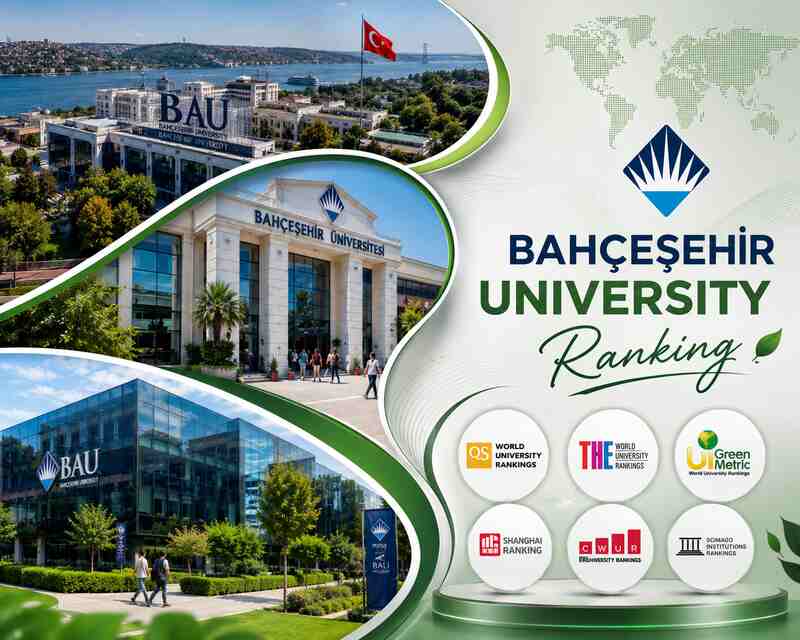
When you look at Bahcesehir University ranking across multiple systems, one thing stands out pretty quickly: this university shows up in more ranking tables than most of its private Istanbul competitors. THE, QS, Webometrics, SCImago, US News, UniRank, it's in all of them, with varying positions depending on what each system actually measures. That breadth isn't accidental, and understanding why it happens tells you a lot about what kind of institution BAU actually is.
Founded in 1998, Bahcesehir University (BAU) has had 25+ years to build the one thing you can't manufacture overnight: accumulated presence. Web content, international collaborations, published research, exchange agreements, all of it takes time to stack up, and in 2026, that stack is visible in the numbers.
Let's go through each ranking system carefully, because the methodology differences matter a lot when you're trying to figure out what a number actually means for you as a student.
Bahcesehir University Rankings at a Glance 2026
Ranking System | Global Position | Turkey Position | What It Measures |
|---|---|---|---|
THE World University Rankings 2026 | 801–1,000 band | 9th in Turkey (tied) / 5th on THE Leading Universities list | Teaching, research, citations, international outlook, industry |
THE Young University Rankings 2026 | 251–300 band | Top Turkey position | Universities under 50 years old only |
QS World University Rankings 2026 | Confirmed global inclusion | Confirmed Turkey position | Reputation, citations per faculty, student ratios |
QS Sustainability Rankings 2026 | 1,151–1,200 band | Confirmed Turkey inclusion | Environmental and social responsibility metrics |
QS EECA Rankings | Confirmed inclusion | Confirmed regional position | Eastern Europe & Central Asia comparative ranking |
Webometrics 2026 | ~1,346th globally | 18th in Turkey | Web presence, academic digital visibility |
SCImago Institutions Rankings | Confirmed global inclusion | Confirmed Turkey position | Pure bibliometric research output from Scopus |
US News Best Global Universities | ~1,040th | Confirmed inclusion | Research output, reputation, citations |
UniRank 2026 | Confirmed global | 9th among private Istanbul universities | Web analytics and engagement |
That's a wide spread. And again, this is what 25 years of consistent operation produces. But position numbers alone don't tell you much without understanding what's driving them.
The THE 801–1,000 Band - and Why the 5th Place Matters More
BAU's THE World University Rankings position of 801–1,000 globally puts it in a recognized international tier, but the number that's actually more useful for students is the 5th position on THE's Leading Universities Turkey editorial list ahead of several larger and older institutions.
How does THE actually calculate this? The system uses 18 carefully calibrated performance indicators across five areas: Teaching (the learning environment), Research Environment (volume, income, and reputation), Research Quality (citation impact), International Outlook (staff, students, and research), and Industry (income and patents). THE's full methodology for the 2026 rankings is publicly available and worth reading if you want the full picture it's one of the more transparent ranking methodologies out there.
BAU's position within this system is driven significantly by the International Outlook pillar. This measures the proportion of international students enrolled, the proportion of international faculty, and the share of research publications produced with international co-authors. BAU scores strongly here because of something genuinely structural: the BAU Global network.
BAU Global currently connects campuses in Washington DC, Berlin, Toronto, Batumi, Hanoi, Kyiv, Cyprus, Puebla, and Brockville plus liaison offices in Azerbaijan, Jordan, Uzbekistan, Mongolia, and Pakistan. Over 6,600 international students from 116 countries are enrolled across these network institutions. That scale of cross-border academic collaboration isn't just a marketing talking point it feeds directly into the international co-authorship ratios and international student proportions that THE measures.
A 2019 paper published in ResearchGate reviewing global university rankings and their impact on internationalization of higher education noted that universities with structured internationalization strategies rather than just high domestic reputation are positioned to outperform in THE's international outlook metrics specifically. BAU's Global network is exactly that kind of structural strategy, and the THE position reflects it.
BAU also holds a confirmed position in the THE Young University Rankings 2026 (251–300 band) which only evaluates universities founded within the last 50 years. This ranking removes the historical advantage of century-old institutions and measures development trajectory, so being in the 251–300 band globally for a university that didn't exist before 1998 is a reasonable signal of upward momentum.
QS Rankings - Sustainability and EECA Positions
BAU's QS World University Rankings inclusion is confirmed for 2026, with Turkey positioning visible on QS TopUniversities.
But the QS position worth paying closest attention to is the QS Sustainability Rankings 2026 band of 1,151–1,200 globally. The Sustainability Rankings measure environmental and social responsibility independently of academic output, they evaluate things like carbon emissions policies, social equity programs, governance transparency, and SDG alignment. BAU has historically scored in THE Impact Rankings categories including Industry Innovation and Infrastructure (101–200 band) and Gender Equality (201–300 band), which suggests the sustainability performance is consistent across different measurement systems, not just one.
For international students who care about institutional values alongside academic quality, this is relevant context. It's not a research ranking, it's measuring something different but it does confirm that BAU's international positioning isn't just cosmetic.
BAU also holds a position in the QS EECA Rankings (Eastern Europe and Central Asia), sitting in the 221–230 band in the most recent cycle. This regional ranking includes universities from 30+ countries, so even a confirmed presence here signals regional academic recognition.
Webometrics - What 25 Years of Web Presence Produces
BAU's Webometrics position of approximately 1,346th globally and 18th in Turkey is the strongest Webometrics position among major private Istanbul universities. This matters more than it might initially seem.
Webometrics measures web visibility the volume of web content, external links pointing to the university from other institutions, and how much academic content is digitally indexed and accessible. What it's really capturing is accumulated digital footprint over time. A university that's been publishing course materials, research outputs, faculty profiles, and institutional announcements online since the late 1990s naturally builds a bigger footprint than one that launched in 2010.
For students, the practical implication of strong Webometrics performance is discoverability. Employers and graduate school admission readers in countries outside Turkey are more likely to have seen or heard of BAU than younger institutions because BAU has been showing up in search results, in Google Scholar citations, and in partner institution listings for a much longer time.
Webometrics isn't a proxy for academic quality the way SCImago is, but it does reflect institutional maturity and international digital presence both of which matter when your degree needs to be recognized outside Turkey.
Subject-Level Strengths Worth Knowing
Beyond overall Bahcesehir University ranking positions, the subject-level data from THE is worth highlighting. BAU ranked 1st in Educational Sciences and 4th in Computer Science among Turkish foundation universities in the most recent THE subject breakdown. These are specific, verifiable positions not general impressions.
For students thinking about education programs or computer science degrees, those subject positions tell you more than a global band number. They tell you that within Turkey's private university sector specifically, BAU's faculty in those fields is producing the citation output needed to rank in those positions.
On the accreditation side: BAU holds MÜDEK accreditation for engineering programs (the Turkish engineering accreditation body equivalent to ABET), EUR-ACE label recognition for European engineering standards, and AACSB accreditation for its business programs. AACSB is the hardest business school accreditation to obtain only around 6% of business schools worldwide hold it. Bahcesehir University is one of a small number of Turkish private universities that does.
These accreditations matter specifically if you're planning to work in a country that checks academic credentials rigorously the EU, Canada, or parts of the Middle East.
Peer Comparison; How BAU Sits Against Istanbul Private Universities
University | THE 2026 Turkey Position | Key Ranking Strength | Primary Driver |
|---|---|---|---|
Bahcesehir University | 9th Turkey / 5th THE Leading Universities list | THE International Outlook, Webometrics | BAU Global network, 25-year digital presence |
Istanbul Medipol | 9th Turkey (tied with BAU) | THE Research Citations | Health sciences clinical research output |
Istanbul Bilgi | Confirmed THE inclusion | Webometrics (~1,346th globally) | EUA membership, 600+ international agreements |
Ozyegin University | Confirmed QS inclusion | AACSB business accreditation | Business and engineering focus |
Altinbas University | Confirmed THE inclusion | SCImago 11th among foundation universities | Health sciences bibliometric research |
The BAU vs. Medipol comparison is interesting because they share the same THE band (801–1,000) and the same 9th Turkey position, but the drivers are completely different. Medipol gets there through health sciences research citations. BAU gets there through international outlook metrics. For a student choosing between them, that distinction maps onto real differences in the student experience: Medipol is research-intensive with a clinical focus; BAU is globally networked with exchange and international career pathway emphasis.
Neither is objectively better they're optimized for different outcomes. It depends on what you're actually there to do.
What Webometrics and SCImago Don't Show
BAU's SCImago position is confirmed but not as prominent as its THE performance which makes sense when you look at what SCImago measures. SCImago pulls from Scopus-indexed publication and citation data, so it specifically rewards medical and health sciences research volume (which is why universities like Altinbas with dedicated health faculties tend to score higher there). BAU's research profile is more distributed across business, engineering, education, and social sciences, so its SCImago position reflects a broader but less concentrated research base.
That's not a weakness, exactly. It's a tradeoff. A university with AACSB-accredited business programs and EUR-ACE engineering programs is building different kinds of research output than one with three medical faculties. The ranking that best captures BAU's actual value, international network, accreditation quality, digital visibility is THE, not SCImago.
THE Impact Rankings; Sustainability Goals
BAU's performance in THE's Impact Rankings, which measure alignment with the UN Sustainable Development Goals, adds another layer to the picture. In the most recent cycles, BAU held positions including 101–200 in Industry Innovation and Infrastructure (SDG 9), 201–300 in Gender Equality (SDG 5), and 301–400 in both Reducing Inequalities (SDG 10) and Sustainable Cities and Communities (SDG 11).
These aren't traditional academic metrics, but they increasingly matter to international students from regions where social accountability of institutions is a factor in university selection.
So What Does All This Mean for You?
If you're choosing between private Istanbul universities and trying to decode the Bahcesehir University ranking picture, here's the honest summary:
BAU's strongest numbers come from THE specifically the International Outlook pillar, driven by the BAU Global network structure. That network isn't just a branding exercise; it produces real measurable metrics that translate into THE's ranking methodology. The 5th place on THE's Leading Universities Turkey list, the 18th Webometrics Turkey position, and the AACSB business accreditation together paint a picture of an internationally oriented institution that's been building global connections for a quarter century.
If you want a clinical research environment with Scopus publication depth, Medipol or Altinbas may be more aligned with that goal. If you want a globally networked degree at an AACSB-accredited business school or MÜDEK-accredited engineering program, with the possibility of studying on a BAU Global campus in Berlin or Toronto as part of your degree BAU is genuinely one of the stronger choices in the Turkish private sector.
Rankings are a starting point. Use them to narrow your options, then dig into program-specific details, accreditations, and fee structures.
For a complete breakdown of programs, fees, and intake information: Bahcesehir University — Complete University Guide
Additional verified ranking sources: