Istanbul Atlas University Ranking 2026 - Youngest Private Medical Campus, Rising Ranking Trajectory

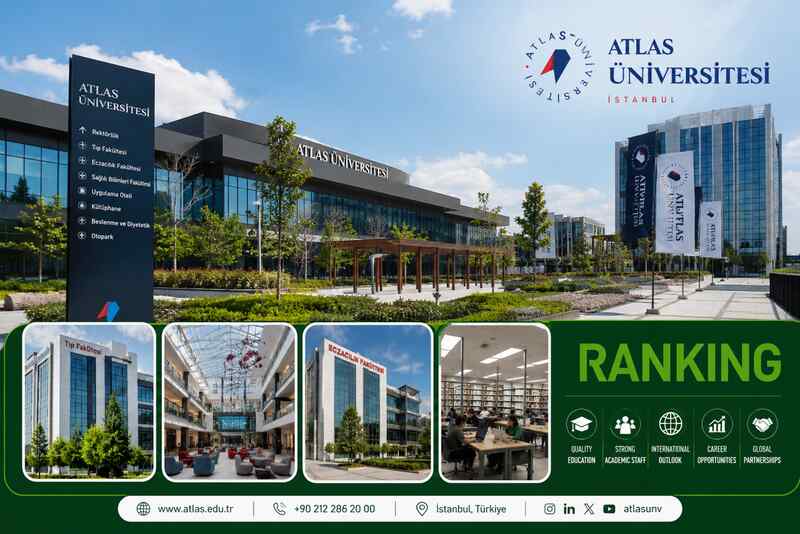
Most ranking guides apply the same template to every university a table of numbers, a brief description, and a verdict. That approach works fine for institutions with 20+ years of research output behind them. But Istanbul Atlas University ranking in 2026 requires a different kind of reading because Atlas is only eight years old, and the systems that produce the ranking numbers most students are familiar with were simply not designed to evaluate universities that young.
That's not a criticism of Atlas. It's an explanation of how ranking algorithms actually work, and understanding it changes what you should look for when evaluating this university.
Istanbul Atlas University Rankings at a Glance 2026
Ranking System | Global Position | Turkey Position | What It Measures |
|---|---|---|---|
Webometrics 2026 | ~6,302nd globally | 136th in Turkey | Web visibility and academic digital footprint |
UniRank 2026 | Confirmed global presence | 136th in Turkey | Web analytics and online engagement |
UI GreenMetric 2024 | 743rd globally | 15th among Turkish foundation universities / 6th in Istanbul | Green campus and environmental sustainability |
AD Scientific Index 2025 | Confirmed global inclusion | Confirmed Turkey position | Individual researcher H-index and citation accumulation |
YÖK Recognition | N/A | Fully accredited | Prerequisite for all downstream recognition |
WDOMS (World Directory of Medical Schools) | Listed | Confirmed | Critical for Gulf, US, and international medicine licensing |
THE Profile | Data submitted, not yet ranked | — | Publication threshold not yet reached |
That's a shorter table than you'd see for Altinbas or Bahcesehir. It's short for a specific, documentable reason and the reason isn't quality. It's time. Let's explain precisely why.
Why Age Is the Most Important Variable in Any Ranking Table
Here's the thing nobody explains clearly in study-abroad content: virtually all major university ranking systems measure accumulated research output over multi-year windows. THE's citation quality metric, which accounts for a large share of the overall THE score, examines 174.9 million citations to 18.7 million journal articles published over a five-year period specifically publications between 2020 and 2024, with citations collected from 2020 to 2025. SCImago pulls five years of Scopus publication and citation data. Even Webometrics, which measures web presence rather than citations, rewards accumulated content volume built up over years of institutional operation.
A university that published its first research papers in 2020 or 2021 has had, at most, four or five years to build the publication record that these systems require. And not just any publications Scopus-indexed, internationally cited, peer-reviewed work in journals that the ranking data suppliers (Elsevier's SciVal, Web of Science) actually cover. That takes time regardless of how strong the faculty is.
A 2023 peer-reviewed study published in PMC (PMC10468493) analyzing the relationship between bibliometric indicators and university ranking positions found that citation-based metrics are inherently backward-looking they capture the cumulative research record of an institution, not its current capacity. A university with strong current faculty research but a short operational history will consistently underperform in citation-weighted rankings relative to older institutions with equivalent current research quality. The lag is structural, not correctable in the short term.
This finding maps almost exactly onto what you see when you compare private Istanbul medical universities by founding year. Istanbul Medipol (founded 2009) sits in the THE 801–1,000 band after 15 years of research accumulation. Istinye (founded 2015) appears at around 2,329th on Webometrics after 10 years of operation. Biruni (founded 2014) holds a confirmed THE position in the 1,201–1,500 band after 12 years. Atlas (founded 2018, first students 2020) is at 136th in Turkey on Webometrics and UniRank after 6 years of institutional operation which is exactly where the trajectory of comparable universities predicts it should be.
So, if Istanbul Atlas University ranking looks modest in 2026 compared to older institutions, that's the explanation. The comparison isn't with universities of the same age. It's with universities that have had a decade or more head start on building the citation record that algorithms measure.
What Atlas Has Built in Six Years; and Why It Matters for Future Rankings
Here's the part that most evaluations of young universities get wrong: they focus entirely on current ranking numbers without asking what infrastructure is being built that will produce future ranking performance. For Atlas specifically, the infrastructure story is unusually strong for a six-year-old institution.
The WADI Campus and hospital: Atlas's Kağıthane Valley (WADI) campus spans approximately 110,000 m² in central Istanbul. The Faculty of Medicine hospital on campus operates with 400 beds, 19 operating rooms, and 100 intensive care units, performing around 30,000 surgeries annually. This is confirmed on both the hospital's official website and Atlas's THE profile page. The Dentistry campus additionally houses dedicated clinical facilities and simulation laboratories for pre-clinical training.
Why does hospital infrastructure matter specifically for ranking trajectory? Because the research output that THE and SCImago measure comes predominantly from clinical research case studies, surgical outcome analyses, drug trials, and medical device evaluations published in Scopus-indexed medical journals. A university whose faculty performs 30,000 surgeries a year in a functioning teaching hospital has a continuous stream of clinical case material that can be published as peer-reviewed research. As those publications accumulate citations over the next five to eight years, they feed directly into the bibliometric databases that THE and SCImago draw from.
This is exactly the mechanism behind Medipol's current THE 801–1,000 position. Medipol's ranking is built on clinical research output from its large hospital network, accumulated over 15 years of operation. Atlas is investing in the same model — a hospital-anchored clinical research pipeline five years into the same trajectory.
Research infrastructure: The campus houses 38 advanced laboratories, including Atlas Creative Labs for interdisciplinary research at the intersection of engineering, arts, and artificial intelligence. The AD Scientific Index 2025 lists 243 ranked researchers from Istanbul Atlas University, with H-index rankings visible across Natural Sciences, Medicine, and Engineering. Having 243 globally ranked scientists at a six-year-old institution is a meaningful indicator of faculty research quality that isn't yet visible in citation-weighted ranking tables because those publications haven't had time to accumulate citations.
International student community: Atlas currently enrolls over 2,763 international students from 101 countries. This figure contributes directly to Webometrics and UniRank metrics both of which measure institutional web presence and digital engagement, which scale with the size and geographic diversity of the international student community generating content and activity around the university's online presence.
GreenMetric 743rd Globally; An Early Signal Worth Understanding
Istanbul Atlas University's 743rd global position and 15th place among Turkish foundation universities in the UI GreenMetric World University Rankings 2023 is the most concrete early-stage international ranking it holds. In 2024, it improved further to 6th among Istanbul foundation universities in the GreenMetric general ranking, and placed in the top 10 among Turkish foundation universities in the Energy and Climate Change category confirmed on Atlas's official website.
GreenMetric measures green campus practices and environmental sustainability rather than research citations. So this ranking doesn't predict THE or SCImago performance directly. But it does signal something important about institutional management: a university that invests in the operational systems needed to rank 6th among Istanbul foundation universities for sustainability within six years of founding is one that takes formal institutional benchmarking seriously. The same management culture that pursues GreenMetric performance tends to invest in the accreditation processes and research infrastructure that produce longer-term ranking improvements.
The comparison with what other very young Turkish private universities scored at the same institutional age suggests Atlas is on an above-average trajectory. Fenerbahce University (founded 2016), for context, sits at around 177th in Turkey on Webometrics eight years in two years further along than Atlas but without a comparable hospital infrastructure.
WDOMS Listing; The Credential That Matters Most Right Now for Medicine Students
For students choosing Atlas specifically for medicine or dentistry, the most practically important credential at this stage isn't a THE band. It's the World Directory of Medical Schools (WDOMS) listing with ECFMG eligibility.
WDOMS is maintained by the Foundation for Advancement of International Medical Education and Research (FAIMER) and is used by licensing bodies worldwide — Gulf countries, the USA, Canada, and others — to determine whether a foreign medical degree is eligible for further professional licensing processes. ECFMG (Educational Commission for Foreign Medical Graduates), which governs the eligibility of international medical graduates to sit USMLE exams in the US, requires graduates to come from WDOMS-listed institutions accredited by a WFME-recognized agency.
Atlas holds full YÖK (Turkey's Higher Education Council) recognition, which is the base layer that makes WDOMS listing possible. For an international student planning to practice medicine in the Gulf region, UK, or anywhere that checks WDOMS status this listing is the binary credential that either permits or blocks that pathway. It exists at Atlas. That's the starting point for any medicine student's evaluation.
Peer Comparison; Young Istanbul Medical Universities
University | Founded | THE 2026 Position | Webometrics Turkey | Key Infrastructure |
|---|---|---|---|---|
Istanbul Medipol | 2009 | 801–1,000 band | ~17th Turkey | Large hospital network, 15 years citation accumulation |
Biruni University | 2014 | 1,201–1,500 band | Mid-tier Turkey | TEPDAD accredited 2025, 400-bed hospital |
Istinye University | 2015 | Confirmed THE | ~34th Turkey | Multiple hospital affiliations, 10 years operation |
Istanbul Atlas University | 2018 | THE profile exists, not yet banded | 136th Turkey | 400-bed hospital, 19 operating rooms, 243 ranked researchers |
Fenerbahce University | 2016 | Not confirmed THE | ~177th Turkey | Smaller campus, fewer health facilities |
The peer comparison pattern is consistent across all five institutions: each additional year of research-generating operation produces measurable improvement in Webometrics position and eventually in SCImago and THE inclusion. Medipol leads because it has had 15 years to build the citation record. Biruni and Istinye are ahead of Atlas because they have 8–10 years of operation. Atlas is where Biruni and Istinye were in 2022–2023 and where Medipol was in 2018–2019.
The most meaningful forward-looking indicator to watch for Atlas is SCImago inclusion which requires that the university's Scopus-indexed publications reach the threshold volume and citation accumulation needed for SCImago to generate a calculable score. Based on comparable university trajectories, that threshold is typically reached between years 7–10 of institutional operation. For Atlas, that window is approximately 2025–2028.
What 38 Laboratories and a 110,000 m² Campus Actually Signals
Rankings measure past output. Infrastructure signals future output. And the WADI campus infrastructure at Istanbul Atlas University is more substantial than you'd expect from a six-year-old institution.
Beyond the hospital, the 38 specialized laboratories span medical sciences, engineering, and creative technology — including dedicated facilities for molecular biology, biomedical applications, and AI-integrated research. Atlas Creative Labs specifically positions the university for research at the intersection of health technology and engineering, which is an emerging area generating high-citation publication output in Scopus-indexed journals.
The university currently offers 24 undergraduate programs and 5 graduate programs across faculties of Medicine, Dentistry, Health Sciences, Engineering and Natural Sciences, Arts/Design/Architecture, and Humanities and Social Sciences. English-medium options exist across Medicine ($22,500/year), Dentistry, Computer Engineering, Software Engineering, Psychology, Nursing, and Physiotherapy.
For most students evaluating Atlas in 2026, the honest question isn't "does Atlas rank with Medipol right now?" It doesn't, and it can't those are 15 years apart. The real question is: does Atlas have the infrastructure, hospital clinical platform, and faculty research capacity to follow the same trajectory? Based on the WADI campus, the hospital operational volume, the 38 laboratories, and the 243 indexed researchers, the answer is yes and the GreenMetric 6th-in-Istanbul position in year six confirms that the institutional management is building systematically rather than coasting.
What This Means If You're Choosing Atlas Right Now
Istanbul Atlas University ranking in 2026 should be read as a trajectory snapshot, not a final verdict. The Webometrics 136th Turkey position is real and verifiable. The absence from THE and SCImago is a function of institutional age, not a quality deficiency and it's fully consistent with where every comparable Turkish private medical university was at the same point in its development cycle.
If you're a medicine or dentistry student, the WDOMS listing is the credential that opens international licensing pathways. If you're an engineering student, the English-medium programs and the 38 research laboratories are the relevant infrastructure. If you're thinking about the long term graduate recognition, employer familiarity, accreditation development the trajectory from GreenMetric 743rd globally in year five to SCImago inclusion in years 7–10 to potential THE inclusion in years 12–15 is the arc that comparable Turkish medical universities have followed before Atlas.
For program-specific fees, scholarship details, and 2026–2027 intake information: Istanbul Atlas University — Complete University Guide
Verification sources: