How to Apply to a Turkish University Step by Step - And Why You Should Never Do It Alone

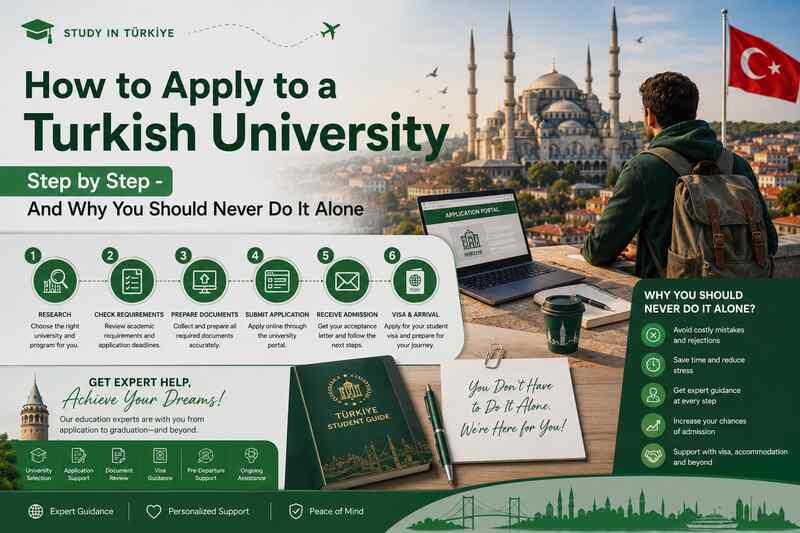
So you've decided Turkey is where you want to study. Good choice. Now comes the part that trips up more students than anything else the actual application process.
Here's the thing most guides won't tell you upfront: steps to apply to a Turkish university as an international student is not complicated on paper, but it's full of small steps that depend on each other. Miss one, and the whole timeline falls apart. Start too late, and you're waiting another intake cycle. Submit the wrong document, and your registration gets delayed or cancelled.
I've seen this happen more times than I'd like to count. Students who do everything "mostly right" still end up losing their spot because they didn't know about denklik, or they missed a deadline by a week, or they didn't realize their diploma needed an apostille before translation. These aren't rare situations. They're the norm for students who go through this alone.
This guide gives you the full picture step by step, in plain language. And by the end, you'll understand not just what the steps are, but why each one matters, and where things usually go wrong.
Step 1; Choose the Right Program and University (Before Anything Else)
This sounds obvious, but a lot of students skip the thinking phase and go straight to asking "how do I apply?" without deciding what they're applying to. That matters more than you think, because the process is different depending on whether you're applying to a public or private university, and different again depending on your program.
Public universities in Turkey require entrance exams usually YÖS (Yabancı Öğrenci Sınavı) or TR-YÖS, the centralized version managed by ÖSYM. For the 2026 intake, TR-YÖS registration opened in January and the exam was held in April 2026. If you missed that window, you'd have to wait for the next cycle or apply to universities that accept alternative scores like SAT or high school GPA directly.
Private universities are much more flexible. Most accept international students based on high school diploma and transcripts alone no entrance exam required. That's actually one of the biggest reasons private universities in Turkey attract so many international applicants. The process is faster, the windows stay open longer, and requirements are more predictable.
So before you do anything else, answer these questions:
What program do I want to study, and in which language?
Do I want a public or private university?
What's my actual budget for tuition per year?
Which city do I want to live in?
If you're not sure, universityfinder.org has a free matching tool that helps you narrow this down based on your grades, budget, and program goals. It saves a lot of going back and forth.
Step 2; Prepare Your Documents Early (This Is Where People Lose Time)
Once you know where you're applying, start gathering documents immediately. Don't wait for acceptance to think about paperwork. The document preparation phase takes longer than most students expect, especially if you need translations, apostilles, or equivalency certificates.
Here's what you'll typically need for a private university bachelor's application:
Valid passport (must be valid for at least 18 months from the date of application)
High school diploma or certificate (original + certified translation into English or Turkish)
Academic transcripts (all years of high school, original + certified translation)
Personal photo (passport-style, recent)
Language proficiency proof (IELTS/TOEFL for English-medium programs, or you may sit an internal test after acceptance)
Copy of any previous university transcripts (if applying as a transfer student)
For public universities, you'll also need your YÖS or TR-YÖS score certificate, and requirements may vary significantly by faculty.
One document that surprises many students: the apostille. Your diploma and transcripts may need to be apostilled in your home country before they're legally recognized in Turkey. Not every country is part of the Hague Apostille Convention so if yours isn't, you'll need authentication through the Turkish embassy instead. Start this process early because it can take 2–4 weeks even when things go smoothly.
If you apply through universityfinder.org, we check your document list before you submit anything so you're not discovering missing apostilles after you've already paid a registration fee.
Step 3; Submit Your Application
For private universities, you can usually apply directly through the university's online portal, or through an authorized education agency (like universityfinder.org) that applies on your behalf. Applying through an agency at no cost to you is genuinely the smarter move — not because the process is impossible to do yourself, but because agencies often have direct contacts at admissions offices, can track your file status, and know exactly which documents each university wants in which format.
Application windows for private universities are generally open from late autumn through mid-summer for the September intake, and from September through November for the February intake. That said, popular programs in medicine, dentistry, and pharmacy fill up faster so don't assume a window being "open" means there's no rush.
For public universities, the September intake application window is usually May to August, depending on the institution. Some open as early as May, others run until late July or August. Check each university's international admissions page directly, or have an advisor track this for you.
When you submit, double-check everything:
Are all documents translated and certified?
Is the application form filled completely, no blank fields?
Did you attach every required document in the correct format (usually PDF)?
Did you pay any required application fee? (Public universities sometimes charge a small application processing fee. Private universities that work with authorized agencies like universityfinder.org typically waive this.)
Step 4; Receive Your Acceptance Letter (Kabul Belgesi)
If your application is complete and you meet the admission requirements, the university issues an official kabul belgesi the acceptance letter. This document is more important than most students realize. It's not just a congratulations note. You'll need it for:
Applying for your student visa at the Turkish embassy or consulate
Applying for your residence permit once you arrive in Turkey
Getting your student ID at the university
Proving your student status for things like discounts, bank accounts, and public transport cards
Acceptance usually comes within 1–4 weeks for private universities if your file is complete. Some universities issue it faster if they know the agency submitting the application.
Once you have it, don't sit on it. Your next steps have deadlines too.
Step 5; Apply for Your Student Visa
With your acceptance letter in hand, go to the nearest Turkish embassy or consulate in your country and apply for a student visa. Most nationalities need this. A few countries (check with the consulate) can enter Turkey visa-free or with an e-visa and convert their status to a student residence permit after arriving.
Documents typically required for the student visa:
Valid passport
Completed visa application form
Acceptance letter from your Turkish university
Proof of financial means (bank statement showing you can cover your living costs)
Passport-size photos
Visa fee payment (usually $50–$100 depending on nationality)
Processing time is roughly 3–8 weeks depending on your country and the embassy's current workload. Apply as early as possible after getting your acceptance letter. Don't wait until a month before your program starts you could miss registration.
Some students from countries with easier travel arrangements choose to enter Turkey on a tourist e-visa first and then apply for the student residence permit locally. This is technically possible but comes with risks if something goes wrong with the residence permit, you're in Turkey without a valid legal status. If you're considering this route, talk to someone who knows Turkish immigration law before you decide. [Student Visa Turkey]
Step 6; The Denklik (Diploma Equivalency) - The Step Everyone Forgets
This one catches students completely off guard every year. So I want to spend some extra time here.
Denklik is the official recognition of your foreign high school diploma by the Turkish Ministry of National Education (Milli Egitim Bakanligi). Without it, you cannot complete your final university registration in Turkey. It doesn't matter that you have an acceptance letter. Without denklik, you're not fully enrolled.
You can apply for denklik in two ways:
Through the Turkish embassy or consulate in your home country before you travel (preferred and faster)
Through the Ministry of Education office in Turkey after you arrive
The online system is called e-Denklik (edenklik.meb.gov.tr). You upload your documents, book an appointment, and submit your original diploma and transcripts for review. The process takes 2 to 6 weeks on average. If you start this only after arriving in Turkey, you risk delaying your enrollment and some universities will cancel your registration if you don't submit your denklik by their deadline.
Important: your diploma must have an apostille (or embassy authentication if your country isn't in the Hague Convention) for the denklik process to work. If this step isn't done, the Ministry won't accept your documents.
Diplomas from online/distance education programs are not eligible for equivalency in Turkey. If this applies to your situation, check with an advisor before applying.
This is one of the biggest areas where students who apply alone run into serious problems and where having experienced support makes a real difference. At universityfinder.org, we walk every student through the denklik process before they leave home, not after they land. [Services]
Step 7; Arrive, Register, and Get Your Residence Permit
You made it to Turkey. Now there are a few more things to handle in your first 2–4 weeks.
Final university registration: You'll go to the university's international students office with your original documents passport, acceptance letter, denklik certificate, diploma, transcripts, and photos. They'll process your final enrollment, issue your student ID, and assign you to your faculty. This is where you also typically pay your first semester tuition if you haven't done so already.
Student residence permit (ikametgah): All international students must apply for this within 30 days of arrival. You apply online through the official Turkish immigration system (e-ikamet.goc.gov.tr), book an appointment at your local immigration directorate, and attend in person with your documents.
What you'll need for the residence permit application:
Valid passport
Acceptance letter or proof of enrollment
Health insurance valid in Turkey (mandatory)
Proof of accommodation (rental contract or dorm agreement)
Passport photos
Application fee payment ($50–$75 plus card issuance fee of ~$20)
First-time applicants usually receive their permit within 2–4 weeks after the in-person appointment.
Renewals happen every year, before your current permit expires. Miss the renewal window and you'll be in Turkey illegally, which creates serious complications. This is another area where universityfinder.org stays with you not just for the first application, but every renewal until you graduate. [internal link: /residence-permit-turkey]
University Comparison: How Application Requirements Differ
Knowing where you're applying changes everything about your preparation timeline. Here's how some popular universities for international students compare on application requirements:
University | City | Type | Entrance Exam | Denklik Required | Tuition (USD/Year) | English Option |
|---|---|---|---|---|---|---|
Istanbul Medipol | Istanbul | Private | No | Yes | $18,000–$25,000 (Medicine) | Yes |
Bahçeşehir (BAU) | Istanbul | Private | No | Yes | $5,000–$8,000 | Yes |
Istanbul Aydin | Istanbul | Private | No | Yes | $3,500–$6,000 | Yes |
Istanbul Gelisim | Istanbul | Private | No | Yes | $4,000–$6,500 | Yes |
Bogazici University | Istanbul | Public | TR-YÖS/SAT | Yes | $1,000–$2,200 | Yes |
Ankara University | Ankara | Public | TR-YÖS | Yes | $2,000–$13,000 | Partial |
Acıbadem University | Istanbul | Private | No | Yes | $15,000–$22,000 (Medicine) | Yes |
Private universities are consistently the faster, more accessible route for international applicants. Public universities cost less, but the exam and quota system adds complexity and risk to your timeline. Neither is better in an absolute sense it depends on your scores, your budget, and how much time you have before the intake you want to join.
Common Mistakes That Delay or Destroy Applications
Let me be direct about what I see go wrong most often:
Starting too late is the biggest one. Students who begin preparing in July for a September intake are already in trouble. Denklik alone takes up to 6 weeks. Add apostille processing, translation, visa application, and university deadlines and 8–10 weeks of preparation time is the bare minimum. Start in January or February for a September intake.
Mixing up public and private processes is very common. Public universities use government portals and have specific exam requirements. Private universities have their own direct systems. If you submit a public university application to a private university, or assume you don't need YÖS because you saw a private university that didn't require it, and then try for a public one you'll miss the exam window.
Incomplete documents is almost universal among students who apply alone. One missing notarization, one document without apostille, one transcript with the wrong certification and your application sits in a pile until you fix it, sometimes missing the deadline entirely.
Not checking if the program is accredited for your home country. If you plan to work as a doctor, engineer, or pharmacist in your home country after graduating from Turkey, the degree must be recognized there. YÖK accreditation in Turkey doesn't automatically mean recognition everywhere. Check with a specialist before choosing a program, not after graduating.
Frequently Asked Questions
Q: Can I apply to a Turkish university without IELTS? A: Yes, many private universities in Turkey don't require IELTS or TOEFL if your previous education was in English. If it wasn't, you may sit an internal English placement test after acceptance, or enroll in a one-year English preparatory program first. Always check the specific university's language policy before applying.
Q: How long does the full application process take from start to acceptance? A: For private universities with complete documents ready, the process from application to acceptance letter is usually 2–4 weeks. Add denklik (2–6 weeks), visa (3–8 weeks), and you're looking at a minimum of 10–12 weeks from starting paperwork to being ready to travel. Start early.
Q: Do I need to apply separately to multiple universities? A: You can, and it's often wise to have a backup option. Applying through an agency like universityfinder.org means we can submit to multiple universities simultaneously without extra cost to you, and you then choose from whichever offers come in.
Q: What is the minimum GPA or grade to get into a Turkish private university? A: Most private universities in Turkey accept international students with a minimum high school grade of 50 out of 100 (or equivalent). Some competitive programs like medicine and pharmacy set higher minimums, often 70–75 out of 100. Strong grades also help you qualify for scholarship discounts.
Q: Can I change my program or university after I arrive in Turkey? A: Yes, but it's complicated and comes with conditions. Changing programs within the same university is more straightforward. Transferring to a different university requires meeting that university's transfer requirements and restarting some paperwork, including potentially a new denklik process. It's much better to choose right the first time.
Q: What happens if my visa is delayed and I miss the registration deadline? A: This happens, and most universities have a grace period. Contact the international students office as soon as you know there's a delay they can often extend your registration deadline if you have proof your visa is in process. An agency that is tracking your file can handle this communication on your behalf quickly.
The Honest Reason You Shouldn't Do This Alone
Look, the application to a Turkish university is manageable. It's not impossible. Students do it solo every year.
But the students who go through the process with proper support a real agency that knows the system, knows the universities, and stays with them from day one they show up in Turkey with their denklik already done, their residence permit application ready to submit, their accommodation contract signed, and someone waiting for them at the airport. The students who go alone? A good number of them are still figuring out their denklik at the immigration office in week three, or they're living in a questionable apartment because they didn't know how to read a Turkish rental contract.
That's the real difference. And at universityfinder.org, it costs you nothing. No application fees. No hidden charges. Just experienced people who have done this for students from dozens of countries, who know exactly what each university needs, and who stay with you not just through admission but through registration, residence permits, accommodation, and beyond.