Study Medicine Abroad: What It Actually Involves, What It Costs, and Where It Leads

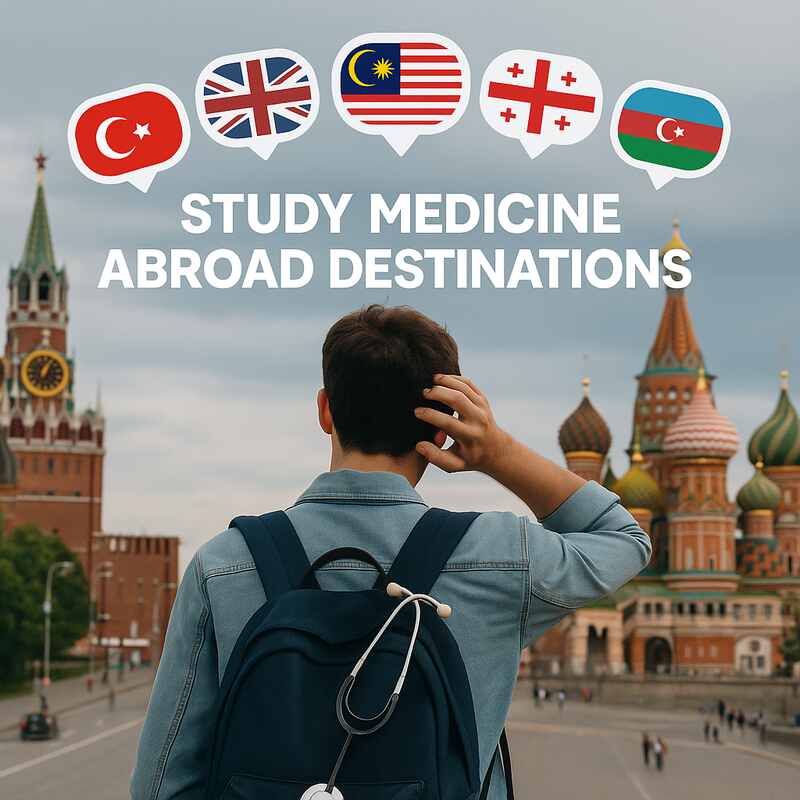
Study medicine abroad - it sounds straightforward until you actually start researching it. Then you realize there's six years of structure to understand, a dozen countries to compare, accreditation terms you've never heard of, and a decision that will shape the next decade of your life. So let's break it down properly, without the vague answers.
What You're Actually Signing Up For
A medical degree abroad - whether it's called MBBS, MD, or Tıp Doktoru (the Turkish title) - follows a similar structure nearly everywhere. Most programs run five to six years and move through three distinct phases.
Years 1-3 are the pre-clinical phase. You're in lecture halls and labs, working through Anatomy, Physiology, Biochemistry, Pathology, Pharmacology, and Microbiology. There's cadaver dissection, simulation-based training, and a serious volume of content to absorb. You won't see many patients yet. Some students find this phase surprisingly hard, not because the material is impossible, but because the shift from high school to medical school content load is steeper than expected.
Years 4-5 bring the clinical rotations. This is the part most students picture when they imagine medicine - rotating through Internal Medicine, Surgery, Pediatrics, OB-GYN, Psychiatry, Orthopedics, and Family Medicine in real hospital settings, under real doctors. How much you actually get from this phase depends a lot on where you study. High-volume hospitals in cities like Istanbul mean genuine case diversity. Smaller institutions in less populated areas may offer less variety.
The final year is the internship. You function as an intern doctor under supervision, handling ward duties, outpatient clinics, and emergency units. By the end of it, you're expected to be ready for licensing. In Turkey, the UK, Malaysia, and most other destinations, completing this year is mandatory before you can register as a practicing physician.
One thing the source material doesn't always spell out clearly: if you arrive without the required English level or science foundation, many universities offer a prep year before Year 1. So the realistic timeline for some students is seven years, not six.
Why Students Are Choosing to Study Medicine Abroad Now
The reasons are partly economic, partly strategic - and there's real data behind them.
The OECD reported in 2023 that across member countries, 24% of practicing doctors were foreign-born and 20% were foreign-trained. That figure has been climbing steadily since 2010. Countries like the UK, Australia, Canada, and the US have been actively recruiting international medical graduates for years because they simply don't train enough domestic doctors to meet demand.
A 2024 scoping review published in PMC that analyzed global patterns of medical student migration found that graduates from lower and middle-income countries are driven primarily by limited local career progression, while the international recognition of their degrees opens real pathways to work in high-income healthcare systems. The review, which followed PRISMA-ScR guidelines, covered data from Turkey, Pakistan, Malaysia, Egypt, and over a dozen other source countries - and found that the decision to study medicine abroad is increasingly tied to long-term migration and career strategy, not just tuition cost.
That matters for you as a student because it means your degree choice is also a career geography choice. Where you study, and whether that institution is properly listed and accredited, will determine which licensing exams you can sit and which countries you can practice in after graduation.
Why Medicine Costs More Than Other Degrees
This is a fair question and it has a real answer. A standard three or four year business or humanities degree needs classrooms and staff. A medical program needs all of that plus fully equipped teaching hospitals, advanced simulation labs, practicing specialists who teach, cadavers, diagnostic technology, and significantly more faculty hours per student over a longer program.
The result is that MBBS abroad fees are consistently higher than most other international degrees, regardless of which country you choose. Private English-medium programs in Turkey run roughly $17,000 to $40,000 per year. Malaysia and Georgia tend to sit in a similar or slightly lower range for private schools. The UK is at the top end globally, with some schools reaching $50,000-$70,000 per year for international students. North Cyprus and Azerbaijan offer lower-cost options, though program recognition varies and you should verify each school's WDOMS listing before applying.
Public universities are cheaper almost everywhere, but they usually teach in the local language and competition for international seats is real.
Living costs add a separate layer. Istanbul is on the higher end for Turkey at roughly $500-$800 per month. Georgia and Azerbaijan tend to be cheaper. UK living costs are among the highest of any study destination.
Who Should Actually Consider Studying Medicine Abroad
Not everyone, honestly. This is worth saying plainly.
Medicine abroad works well if you have a strong science background in Biology, Chemistry, and Physics - and you're genuinely motivated by clinical work, not just the title. It works well if you're looking for an internationally recognized degree at a lower cost than your home country offers. It's a smart route if your long-term plan involves taking USMLE (for the US), PLAB (for the UK), or AMC (for Australia) after graduation.
It's harder if you expect a fully passive experience, if you underestimate the language demands of clinical rotations in a non-English-speaking country, or if you haven't researched whether your target school is recognized in the country where you plan to practice.
A 2024 paper in Academic Psychiatry on international medical graduate workforce integration noted that IMGs who had completed training in recognized programs abroad were already filling critical gaps in the US healthcare system - and several states passed new laws in 2023 and 2024 specifically to ease their path to licensure. Tennessee and Virginia are two examples. The point is: a well-chosen degree from an accredited foreign medical school is genuinely valued in major healthcare systems, not treated as inferior.
What Happens After You Graduate
The path after graduation breaks into a few options, depending on where you studied and where you want to end up.
If you want to work in the US: You need to pass the USMLE (all three steps), apply through ECFMG for certification, and match into a US residency through ERAS. Your medical school must be WDOMS-listed with ECFMG eligibility noted. It's a long process, but Turkish, Georgian, and other international graduates do it every year.
If you want to work in the UK: You sit PLAB Parts 1 and 2, then register with the GMC. Graduates from properly accredited programs in Turkey and elsewhere are eligible for this route.
If you want to specialize: Your MD or MBBS opens the door to residency and fellowship programs. Whether you pursue Cardiology, Surgery, Dermatology, or another field, you'll typically need to pass the national licensing exam of your target country first.
Research and academic medicine are also real options. Graduates can pursue master's and PhD programs, join hospital research units, or work in public health. The global shortage of physicians documented by the WHO - which has consistently warned of a critical worldwide deficit of healthcare professionals - means demand for trained doctors across all these tracks is unlikely to fall anytime soon.
A Quick Comparison Across Destinations
If you're still deciding where to study medicine abroad, here's an honest side-by-side of the main destinations:
Country | Annual Tuition (Private, English) | Program Length | Key Recognition | Language in Clinics |
|---|---|---|---|---|
Turkey | $17,000 - $40,000 | 6 years | WDOMS, TEPDAD, YÖK | Turkish |
Georgia | $6,000 - $10,000 | 6 years | WDOMS (varies by school) | Georgian/English |
Malaysia | $10,000 - $18,000 | 5 years | MQA recognized | English |
North Cyprus | $10,000 - $16,000 | 6 years | Verify WDOMS per school | English/Turkish |
Azerbaijan | $5,000 - $10,000 | 6 years | Verify per school | Azerbaijani/Russian |
UK | $40,000 - $70,000 | 5-6 years | GMC, global prestige | English |
Fees are approximate for 2026-2027. Always confirm directly with the university before applying.
Turkey stands out in this comparison for combining modern university hospitals, English-medium tracks, TEPDAD accreditation, and a cost level that's significantly lower than Western Europe - which is why it's become one of the more practical choices for students from Africa, the Middle East, and South Asia who want a degree with real global pathways attached.
The Honest Bottom Line
Studying medicine abroad is not a shortcut. The workload is real, the clinical demands grow by the year, and the licensing process after graduation requires planning. But the structural pieces are there: internationally recognized programs, modern hospitals, competitive fees, and a global job market that genuinely needs more doctors.
If you go in with clear goals - knowing which licensing exam you're preparing for, which country you want to practice in, and which accreditation your target school holds - study medicine abroad becomes one of the more logical routes available to an internationally mobile student in 2026.


When students start researching where to study medicine abroad, the comparison usually comes down to four questions: How long is the program? Is it in English? Can I actually get in? And what will it cost me? These are the right questions - but the answers vary more than most comparison articles admit. So here's an honest breakdown of six destinations: Turkey, the UK, Malaysia, North Cyprus, Azerbaijan, and Georgia.
How Long Will It Take?
Most countries run six-year medical programs, but the fine print matters.
Turkey runs a standard six-year program divided into pre-clinical, clinical, and internship phases. Some students add a prep year for English or foundational sciences, so the realistic timeline for those students is seven years. Still - the actual medical degree stays at six years, and that prep year is optional, not mandatory.
The UK advertises five-year medicine programs, but that's only part of the picture. After graduation, doctors must complete two Foundation Programme years before they can fully register and practice independently. So the real pathway to practicing medicine in the UK is closer to seven years from enrollment - and that's before any specialty training. It's the longest effective path among these six destinations.
Malaysia sits at five to six years depending on whether you're at a private or public institution, with some programs including the internship year within the degree structure.
North Cyprus follows a similar six-year model to Turkey, with optional English prep available. Azerbaijan typically runs five academic years plus a one-year compulsory internship, totaling six. Georgia also runs six-year MBBS programs, with some universities beginning clinical exposure as early as Year 3, which is earlier than most.
Bottom line on duration: If you're comparing purely by years in medical school, most destinations are roughly equal. The UK stands out for adding mandatory post-graduate years before full practice, making it the longest overall commitment.
What Language Will You Study In?
This matters more than just the classroom. Medicine involves patient communication, clinical documentation, and working with hospital staff - and that happens in the local language, whatever the brochure says about English instruction.
Turkey has a solid range of English-medium programs, particularly at private universities like Medipol, Bahçeşehir, Biruni, Uskudar, and Altinbas. Even some public universities have English tracks. But once you enter clinical rotations from Year 4 onward, day-to-day hospital interaction happens in Turkish. Basic medical Turkish becomes genuinely necessary. Most universities offer Turkish language support through TÖMER, and students who start early manage the transition well.
The UK is fully English from day one, which is the obvious advantage. But entry requirements for English proficiency are high, IELTS scores need to be strong, and competition is intense.
Malaysia at the private level (IMU, Monash Malaysia, NUMed) teaches almost entirely in English. Public universities sometimes mix Malay into instruction, though international student programs tend to stay English-heavy.
North Cyprus offers English-medium programs at most universities, though as in Turkey, Turkish helps in clinical years. Georgia is increasingly popular for English-medium medicine, but Georgian is needed for clinical communication - a factor many students underestimate before they arrive. Azerbaijan has English tracks at universities like ADA and Khazar, but some institutions still use Azerbaijani or Russian for parts of the program.
Bottom line on language: Almost every destination now offers English instruction. Turkey's advantage is that it combines English-medium programs with relatively affordable tuition and modern hospitals - something the UK offers too, but at three to four times the cost.
How Competitive Is Admission?
This is where the destinations split quite clearly.
Turkey is genuinely accessible for international students. Most private universities accept applications after 12th grade with roughly 70% in science subjects. Many don't require IELTS, accepting an internal English proficiency exam instead - making it a realistic route to study medicine without IELTS. YÖS (Turkey's university entrance exam for foreign students) is helpful for scholarship applications but not always compulsory at private schools.
The UK sits at the opposite end. You need strong A-Level or IB scores, UCAT or BMAT entrance exam results, personal statements, and interviews - and even then, acceptance rates at top medical schools are low. It's the most competitive entry process of the six destinations by a significant margin.
Malaysia requires solid science grades (typically 70% and above), and many private universities conduct interviews. IELTS or TOEFL is often required, though some private institutions offer internal tests as an alternative.
North Cyprus is more flexible - most universities accept students with 60-70% in science subjects and offer internal English tests. Azerbaijan sits in a similar range, typically 50-70% in sciences, with IELTS often waived if students pass internal assessments. Georgia has arguably the most open admissions of the six - many universities accept students directly from high school with passing grades, no mandatory entrance exam and no IELTS required.
Bottom line on admissions: Georgia and Azerbaijan are the easiest to enter, but this also reflects differences in selectivity and program intensity. Turkey occupies a practical middle ground - easier to access than the UK and Malaysia, with higher academic baseline than the ultra-low-cost options. From what I've seen helping students navigate applications, that balance is exactly what most families are looking for.
What Will It Actually Cost?
Here is where the comparison gets most useful - and where students sometimes get a partial picture from other sources.
Turkey (private, English-medium): Tuition typically runs $15,000 to $44,000 per year. Some well-known programs like Atlas sit around $25,000, Okan and Altinbas around $22,000, while Medipol reaches the higher end. Public universities are much cheaper ($2,000-$10,000 per year) but are primarily Turkish-medium and highly competitive on entry.
UK: International student tuition for medicine ranges from roughly $40,000 to $70,000 per year - and London living costs add another $15,000-$20,000 annually on top of that. It's the most expensive destination in this comparison by a clear margin.
Malaysia: Private universities run $20,000-$30,000 per year. Public universities can be lower ($5,000-$10,000) but international seats are limited and the application process is more selective.
North Cyprus: One of the more affordable options among English-medium programs, with tuition averaging $7,000-$15,000 per year. Living costs are moderate compared to Istanbul.
Azerbaijan: The lowest-cost option in the group, with fees between $3,500-$7,500 per year. Georgia sits just above that at $5,000-$8,000 per year. Both are significantly cheaper than Turkey or Malaysia.
A 2024 cross-sectional study published in BMC Medical Education, which surveyed 482 international medical students across 30 Turkish medical schools, found that affordability and the perceived quality of Turkish medical education were the two primary drivers behind students choosing Turkey. The study noted that students from a wide range of socioeconomic backgrounds were enrolling - suggesting Turkey's fee range hits a sweet spot that lower-income families in Africa and South Asia can reach, while still offering standards that more affluent families consider credible.
Bottom line on fees: Azerbaijan and Georgia are cheapest. But cheapest is not always the best value, especially when accreditation, hospital quality, and post-graduate licensing pathways vary significantly between institutions in those countries. Turkey costs more, but the combination of TEPDAD accreditation, WDOMS listing, modern university hospitals, and English tracks makes the additional cost defensible for most families doing a long-term cost-benefit calculation.
Quick Comparison Table
Country | Duration | Language | Admission Ease | Tuition/Year (USD) | USMLE/PLAB Eligible |
|---|---|---|---|---|---|
Turkey | 6 years (7 with prep) | English + Turkish | Moderate - easy | $2,000-$44,000 | Yes (TEPDAD/WDOMS) |
UK | 5 years + 2 foundation | English | Very competitive | $40,000-$70,000 | Yes (GMC recognized) |
Malaysia | 5-6 years | English (private) | Moderate | $5,000-$30,000 | Yes (MQA) |
North Cyprus | 6 years | English + Turkish | Easy | $7,000-$15,000 | Verify per school |
Azerbaijan | 6 years | English + local | Easy | $3,500-$7,500 | Verify per school |
Georgia | 6 years | English + Georgian | Very easy | $5,000-$8,000 | Verify per school |
Tuition figures are approximate for 2026-2027. Always confirm directly with the university before applying.
So Which Country Should You Choose?
Honestly, it depends on what you're optimizing for.
If budget is the primary constraint and you're comfortable doing extra research to verify each school's WDOMS listing and ECFMG eligibility, Azerbaijan and Georgia offer the lowest entry cost. Just don't assume all programs in those countries carry equal recognition - they don't, and it's worth checking school by school before you commit.
If your long-term goal is practicing in the UK and you have the grades, the financial means, and the appetite for a highly competitive process, UK medicine is still one of the most prestigious paths available.
If you're looking for the best combination of English-medium instruction, recognized accreditation, modern hospitals, reasonable admission requirements, and a fee level that's manageable without being dangerously cheap - Turkey is the strongest option in this group. That's not a promotional claim; it's what the data shows when you line up duration, cost, clinical quality, and post-graduate pathways side by side.
I've seen students from Nigeria, Pakistan, Egypt, and Indonesia make this exact comparison and land on Turkey - not because it was the cheapest, but because it was the most complete package for what they actually needed from a medical degree.
When deciding to study medicine abroad, international students must consider not only tuition fees and admission criteria but also whether their degree will be recognized globally. Another crucial factor is the quality of local hospital practice
since clinical rotations and internships determine how well-prepared graduates will be to enter the medical workforce.
Turkey: Rapid Growth, Strong Recognition, and Resilient Healthcare
In the last decade, Turkey has emerged as a global medical hub. Many universities, such as Bahçeşehir University, Istanbul Medipol University, and Hacettepe University, are listed in the World Directory of Medical Schools (WDOMS) and recognized by international bodies. Graduates are eligible to sit for USMLE (USA), PLAB (UK), and other licensing exams.
Local Practice: Students train in some of the largest university hospitals in Europe, with advanced simulation labs and real-world patient exposure.
Medical Achievements: Turkey’s healthcare reforms have expanded hospital capacity, improved doctor-patient ratios, and built advanced city hospitals. During the COVID-19 pandemic, Turkey’s system remained stable, avoiding collapse thanks to effective government measures, rapid vaccine deployment, and strong hospital infrastructure.
Why It Matters: This combination of international recognition, modern hospitals, and proven resilience makes Turkey a reliable and attractive choice for studying medicine abroad.
United Kingdom: Global Gold Standard
Medical universities in the UK, including Oxford, Cambridge and University College London (UCL), are internationally recognised. In almost every country, UK degrees are accepted with General Medical Council (GMC) oversight to ensure consistent quality.
One of the most developed healthcare systems worldwide is the NHS, which enables students to engage in structured hospital rotations.
The UK has made significant strides in research, particularly in areas such as cancer therapies, vaccine development (such as the Oxford-AstraZeneca COVID-19 vaccine), and genetic medicine.
Training expenses are higher than those of Turkey or Azerbaijan, and the entry process is highly competitive.
Malaysia: Regional Excellence
The MQA (Malaysian Qualifications Agency) accreditation is held by Monash University Malaysia and International Medical University (IMU), two of the medical schools in mainland Malaysia, which are also recognized by the Malaysian Medical Council (MC). Many also appear in WDOMS
Local Practice involves training in both government hospitals and private medical centers, where students are exposed to tropical and urban diseases.
Medical Progress: Malaysia has achieved some medical tourism, increased collaboration on vaccine research and improved access to primary healthcare.
The degree of prestige in Malaysia, even outside Asia, is not always matched by its recognition.
North Cyprus: Growing but Limited Recognition
Universities such as Near East University and Eastern Mediterranean University are included on the WDOMS, although their recognition varies by country. Degrees are typically recognized for international licensing exams, but not all institutions hold the same rank.
University students are exposed to clinical practice in private university hospitals.?
North Cyprus's medical education exports have seen a rise due to the demand for affordable English-medium MBBS among international students, particularly from the Middle East and Africa.
Clinical exposure has been more diverse than in Turkey or the UK due to the smaller size of the healthcare system.
Azerbaijan: Affordable but Developing
Azerbaijan Medical University (AMU) and others are listed in WDOMS, giving access to licensing exams abroad. However, some smaller institutions lack broad recognition.
Local Practice: Students rotate in Baku hospitals, with exposure to general medicine but fewer specialized facilities compared to Turkey or Malaysia.
Medical Achievements: Investments in modern hospitals and partnerships with foreign institutions have raised standards. Azerbaijan’s healthcare system has expanded, but it is still developing compared to Turkey.
Georgia: Popular Among Foreign Students
Georgian medical universities (e.g., Tbilisi State Medical University) are widely listed in WDOMS and attract thousands of foreign students.
Local Practice: Students complete rotations in teaching hospitals, though clinical diversity may be narrower than in Turkey or the UK.
Medical Achievements: Georgia has improved medical education infrastructure in the last decade, but its healthcare system still struggles with funding challenges.
Key Draw: Affordability and English-medium MBBS make it a common choice for students from India, Africa, and the Middle East.
Quick Comparison Table
Country | Accreditation & Global Recognition | Local Hospital Practice | Achievements in Last 10 Years |
|---|---|---|---|
Turkey | WDOMS listed, eligible for USMLE/PLAB, globally recognized | Large modern hospitals, high patient volume, English-medium options | Expanded healthcare system, survived COVID without collapse, built mega hospitals |
UK | GMC-accredited, globally accepted | NHS hospital training | Oxford-AstraZeneca vaccine, genetic medicine advances |
Malaysia | MQA & MMC accreditation, WDOMS listed | Mix of government + private hospitals | Growth in medical tourism, vaccine research collaborations |
North Cyprus | WDOMS-listed universities, variable recognition | University hospital practice | Growth in attracting foreign students |
Azerbaijan | AMU & others WDOMS listed | Training in Baku hospitals | New hospitals, growing international student numbers |
Georgia | WDOMS-listed, popular for foreign MBBS | Teaching hospitals with moderate capacity | Infrastructure growth, affordability for internationals |
Final Insight
Across all six destinations, Turkey stands out. Its universities are internationally accredited, its hospital system is large and diverse, and its medical progress in the last decade has been remarkable. Unlike some countries that struggled during COVID-19, Turkey’s healthcare system remained resilient, proving the strength of its infrastructure and the reliability of its medical training environment.
For students who want affordable tuition, global recognition, and top-quality hospital practice, studying medicine in Turkey offers a compelling balance unmatched by many competitors.
One of the most important considerations when choosing to study medicine abroad is what happens after graduation. A medical degree is only the first step students also need to know where they can practice, what exams are required, and whether local laws allow them to work in the country where they studied.
Here’s how work opportunities compare across Turkey, UK, Malaysia, North Cyprus, Azerbaijan, and Georgia for international medical graduates.
Turkey: Open Pathways for International Graduates
Turkey offers international students an important advantage: graduates of Turkish medical universities are eligible to work as doctors in Turkey, provided they pass required equivalency exams and complete standard licensing procedures.
Residency & Specialization: International graduates can apply for TUS (Medical Specialty Exam in Turkey) to pursue postgraduate specialization in Turkish hospitals.
Local Employment: Foreign doctors can obtain work permits if they are graduates of Turkish universities, which sets Turkey apart from many countries that restrict employment to citizens.
Global Pathways: Turkish degrees are listed in WDOMS, allowing graduates to attempt USMLE (USA), PLAB (UK), AMC (Australia), DHA (UAE) and other international exams.
This combination of local employment opportunities and international recognition makes Turkey especially attractive for students who want both short-term work options in Turkey and long-term career flexibility abroad.
United Kingdom: Highly Competitive but Globally Respected
Foundation Years: Graduates of UK universities automatically enter the 2-year Foundation Programme, a structured internship system.
Residency: After foundation, they can specialize through NHS training pathways.
International Students: Non-UK citizens often face visa restrictions. While many international students do remain and work in the UK, it requires sponsorship and competition is intense.
Global Recognition: UK-trained doctors face no barriers to practicing abroad; their degrees are among the most respected worldwide.
Malaysia: Local Practice is Possible, but Competitive
Licensing: International students who graduate in Malaysia may need to apply for Malaysian Medical Council (MMC) registration.
Housemanship: All graduates must complete 2 years of housemanship (internship) in Malaysia.
Challenges for Foreigners: Priority is given to Malaysian citizens, so foreign graduates face limited availability of work placements unless they secure sponsorship.
Global Recognition: Many Malaysian universities have partnerships with UK, Australia, and Ireland, which helps with international mobility.
North Cyprus: Education Hub, Limited Local Practice
Local Restrictions: North Cyprus medical schools primarily target international students, but the TRNC healthcare system is relatively small, limiting opportunities for graduates to remain and work locally.
Global Options: Since universities are WDOMS-listed, graduates are eligible to pursue postgraduate training abroad, especially in Turkey, the UK, or their home countries.
Azerbaijan: Pathways Abroad, Local Challenges
Local Licensing: Foreign graduates can apply for licenses to work in Azerbaijan, but opportunities are limited and language (Azerbaijani/Russian) is a barrier.
Global Practice: Since universities like Azerbaijan Medical University (AMU) are WDOMS-listed, graduates can attempt USMLE, PLAB, and other exams.
Practical Note: Most foreign students return home or move to third countries after graduation rather than staying in Azerbaijan.
Georgia: Focus on Exporting Doctors
Local Employment: Foreign graduates of Georgian medical universities rarely remain to work in Georgia, as the system has limited opportunities for non-citizens.
Global Recognition: Degrees are widely accepted for licensing abroad (USMLE, PLAB, MCI, etc.), which is the main reason students from India, Africa, and the Middle East choose Georgia.
Reality: Georgia positions itself as an education hub, not a destination for long-term doctor employment.
Quick Comparison Table – Work Opportunities After Graduation
Country | Can Foreign Graduates Work Locally? | Licensing & Exams | Global Recognition |
|---|---|---|---|
Turkey | Yes, with work permit | TUS for specialization | WDOMS-listed; eligible for USMLE, PLAB, AMC |
UK | Yes, but competitive | Foundation Years + NHS training | Globally respected |
Malaysia | Limited for foreigners | MMC registration + 2-year housemanship | Recognized regionally & globally |
North Cyprus | Limited due to small healthcare system | Local licensing possible but rare | WDOMS-listed; abroad opportunities |
Azerbaijan | Possible, but language + demand limits | Local exams + registration | Globally recognized |
Georgia | Rare for foreigners | Registration possible, but limited jobs | Popular for global exam eligibility |
Final Insight
While all six destinations provide global recognition, their local work opportunities differ significantly. Countries like the UK and Malaysia have strong healthcare systems but limited slots for foreign doctors. North Cyprus, Azerbaijan, and Georgia mainly serve as education hubs students graduate and move abroad.
By contrast, Turkey is unique: it not only provides globally recognized medical degrees but also allows foreign graduates of Turkish medical universities to work locally as doctors if they meet licensing requirements. This dual pathway stay in Turkey or move abroad gives international students flexibility that few other countries offer.