Why Most Study Abroad Agencies Disappear After Admission - And What a Real Agency Should Do

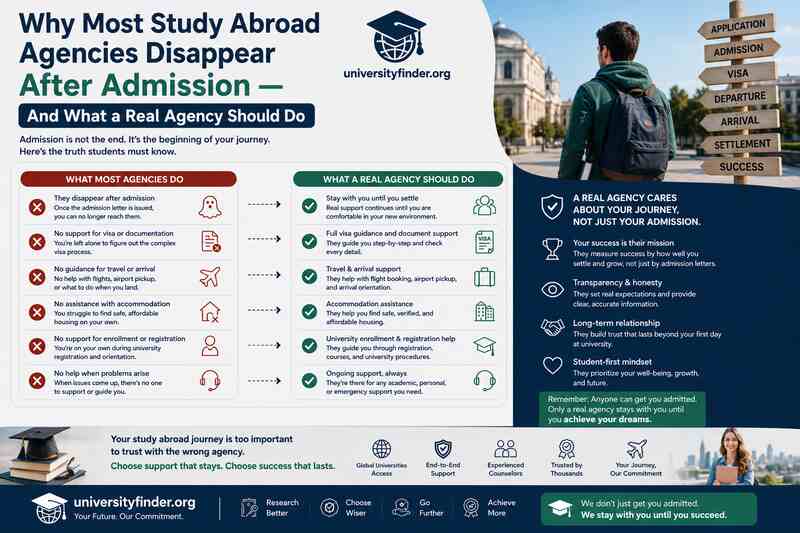
You finally got your acceptance letter. Months of waiting, document preparation, anxious email-checking and now it's real. You're going to study abroad.
So you message your agency. The one that helped you pick your university, collected your documents, submitted your application, and celebrated with you when the offer came through.
Silence.
Or maybe a short reply: "Congratulations! You're all set. Best of luck with your studies!"
That's it. The relationship is over. You've been admitted, and as far as the agency is concerned, their job is done.
This is the reality for a huge number of international students every year. And honestly, it's one of the most damaging problems in the study abroad agency industry not because the admissions part was done badly, but because what comes after admission is often far harder, far more stressful, and far more consequential than the application itself.
Let me explain exactly what I mean, and what a real agency one that actually cares about the student and not just the commission should be doing after that acceptance letter lands.
The Admission Is the Starting Line, Not the Finish Line
Here's something most agencies don't want to say out loud: getting you admitted is actually the easy part.
Universities, especially private ones in countries like Turkey, Malaysia, or Eastern Europe, have relatively straightforward admission criteria for international students. High school diploma, transcripts, passport and you're in. An experienced agency can get you an acceptance letter in 2–4 weeks. It's a process they've done hundreds of times.
What comes next is a completely different kind of challenge. And it's the part that determines whether your first semester goes smoothly or turns into a months-long crisis.
Think about what an international student faces after getting accepted:
Getting the student visa processed correctly and on time
Handling the diploma equivalency process (a legal requirement in many countries)
Finding legitimate accommodation before arriving in a city you've never visited
Navigating the airport, transportation, and the first 48 hours in a foreign country, often alone
Completing final university registration with original documents
Getting a local SIM card, opening a bank account, understanding the transit system
Applying for a student residence permit within the legal deadline
Selecting courses that actually make sense for your degree plan
Understanding local laws, cultural expectations, and how to avoid costly mistakes
Renewing the residence permit every year until graduation
Each of these steps sounds manageable on paper. But when you're alone in a country where you don't speak the language, where official processes are in a language you can't read, where you don't know a single person every single one of these steps becomes a stressful, time-consuming challenge.
A 2024 study on international student dropout rates in European universities found that language barriers, financial issues, and residence permit complications were among the leading reasons students left before completing their degrees. Not academic failure. Not unhappiness with their program. Administrative and practical overwhelm after arriving. That's what forces students out. [internal link: /student-support-services]
Why Most Agencies Stop at Admission
So why do the majority of study abroad agencies disappear the moment the acceptance letter arrives? The honest answer is money.
Most agencies make their income from university commissions a fee paid by the institution for every student successfully enrolled. The commission is calculated at enrollment. After that, there's no financial incentive to keep helping the student. The agency has been paid. The student is now the university's problem.
Some agencies are completely upfront about this they market themselves as "admission services" and nothing more. That's fair. You know what you're getting.
But many agencies imply or outright promise full support, let students believe they'll be taken care of throughout their journey, and then quietly disappear after the commission comes in. Students realize what happened only when they land at a foreign airport with no one waiting, check into accommodation they booked blind, miss the residence permit deadline because no one told them about it, and sit in a university registration queue that takes two days to navigate without knowing which documents to bring.
This happens in Turkey. It happens in Malaysia, in Eastern Europe, in the Gulf. It happens in every study abroad destination that relies on a high volume of international students coming through agency networks.
What Happened After Admission Matters More Than You Think
Let me give you some specific examples of what goes wrong for students without proper post-admission support.
Missed residence permit deadlines. In many countries, international students must apply for a residence permit within 30 days of arrival. Miss this window and you're technically living there illegally which means fines, complications, and sometimes having to leave and re-enter the country. Students who weren't told about this deadline or who were told but had no one to help them navigate the application regularly fall into this trap.
Unreviewed accommodation contracts. A student who doesn't read the local language signing a rental contract in that language is taking a genuine risk. Unfair clauses, non-refundable deposits, penalty fees for ending the contract early these show up regularly in rental agreements for international students. Without someone who knows the market and the legal norms to review the contract, students agree to things they wouldn't have if they'd understood them.
Course selection mistakes. Choosing the wrong courses in your first semester can push your graduation date back by a full year. In some programs, core prerequisite courses are only offered once per academic year. Taking electives instead of required courses because no one told you the difference, or because the registration system was confusing, is more common than universities would like to admit.
Cultural violations that cause legal trouble. Every country has laws and customs that aren't obvious to someone coming from a different background. What's normal in one culture can be deeply offensive or outright illegal in another. Students without cultural orientation often find themselves in embarrassing or legally complicated situations in their first months, simply because no one told them what to expect.
Bank account and money transfer problems. Getting a local bank account as a new international student is harder than it sounds in most countries. Without a residence permit card, some banks won't open accounts. Without a bank account, receiving money from home becomes expensive and complicated. Students get stuck in this loop for weeks.
None of this is the university's responsibility universities provide academic services and on-campus resources. The practical, on-ground life of an international student falls outside what any institution is designed to handle. And if the agency has disappeared, the student handles it alone.
What a Real Study Abroad Agency Should Actually Do
Let's be direct about what genuine, end-to-end support looks like. Not what agencies promise in their marketing materials, but what students actually need.
Before you travel:
Document preparation and verification, making sure everything is correctly certified, translated, and apostilled
Diploma equivalency (denklik) guidance, initiated before the student leaves home, not discovered on arrival
Visa preparation and submission support
Pre-departure budget breakdown, so there are no financial surprises in the first week
Cultural orientation, practical information about the country's laws, customs, and daily life expectations
On arrival:
Airport reception, actually meeting the student at the airport, not just sending a welcome message
Transfer to accommodation in a safe, known vehicle, not leaving a new student to figure out taxis alone in an unfamiliar city at midnight
First-day orientation, where to get a SIM card, how to use public transport, where the university is, what to do on day one
First weeks:
Final university registration accompaniment, being present at the registration office, not just available by phone
Residence permit application, preparing the documents, booking the appointment, attending if needed
Accommodation contract review, making sure the student understands what they're signing
Bank account guidance, which banks work for international students, what documents are needed, how to set up international transfers
Throughout the academic year:
Course selection advice making sure chosen courses align with the degree plan and graduation requirements
Residence permit renewals every year, before the expiry date, without the student having to chase reminders
Ongoing local support a contact who answers when something goes wrong, whether it's a legal question, an administrative problem, or simply not knowing who to call
All the way to graduation:
Final transcript assistance
Degree authentication guidance for use in the student's home country
This is what full support looks like. And most agencies provide maybe the first two items on that list, then disappear.
How universityfinder.org Is Built Differently
The support described above isn't a list of extras at universityfinder.org it's the entire point.
From the day a student contacts us, they're connected to a team that stays with them until they graduate. The admission process yes, that's there, and we do it well, completely free of application fees. But the admission is just the beginning.
When a student we've worked with lands at the airport, someone is there. Not because we have to be. Because that student is traveling alone to a new country for the first time, and that first hour matters. When they need to sign an accommodation contract, we look at it. When the residence permit deadline is 10 days away, we remind them and help them prepare the file. When it's time to renew the permit 12 months later and the year after that we're still there.
The cultural orientation we provide isn't a pamphlet or a website link. It's a real conversation about the country local laws, what's respectful, what to avoid, how to carry yourself as a guest in a new society. Students who go through this feel genuinely prepared, not just officially admitted. [internal link: /cultural-orientation]
And the on-ground support we provide is exactly that on the ground. In the city. Available by message or phone. Real people who know the local system, speak multiple languages, and have navigated every variation of the problems international students face.
Comparison: What Different Agencies Actually Provide
Here's an honest breakdown of what different types of agencies in the study abroad space typically offer versus what universityfinder.org provides:
Support Stage | Admission-Only Agency | Standard Full-Service Agency | |
|---|---|---|---|
University selection and application | Yes | Yes | Yes |
Document preparation | Partial | Yes | Yes |
Acceptance letter | Yes | Yes | Yes |
Visa guidance | Sometimes | Yes | Yes |
Pre-departure cultural orientation | No | Rarely | Yes |
Airport reception | No | No | Yes |
Final university registration | No | No | Yes |
Accommodation contract review | No | No | Yes |
Residence permit - first application | No | Sometimes | Yes |
Course selection support | No | No | Yes |
Residence permit renewals | No | No | Yes (every year till graduation) |
On-ground support during studies | No | No | Yes |
Application fee to student | Often charged | Sometimes free | Always free |
The gap between a standard agency and genuinely full-service support isn't small. It's the difference between being admitted to a country and actually being settled in one.
What to Ask Any Agency Before You Trust Them
If you're currently evaluating study abroad agencies, here are the questions that will reveal very quickly whether they're serious about post-admission support or just trying to get your enrollment processed.
"What happens after I get my acceptance letter?" A serious agency will walk you through a detailed post-admission plan. A commission-focused one will say "we'll help with the visa" and get vague after that.
"Who receives me when I land?" If the answer is "the university's international office," that's not an agency support answer that's the default for every student, whether they used an agency or not.
"Who helps me with my residence permit renewal in year two?" Most agencies have never been asked this question. Listen carefully to the answer.
"Can I contact you after I'm already enrolled, if I have problems?" The answer should be an immediate yes, with a clear explanation of how. If there's hesitation, that tells you something.
"Is there any cost to me for the application or the post-admission support?" Legitimate agencies are paid by universities for successful enrollments. Students should never be charged for admission services or for ongoing support. If an agency charges you directly, ask exactly what for and why.
Frequently Asked Questions
Q: Do all study abroad agencies charge students? A: No. Legitimate agencies are typically paid by universities through enrollment commissions, so students should pay nothing for admission services. Some agencies charge for premium add-ons like document translation or visa application support. universityfinder.org charges students nothing not for application, not for post-admission support, not for anything throughout your studies.
Q: What's the difference between a study abroad agency and the university's international office? A: The university's international office handles academic matters enrollment, course registration, transcripts, academic advising. A good study abroad agency handles everything the university doesn't visa support, accommodation, airport pickup, residence permit applications, cultural orientation, and daily life challenges. They should work together, not replace each other.
Q: Can I switch agencies after I've already been admitted? A: Yes. If your current agency has disappeared post-admission and you need on-ground support, you can connect with an agency that provides those services. universityfinder.org works with students at any stage pre-application, post-admission, or even after arrival.
Q: Is it normal to feel overwhelmed after arriving in a new country to study? A: Very normal. Research consistently shows that the first 4–8 weeks are the hardest for international students, with administrative challenges and cultural adjustment happening simultaneously. Having proper on-ground support during this period dramatically reduces stress and the risk of dropping out early.
Q: What should I do if my agency goes quiet after my admission? A: Contact them directly and ask specifically what post-admission support they provide. If the answer is unsatisfactory, you're not bound to them for your ongoing needs. Seek out an agency or student support service that has actual on-ground presence in your destination country.
Q: How does cultural orientation help and why do most agencies skip it? A: Cultural orientation covers practical things — local laws, social norms, dress codes in certain contexts, what behaviors are considered disrespectful or even illegal in the destination country. Most agencies skip it because it takes time and expertise they don't have, and because it's not something universities commission them for. But for students arriving in a country with significantly different customs from their own, it's genuinely important. Getting it wrong in your first week creates problems that can follow you for months.
The Bottom Line
Getting admitted to a university abroad is exciting — and it should be. But the acceptance letter is not the destination. It's the door. What matters is what's waiting for you on the other side of it.
Most study abroad agencies are built around getting you through that door. The moment you cross it, they're done. And that's when things get real the visa bureaucracy, the accommodation search, the cultural adjustment, the residence permit, the course choices, the daily life in a country that's new in every way.
universityfinder.org was built around the whole journey, not just the admission. Because we've seen what happens to students who cross that door alone, and we decided that wasn't acceptable.
If you're looking for an agency that stays with you from the first email all the way to graduation, start here. No application fees. No post-admission disappearing act. Just real people, on the ground, for as long as you need us.